The case for emerging markets today
Re-examining the case for emerging markets as macro conditions evolve and investor focus begins to broaden.
1st October 2026 09:55
by Gabriel Sacks and Tom Harvey from Aberdeen

What if the markets investors have overlooked for the past decade are now starting to matter again?
Emerging markets (EMs) have spent much of the past decade lagging developed markets (DMs), particularly the US. But recent performance and shifting macro conditions suggest the backdrop may be changing.
A useful starting point is to recognize that EMs are not a single story. They are a diverse group of economies with different growth drivers and risks. That dispersion has been clear in recent years. Taiwan, for example, has delivered strong returns, while China has weighed on broader index performance due to disappointment over measures to boost consumption.[1],[2]
A turning point in performance
After a prolonged period of underperformance, EMs began to regain momentum in 2025 (Chart 1).
Chart 1. Emerging market outperformance (2025 returns vs. Developed markets)
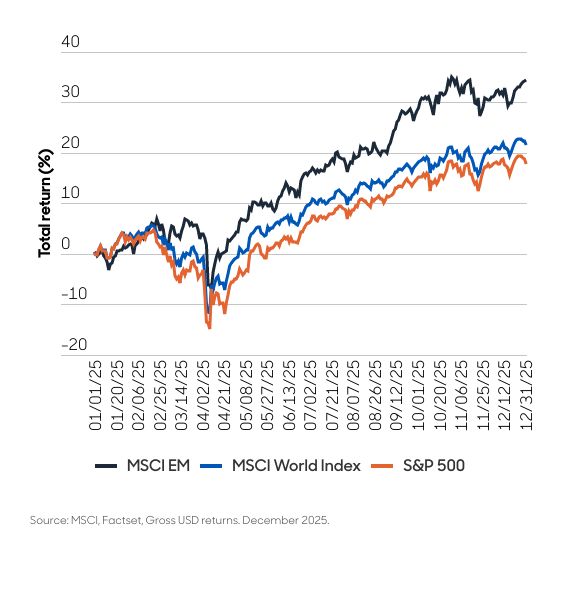
This recovery was supported by a mix of improving sentiment and more favorable macro conditions, with several factors having contributed:
| A reassessment of China. Investors are revisiting China’s role in innovation, particularly in manufacturing and AI-related capabilities. | Dollar weakness. A softer US dollar has historically been supportive of EM returns. | Rising global investment. Technology spending and supply chain investment have lifted key sectors, especially in Asia. |
Performance, however, remains uneven. Recent gains have been driven largely by technology-related markets such as Korea and Taiwan, while Latin America has benefited from commodities and a relatively favorable geopolitical position.
Ongoing risks
The case for EMs is not without challenges. Geopolitical tensions, particularly recent events in the Middle East, remain a source of uncertainty.
The disruption to global energy supply – especially through the Strait of Hormuz – could raise inflation and pressure energy-importing economies in Asia despite what appears to be a resolution.
That said, exposure varies by country. China, for example, may be relatively less vulnerable due to its investment in domestic energy capacity and renewables, which may support both economic resilience and industrial development.
Three drivers shaping the emerging market outlook
Looking beyond near-term volatility, we believe the case for EMs today rests on three structural drivers, or rather, the three C’s: carry, CapEx, and cheap.
Currency dynamics (Carry)
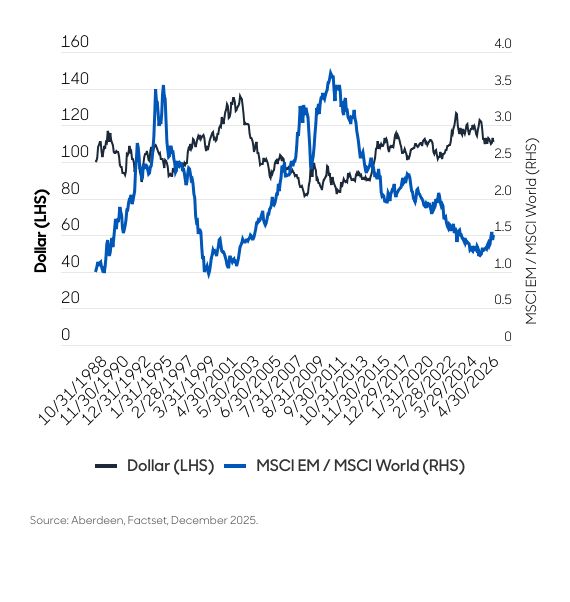
EMs have experienced more than a decade of US dollar strength. A weaker dollar could provide a more supportive environment, given the historical inverse relationship between the dollar and EM performance (Chart 2).
Chart 2. Emerging markets can be a hedge against the dollar
A global (CapEx) cycle
A new phase of global investment is under way, driven by:
| AI infrastructure and data centers | Electrification and energy transition |
| Defence spending | Supply chain diversification |
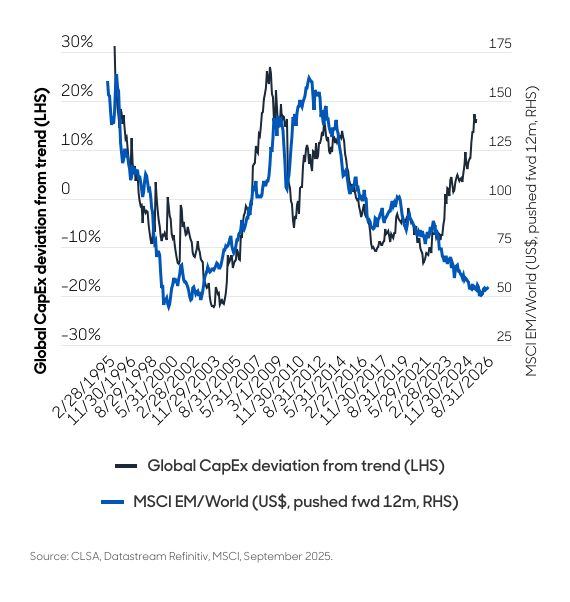
We believe these trends (Chart 3) tend to benefit economies with strong manufacturing capacity, natural resources, and industrial ecosystems – all areas where EMs are well represented.
Chart 3. Emerging markets tends to align with CapEx spending
Relative valuations (Cheap)
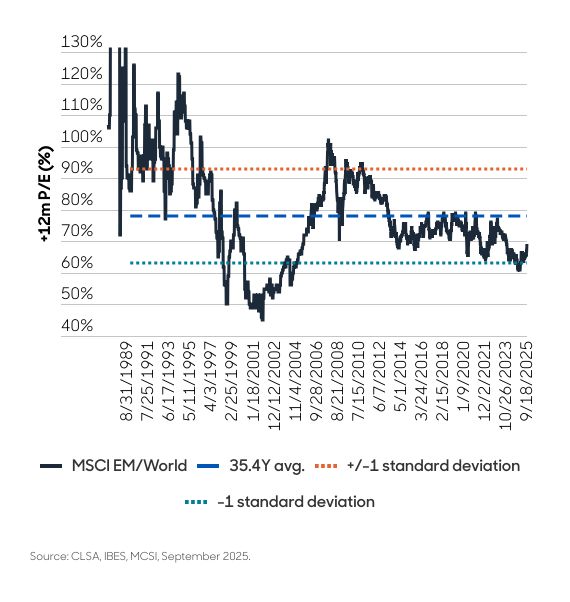
EMs continue to trade at a meaningful discount to DMs (Chart 4), even after recent gains. This reflects past underperformance but also suggests potential value if earnings growth improves.
Chart 4. Valuations are still attractive [3]
Technology
Beyond the headline story
Technology remains central to EMs, however, we believe the opportunity is evolving.
Indices have become more concentrated in a small number of large companies. However, long-term opportunities may extend beyond these names. While outcomes in software and AI applications remain uncertain, the infrastructure layer – semiconductors, memory, and energy – appears more stable. Many of these capabilities are concentrated in EMs, particularly in Asia.
A more selective growth story
In our view, the traditional narrative of a broad middle-class consumption boom is becoming more nuanced. While structural growth remains strong in markets such as India and parts of Southeast Asia, rising inflation and weaker confidence have impacted consumers in other regions. As a result, opportunities in consumer sectors are increasingly differentiated and may require a more selective approach.
Final thoughts
Taken together, we believe EMs today offer a more balanced and multi-dimensional opportunity. The investment case is no longer driven by a single theme but by a combination of industrial and manufacturing expansion, technology infrastructure, commodity cycles, and selective domestic growth. While risks remain, particularly from geopolitics and global growth uncertainty, the current environment suggests that EMs may be entering a more favorable phase after an extended period of underperformance.
MSCI Emerging Markets Index, June 2026.
A standard deviation is a statistical measurement that sheds light on historical volatility. For example, a volatile stock will have a high standard deviation while the deviation of a stable blue-chip stock will be lower. A large dispersion tells us how much the return on the fund is deviating from the expected normal returns.
Gabriel Sacks is investment director at Aberdeen.
Tom Harvey is a senior equity specialist at Aberdeen.
ii is an Aberdeen business.
Aberdeen is a global investment company that helps customers plan, save and invest for their future.
These articles are provided for information purposes only. Occasionally, an opinion about whether to buy or sell a specific investment may be provided by third parties. The content is not intended to be a personal recommendation to buy or sell any financial instrument or product, or to adopt any investment strategy as it is not provided based on an assessment of your investing knowledge and experience, your financial situation or your investment objectives. The value of your investments, and the income derived from them, may go down as well as up. You may not get back all the money that you invest. The investments referred to in this article may not be suitable for all investors, and if in doubt, an investor should seek advice from a qualified investment adviser.
Full performance can be found on the company or index summary page on the interactive investor website. Simply click on the company's or index name highlighted in the article.