Total return opportunities in emerging markets today
Reframing emerging markets through a total return lens, with growing emphasis on income alongside capital appreciation.
6th October 2026 09:44
by Gabriel Sacks and Tom Harvey from Aberdeen

What if half the return story in emerging markets isn’t being fully recognized?
Emerging markets (EMs) are often viewed primarily as a source of long-term growth. While this remains true, it overlooks an important part of the return profile: income.
Over time, EMs have evolved into a more balanced asset class, where dividends play a significant role alongside capital appreciation.
A shift in dividend culture
One of the clearest structural changes in emerging markets is the rise in dividend-paying companies.
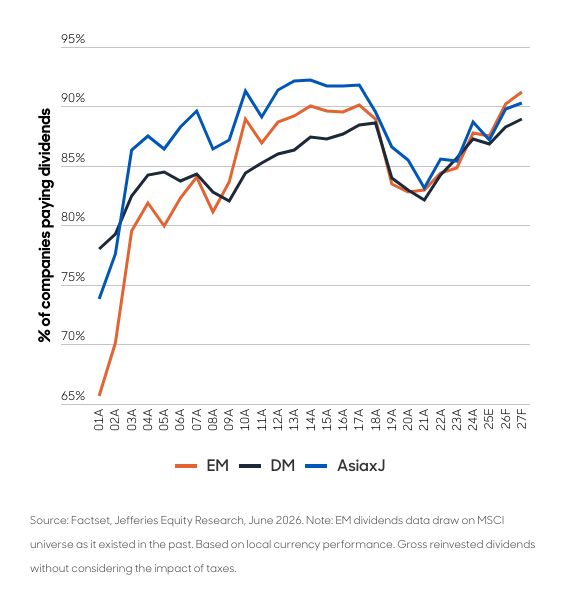
More than 90% of companies in the MSCI Emerging Markets Index now pay a dividend (Chart 1) – higher than in developed markets (DMs). This marks a meaningful shift over the past two decades, supported by stronger cash flows and more disciplined capital allocation.
Chart 1. % of emerging market companies paying dividends (25-year trend)
Income as a key driver of returns
Dividends have contributed significantly to long-term returns in EMs (Chart 2).
Chart 2. Composition of total return (%)
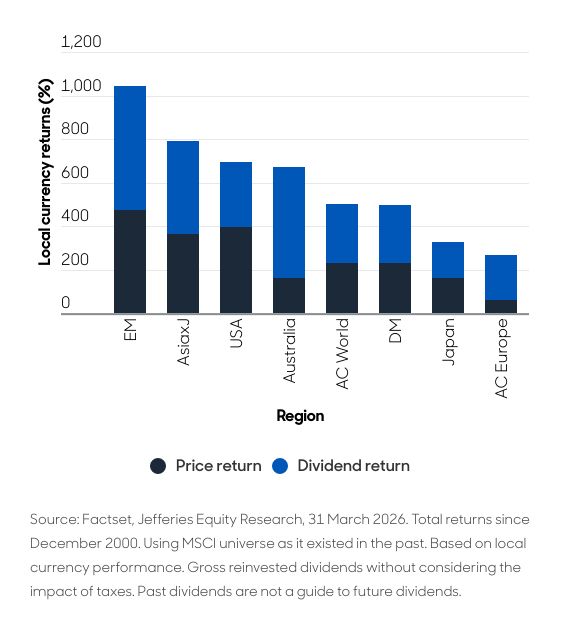
Over extended periods, income has accounted for roughly half of total returns, which have had several implications:
| Total returns are not driven by price appreciation alone | Income can provide stability across market cycles | Dividend growth can reinforce long-term capital gains |
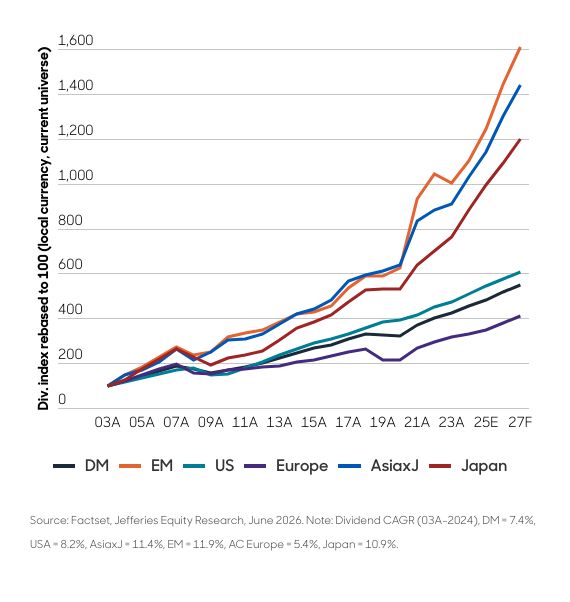
Importantly, dividend growth in EMs has outpaced many DMs over time (Chart 3), reflecting improving corporate fundamentals.
Chart 3. Dividend index growth emerging markets vs. developed markets
Strong corporate fundamentals
The income story is supported by a solid corporate backdrop. Emerging market companies generally exhibit:
| Lower payout ratios, providing room for future increases | Strong cash flow coverage of dividends | Lower leverage, reflecting more conservative balance-sheet management |
In our view, these characteristics suggest that companies have the capacity to maintain or gradually increase shareholder distributions over time.
A measured outlook for payouts
Dividend growth is likely to be gradual rather than dramatic. Many companies prioritize reinvestment, particularly in faster-growing economies.
That said, there are signs of improving capital allocation. In Korea, governance reforms are encouraging greater focus on shareholder returns.[1] In China, certain state-owned enterprises have increased dividend payouts, attracting investor interest in more stable income streams.[2]
We believe these developments point to a steady evolution rather than a sudden shift.
Portfolios, underrepresented
Despite their scale, emerging markets remain underrepresented in many portfolios.
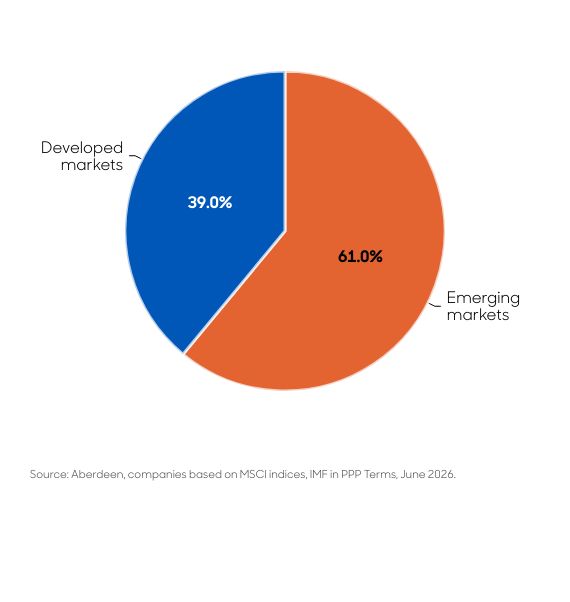
The imbalance becomes clear when viewed across three dimensions. Emerging markets account for a significant share of global economic output, reflecting their growing role in global activity (Chart 4).
Chart 4. Emerging markets’ share of global GDP
They also represent a large portion of listed companies worldwide, underscoring the breadth and depth of the opportunity set (Chart 5).
Chart 5. Emerging markets’ share of listed companies
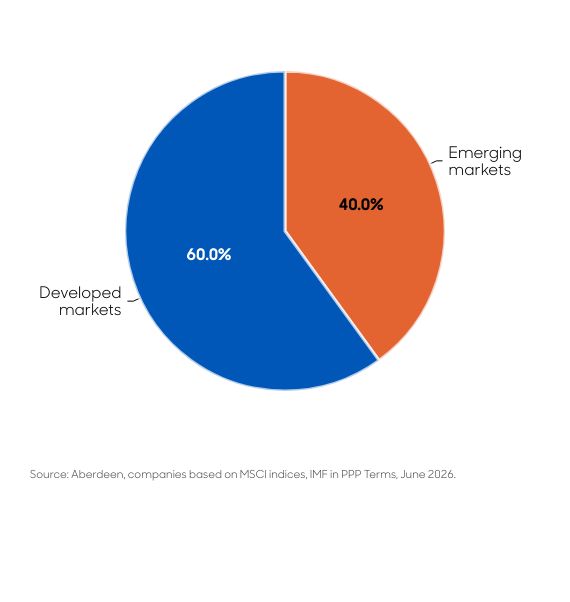
However, this presence is not fully reflected in global equity markets. Emerging markets make up a meaningfully smaller share of total market capitalization, suggesting that investor allocations have not kept pace with their economic and corporate significance (Chart 6).
Chart 6. Emerging markets’ share of global equity market capitalization
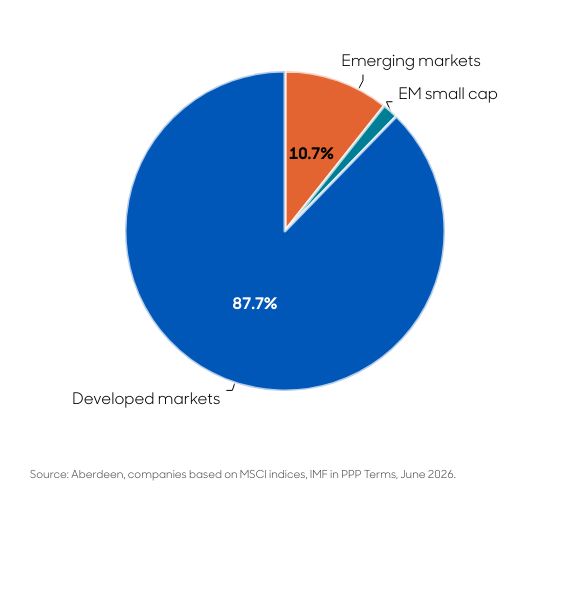
We believe this gap highlights a structural disconnect. While EMs are increasingly central to global growth and production, they continue to occupy a more limited position in many portfolios.
Why it matters
For investors, this may represent an opportunity to revisit how the asset class is positioned – for instance, in the context of a more balanced return profile that includes both income and capital appreciation.
A total return framework
We believe a total return perspective provides a more complete way to assess EMs, which combines:
- Growth, driven by structural economic and industrial trends
- Income, supported by dividends and cash flow discipline
This dual contribution can be particularly valuable in a more balanced and uncertain market environment.
A broader investment landscape
Viewing EMs through a total return lens also highlights the range of opportunities across the asset class, including:
| Infrastructure and industrials linked to global CapEx | Technology enablers within AI supply chains |
| Resource-focused businesses | Select domestic companies with strong market positions |
In each case, attention to cash flow and capital allocation remains key.
Final thoughts
We believe EMs today offer a more complete investment proposition than is often assumed. The combination of growth, income, and improving corporate fundamentals suggests a more balanced return profile. While risks remain, particularly from macro and geopolitical factors, the evolution of dividend behavior strengthens the case for considering EMs as both a growth and income opportunity within a diversified portfolio.
"The goal of South Korea’s reforms: reducing the valuation discount." RankiaPro, March 2026.
"Asia's stocks ride a reform wave, but rough seas lie ahead." Reuters, December 2025.
Gabriel Sacks is investment director at Aberdeen.
Tom Harvey is a senior equity specialist at Aberdeen.
ii is an Aberdeen business.
Aberdeen is a global investment company that helps customers plan, save and invest for their future.
These articles are provided for information purposes only. Occasionally, an opinion about whether to buy or sell a specific investment may be provided by third parties. The content is not intended to be a personal recommendation to buy or sell any financial instrument or product, or to adopt any investment strategy as it is not provided based on an assessment of your investing knowledge and experience, your financial situation or your investment objectives. The value of your investments, and the income derived from them, may go down as well as up. You may not get back all the money that you invest. The investments referred to in this article may not be suitable for all investors, and if in doubt, an investor should seek advice from a qualified investment adviser.
Full performance can be found on the company or index summary page on the interactive investor website. Simply click on the company's or index name highlighted in the article.