Why Lloyds Bank upgrade cycle is 'far from over'
4th April 2017 12:09
by Lee Wild from interactive investor
We heard yesterday that the government had sold down its stake in to below 2%, and that the Treasury would likely make a profit on its controversial bailout of the battered high street lender. Now, one leading analyst has spelled out his expectations for profits, the dividend, and price target.
As we wrote on Monday, the removal of the share overhang will not "pop the champagne cork", but is certainly a positive. And Investec Securities' banks analyst Ian Gordon thinks the government will have offloaded its remaining Lloyds shares by late May.
"Put simply, we see the (near-term) removal of the technical drag of up to 15% of the average daily volume being sold into the market on behalf of the government from late-May as a positive catalyst for the shares," he says.
Before then, however, we've got first-quarter results on 27 April. Gordon expects the numbers to act as a catalyst for a further reduction in impairment expectations, further assure that incremental payment protection insurance (PPI) costs should be "very low" - in the low hundreds of millions - and provide "further evidence of capital accretion, consistent with our forecast of a step-up in the 2017 dividend to 4.5p [1p at the interims and 3.5p at year-end]".
And he "cheats" a little with the maths to give a "compelling" implied total shareholder return (TSR) of 10% for the next 12.5 months – as well as the 4.5p forecast payout for 2017, Lloyds trades ex-dividend on 6 April for both the 2016 ordinary final payout of 1.7p and a 0.5p special dividend.
"We still characterise Lloyds as a "no growth" story – contrary to management guidance, we still model net shrinkage of its mortgage book – but its dividend-paying capacity primarily increases courtesy of (our expectation of) substantially lower net negative exceptional items," explains Gordon.
He still sees Lloyds as "fundamentally attractive", given a price/tangible net asset value (P/TNAV) of 1.1 times for 2018/19, for return on tangible earnings (ROTE) of about 11%, with a prospective dividend yield of 7.5 and 7.3% for next year and 2019, respectively.
Lloyds remains Investec's preferred large-cap UK bank, rated a 'buy' with 74p price target.
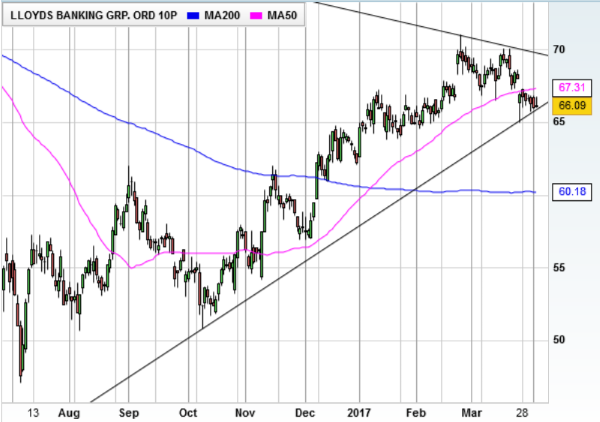
Gordon tips underlying profit to remain "broadly stable" at £7.8-7.9 billion with net interest margin (NIM) growing from 2.71% last year to 2.82% by 2019, partly driven by benefits from the MBNA acquisition.
Expect Lloyds to flesh out further cost reductions in its next three-year plan due later this year. Investec pencils in an improvement in the cost:income ratio from 48.7% to 45.1% by 2019.
Impairment forecasts remain below consensus estimates, too. Gordon is perplexed at market forecasts for a sharp rise in impairments, given UK unemployment is at a 40-year low, UK interest rates are at a 300-year low, UK GDP in 2017 is accelerating.
"We still observe some pretty absurd impairment forecasts," he says, "so we remain confident that the upgrade cycle is far from over."
However, the "transformational" aspect of the bank's performance is "a sharply diminishing drag from net negative exceptional items".
Already, Lloyds has absorbed charges of £5.8 billion in 2013, £6.0 billion in 2014 and £6.5 billion in 2015, mainly PPI. Last year, it was £3.6 billion, but Gordon pencils in "only" £1.7 billion in 2017 and £0.8 billion two years later. From 2018, there's a good chance Lloyds' annual run-rate of incremental conduct costs will fall sustainably below £500 million.
It's why he predicts reported pre-tax profit will increase from £4.2 billion in 2016 to £6.1-7.1 billion out to 2019, underpinning a "sustainably increased dividend-paying capacity".
This article is for information and discussion purposes only and does not form a recommendation to invest or otherwise. The value of an investment may fall. The investments referred to in this article may not be suitable for all investors, and if in doubt, an investor should seek advice from a qualified investment adviser.