Bellway calls for immediate stamp duty cut in challenging market
The FTSE 250 housebuilder is being buffeted by multiple headwinds but remains in decent shape and is seeking to unlock some of the value from its strategic land bank.
11th August 2026 08:47
by Richard Hunter from interactive investor
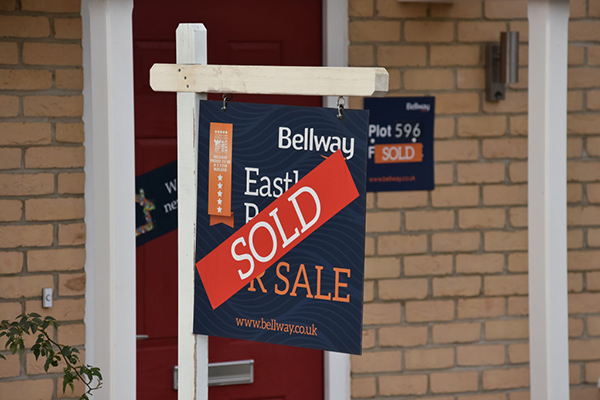
A sold sign at a Bellway housing estate in Rochford, Essex. Photo: John Keeble/Getty Images.
While there may be some sympathy towards the plight of the housebuilders, the harsh reality is that the sector remains moribund. For its part, Bellway (LSE:BWY) has tried to provide some grounds for optimism by managing the levers within its control.
In order to maintain cash generation and asset turnover, the group is looking to unlock some of the value from its strategic land bank. This follows the vital spring selling season which started brightly, but where customer demand then waned in the face of rising mortgage rates, as evidenced by a decline of 5.8% in private reservation rates for the period.
- Our Services: SIPP Account | Stocks & Shares ISA | See all Investment Accounts
This is confirmation of what has been a torrid time for the housebuilding sector and Bellway is no exception. Higher for longer interest rates have joined a list of headwinds, such as consumer sentiment which has been in the doldrums for some time. In addition, there have been increasing calls from the sector for the government to accelerate the proposed relaxation of planning regulations, which is far from taking full effect. There are also general affordability concerns, particularly for first-time buyers, which need to be addressed to give this cyclical sector an overdue boost. Bellway has therefore suggested an immediate reduction in stamp duty and a government-backed deposit scheme for first-time buyers, although this is likely to fall on deaf ears given the parlous state of UK finances at present.
Bellway warned at its half-year numbers in March of an uncertain outlook given the ongoing conflict in the Middle East and there are already signs of upward pressure on building material costs stemming from higher fuel and energy input prices, as well as some surcharges appearing within its supply chain. A less predictable housing environment has led to the group turning inwards to maintain progress with a sharp focus on costs and the monetisation of its strategic land bank, which currently stands at around 48,000 plots.
At the same time, Bellway has contracted to purchase a further 8,578 plots at a cost of £505 million, with its acquisition policy remaining highly selective and in those areas where underlying demand is most in evidence. Even so, the group ended the year with net cash of £157.7 million, as compared to £41.8 million the previous year and overturning the net debt position which had been in place for most of the period. There is also additional solace to be sought from a forward order book which contains 4,206 homes, albeit lower than 5,307 in the corresponding period, with a combined value of £1.2 billion (£1.52 billion).
- ii view: Bellway backs self-help to navigate tough market
- eyeQ: why this FTSE 100 bank’s shares are on the watchlist
- Insider: major director purchases at a big discount
Nonetheless, this careful financial management of its assets leaves Bellway in decent shape. The existing £150 million share buyback programme is nearing completion and will be followed up with a further tranche of £50 million. Meanwhile, a hike to the dividend in March led to a respectable yield of 3.4% which is adequately covered, even if the level of the dividend remains below historic levels given a severe cut to the payment two years ago from 140p to 54p.
The numbers for the full year are likely to be resilient given the circumstances. Revenue will have grown by 13% to £3.14 billion, with underlying operating profit of £320 million at the lower end of the guided range, but up from £303.5 million the previous year. Housing completions were better than expected at 9,695, an increase of 10% and ahead of the previously estimated range of 9,300 and 9,500 homes. Less positively, the group previously reduced estimates for adjusted operating margin, downgrading from 11% to 10.5% due to a combination of sales incentives and building cost inflation, and this has reduced further to 10% for the year.
There might not be a great deal here for the bulls to feed on, but it is recognised that Bellway is adjusting its model to react to challenging circumstances. That being said, and despite its measured progress, the share price tells the story for Bellway. The shares have declined by 15% over the last year, as compared to a gain of 13% for the wider FTSE 250, while the price is 47% lower than its pre-pandemic peak in January 2020, which underlines the scale of the revival needed for the group to regain its former glories.
Even so, the company has picked up many admirers along the way and the market consensus of the shares as a buy reflects optimism that there will surely be brighter times ahead, for which the group would be well-positioned.
These articles are provided for information purposes only. Occasionally, an opinion about whether to buy or sell a specific investment may be provided by third parties. The content is not intended to be a personal recommendation to buy or sell any financial instrument or product, or to adopt any investment strategy as it is not provided based on an assessment of your investing knowledge and experience, your financial situation or your investment objectives. The value of your investments, and the income derived from them, may go down as well as up. You may not get back all the money that you invest. The investments referred to in this article may not be suitable for all investors, and if in doubt, an investor should seek advice from a qualified investment adviser.
Full performance can be found on the company or index summary page on the interactive investor website. Simply click on the company's or index name highlighted in the article.