Can MPC voting history predict next interest rate move?
More Bank of England policymakers believe interest rates should increase but securing a majority won’t be easy. Craig Rickman examines the odds of a rate increase in September.
31st July 2026 14:52
by Craig Rickman from interactive investor
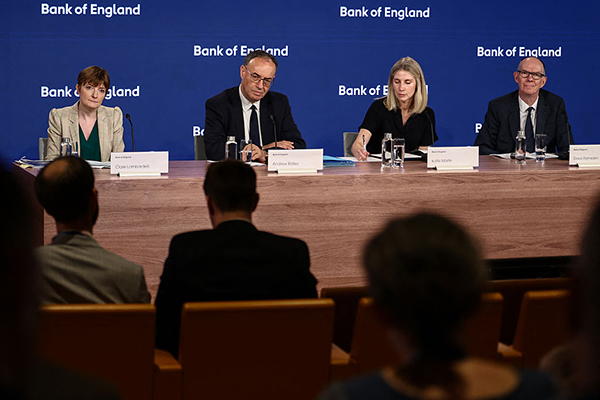
Bank of England Governor Andrew Bailey (second left), deputy governor Clare Lombardelli (left), head of media Katie Martin (second right) and deputy governor for markets and banking Dave Ramsden (right) at the Monetary Policy Report press conference in London in July 2026. Photo: Henry NICHOLLS /POOL /AFP via Getty Images.
Just a few months ago, the outlook for UK interest rates looked very different. Inflation was expected to ease back towards the Bank of England’s 2% target, opening the door for policymakers to reduce borrowing costs.
February’s Monetary Policy Committee (MPC) meeting was a close call, with a slender majority of five to four voting to keep rates on hold at 3.75%, with the dissenters all preferring a 0.25 percentage point cut. A reduction at the next meeting, in March, seemed on the cards.
- Our Services: SIPP Account | Stocks & Shares ISA | See all Investment Accounts
But several weeks later, conflict broke out in the Middle East. The resulting oil price spike and geopolitical uncertainty shifted inflation forecasts on these shores, triggering policymakers to abruptly change tack. All nine members voted to hold in March.
Interest rates have remained at 3.75% for the following four meetings, despite price rises easing over this period. The consumer prices index (CPI), the UK’s main measure of inflation, cooled to 2.6% last month, but the prospect of rate cuts has become more distant, owing to longer-term inflationary concerns.
By contrast, the chorus for rate hikes has becoming louder and is attracting more voices, with a gradual but noticeable shift in sentiment among the Bank’s nine-person strong MPC. Markets are pricing in two rate increases over the next 12 months, with the first anticipated to arrive in November.
At the Committee’s latest meeting, held this week with the decision announced yesterday at noon, three MPC members - Huw Pill, Megan Greene and Catherine L Mann - preferred to jack up rates, outvoted by the remaining six who opted to keep things as they are. In the previous meeting, two members voted for hikes, up from one the time before that, illustrating that policymakers are becoming increasingly concerned about the direction of price rises and feel now is the time to act.
- How to prepare for tax grab on cash returns
- Sign up to our free newsletter for investment ideas, latest news and award-winning analysis
The outlook for interest rates has been reflected in the lending and savings arenas. Mortgage rates, after soaring as the crisis emerged but tempering afterwards, have edged up again; an unfortunate development for borrowers seeking to get on to the housing ladder and those with fixed deals expiring soon who’ll see more of their income swallowed up by repayments.
On the flip side, increased odds of rates rising has shunted up savings rates, with accounts paying 5% now available. People reaching retirement wanting to secure a guaranteed income have also benefited, as this week annuity rates hit an 18-year high.
Despite these shoots of positive news, most household’s biggest outgoing is mortgage or rent payments, so interest rates edging down is the preferred trajectory – none more so than for Andy Burnham who’s placed addressing the cost of living at the heart of his premiership.
Paul Dales, chief UK economist at Capital Economics, offered some comfort to borrowers, suggesting that hikes “remain more of threat than a reality”.
What might rate-setters’ voting records tell us about future decisions?
To unearth any possible clues about how future interest rate decisions with the MPC might play out, let’s take a closer look at the voting history of the current crop of member. But first, it’s worth examining the reasons that Green, Mann and Pill gave for favouring rate hikes.
Concerns centre on second-round inflation effects, which if not addressed in the short term, could keep the cost of goods and serves elevated, the trio claim. Pill, who kickstarted the call for hikes, warned yesterday these could be “insidious”.
“While these may be slower to emerge, they could prove more lasting and create greater intrinsic inflation persistence,” he added.
Green was equally mindful, arguing a “proactive hike in Bank Rate may reduce the probability that second-round effects set in”.
A similar tone was struck by Mann, a policymaker known for her hawkish stance. She said that failing to act now risks building on “an inflation rate that has remained above target for five years”.
| Current members | Andrew Bailey | Sarah Breeden | Swati Dhingra | Megan Greene | Clare Lombardelli | Catherine L Mann | Huw Pill | Dave Ramsden | Alan Taylor | |
| First vote: 19 Mar 20 | First vote: 2 Nov 23 | First vote: 22 Sep 22 | First vote: 3 Aug 23 | First vote: 1 Aug 24 | First vote: 23 Sep 21 | First vote: 23 Sep 21 | First vote: 14 Sep 17 | First vote: 19 Sep 24 | ||
| Bank Rate | ||||||||||
| 05 February 2026 | 3.75% | 3.75% | 3.50% | 3.50% | 3.75% | 3.75% | 3.75% | 3.75% | 3.50% | 3.50% |
| 19 March 2026 | 3.75% | 3.75% | 3.75% | 3.75% | 3.75% | 3.75% | 3.75% | 3.75% | 3.75% | 3.75% |
| 30 April 2026 | 3.75% | 3.75% | 3.75% | 3.75% | 3.75% | 3.75% | 3.75% | 4.00% | 3.75% | 3.75% |
| 18 June 2026 | 3.75% | 3.75% | 3.75% | 3.75% | 4.00% | 3.75% | 3.75% | 4.00% | 3.75% | 3.75% |
| 30 July 2026 | 3.75% | 3.75% | 3.75% | 3.75% | 4.00% | 3.75% | 4.00% | 4.00% | 3.75% | 3.75% |
Source: Bank of England
Glancing into their voting records since joining the Committee, it’s little surprise these three have voted to tighten fiscal policy in response to the ongoing uncertainty.
As noted above, Mann is a renowned hawk, preferring a rate cut only once in the 40 votes she’s taken part in. And in a bizarre and unexpected twist, on that occasion Mann was only one of two members alongside Swati Dhingra to prefer an aggressive 0.50 percentage point reduction at February 2025’s meeting. The Committee ultimately opted for a 0.25 percentage point cut.
Some reports suggest that the next rate decision, to be announced on 17 September, could be on a knife edge. If we assume that Greene, Mann and Pill won’t shift course, two of the other six will need to favour a hike to secure the majority needed.
But who could the likely candidates be? While those voting to maintain rates at 3.75% are closely watching the second-round effects like higher wage demands and rising prices, some feel this could be mitigated by slack in the labour market. They also pointed to underlying disinflation, which supported the decision to keep things as they are.
Sarah Breedon, Clare Lombardelli and Alan Taylor, who joined their first MPC meetings in November 2023, August 2024 and September 2024, respectively, are yet to muster a hike vote between them. That’s not a huge surprise given the aggressive rate-hiking cycle in response to the period of red-hot inflation ended in summer 2023, and decisions since have only resulted in holds and cuts. That said, Greene only joined shortly before Breedon, in August 2023, and has favoured an increase on six occasions.
| Current members | Andrew Bailey | Sarah Breeden | Swati Dhingra | Megan Greene | Clare Lombardelli | Catherine L Mann | Huw Pill | Dave Ramsden | Alan Taylor | |
| First vote: 19 Mar 20 | First vote: 2 Nov 23 | First vote: 22 Sep 22 | First vote: 3 Aug 23 | First vote: 1 Aug 24 | First vote: 23 Sep 21 | First vote: 23 Sep 21 | First vote: 14 Sep 17 | First vote: 19 Sep 24 | ||
| Voted to increase | 14 | 0 | 2 | 6 | 0 | 19 | 17 | 16 | 0 | |
| Voted to maintain | 32 | 15 | 13 | 16 | 13 | 20 | 21 | 44 | 6 | |
| Voted to reduce | 7 | 8 | 17 | 3 | 4 | 1 | 2 | 14 | 10 | |
| Meetings | 53 | 23 | 32 | 25 | 17 | 40 | 40 | 74 | 16 | |
Source: Bank of England
Taylor’s comments at the latest meeting suggest the outlook would have worsen significantly to prompt a shift in stance, and he remains focused on bringing rates down when the ground once again becomes fertile. He said: “Keeping Bank Rate on hold, at a higher level now than the pre-conflict implied path, gives insurance for now, before resuming cuts when and if geopolitical uncertainty clears.”
According to Breedon, the rate is currently in the right place given the circumstances. “Financial conditions facing households and businesses have tightened materially since the onset of the conflict, and consistent with the baseline, provide sufficient restrictiveness for now. Looking ahead, I will continue to focus on how second-round effects are likely to evolve,” she said.
- Pension age to rise? How you can still retire on your terms
- Chancellor Healey’s big tax and pension dilemma
Dhingra would require some heavy persuasion to believe higher interest rates are the right approach. The associate professor of economics at the London School of Economics has only preferred hikes on two occasions, and was one of four members voting for a cut at February’s meeting. Her rationale behind opting to hold at the latest decision underlines her dovish position.
She said: “An increase in Bank Rate now would be disproportionate as, unlike 2022, the starting point for this shock is much softer and the policy stance is more restrictive. I continue to see value in waiting for a clearer read on the energy shock in the coming months before deciding whether a change in policy is required, given the broad range of possible outcomes.”
The Bank’s governor, Andrew Bailey, who might be tasked with the deciding vote next month, said there’s “tentative evidence that inherited inflation persistence may be weaker than had been presumed.”
Bailey added: “Alongside this, the labour market continues to ease, and the demand environment remains soft. There is little evidence yet of second-round effects although it is too early to take much comfort from that.”
These articles are provided for information purposes only. Occasionally, an opinion about whether to buy or sell a specific investment may be provided by third parties. The content is not intended to be a personal recommendation to buy or sell any financial instrument or product, or to adopt any investment strategy as it is not provided based on an assessment of your investing knowledge and experience, your financial situation or your investment objectives. The value of your investments, and the income derived from them, may go down as well as up. You may not get back all the money that you invest. The investments referred to in this article may not be suitable for all investors, and if in doubt, an investor should seek advice from a qualified investment adviser.
Full performance can be found on the company or index summary page on the interactive investor website. Simply click on the company's or index name highlighted in the article.