Tesco shares hit multi-month high after latest upgrade
The UK's largest grocery chain has done it again with these half-year results, reinforcing its dominance of the British aisles. ii's head of markets runs through the numbers.
8th October 2026 08:26
by Richard Hunter from interactive investor
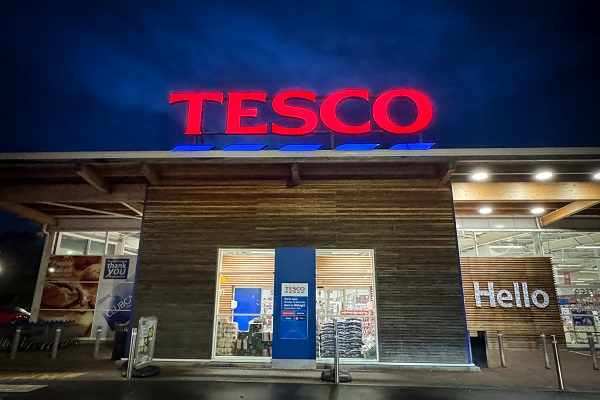
Tesco (LSE:TSCO) has again flexed its financial muscle, with a marginal profit upgrade and an increase to it share buyback programme reflecting its massive cash generation capability.
- Our Services: SIPP Account | Stocks & Shares ISA | See all Investment Accounts
Revenues for the 26 weeks ended 29 August grew by 2% to £33.78 billion, with adjusted operating profit (AOP) rising by 6.5% to £1.78 billion, ahead of the £1.73 billion market estimate.
This momentum resulted in the company upping its guidance for full-year AOP to be in a range of £3.15 billion to £3.3 billion, from a previous £3-3.3 billion. Free cash flow guidance was maintained for the full year at £1.5-2 billion, which has been exceeded with a 21% increase in the first half number to £1.57 billion. This should fall slightly in the second half. Pre-tax profit grew by 11.5% to £1.46 billion as a number of underlying business lines continued to contribute.
Some weakening had been expected by the market, and like-for-like sales (LFL) posted a 1% increase. By far the largest unit, the UK, saw Food sales growth of 2.4% but the range of the group’s offering is not limited to the more cost-conscious consumer. More recently, Tesco has honed its upper-end offering, and the Finest range saw growth of 9%, and 29% over two years, reflecting a unit going from strength to strength.
- Mining sector top share picks
- The Income Investor: why I like this FTSE 100 share’s 6% dividend yield
The wholesale unit Booker remained a slight blot on the landscape, with LFL sales falling by 2.6% as the loss of a contract impacted the numbers. In addition, tobacco sales fell away sharply and look unlikely to recover. Nonetheless, the unit contributes 14% of overall sales, which enables Tesco comfortably to pick up this slack elsewhere.
In any given part of the business, there are tweaks and improvements which contribute to Tesco’s overall dominance. These range from clothing to delivery options such as Whoosh to a broader offering at the higher end, and online growth (8% in the period) to food prices.
Whoosh sales for example were up by 37% and estimated to contribute more than £500 million of sales this year, with the rapid delivery offer being enhanced by launches on the Just Eat and Deliveroo platforms. Much of this has been made possible by the group’s “Save to Invest” programme, which has delivered more than £2.2 billion of cost savings over the last four years including around £535 million last year, with a further £500 million planned for the forthcoming year, of which £251 million has already been achieved.
- Can this market darling finally make a recovery?
- ii view: Shell predicts record refining margin and surge in gas output
The effect of this streamlining is twofold. It allows cost inflation to be offset, which could prove particularly important over the coming year if the inflationary effects of the US/Iran conflict wash through, as well as keeping prices low for consumers. The group’s sheer scale feeds its appetite for lowering prices for customers through the likes of Aldi Price Match, Low Everyday Prices and Clubcard Prices, such that the significant cost reduction creates something of a virtuous circle. As such, the ongoing battle is still for Tesco to lose rather than its rivals to win.
The relentless cash generation, where the group also enjoys a Return on Capital Employed of 15.2%, has enabled an increase to the dividend, where the projected yield is an acceptable 3.1%, but perhaps more significantly an increase of the ongoing £750 million share buyback programme to £950 million. At the same time, Tesco has inched up its forecast for full-year capital expenditure from £1.6 billion to £1.7 billion, as it continues to invest heavily in areas which give it such dominance.
Moreover, in the recent past, and try as they may, other supermarkets have tended to take market share from each other rather than from Tesco. While there was a marginal decline over the last quarter, this is expected to be short-lived and, in any event, the share remains greater than those of its nearest two rivals combined (Sainsbury (J) (LSE:SBRY)'s and Asda). Of course, any such progress comes alongside not only ferocious competition but also pressure on costs, while maintaining lower prices also comes with an inevitable impact on margins and revenues.
- Pensions dashboards are coming: what you need to know
- Sign up to our free newsletter for investment ideas, latest news and award-winning analysis
Tesco’s advances inevitably lead to progressively higher expectations, which in turn lessens the likelihood of positive shocks for investors and, set against a weak wider market at the open, its price gain in reaction to these results, is more impressive.
At a two-month high and near record territory just above 500p, the share price has tended to reflect the group’s relentless progress, having risen by 6% over the last year as compared to a gain of 9.5% for the wider FTSE100. The outperformance is more evident over a longer timeframe, however, with the shares having risen by 31% over the last two years and by 71% over the last three, which is a considerable achievement given the traditional ferocity of sector competition.
It appears that the Tesco juggernaut rumbles on, asserting its dominance of the British aisles and maintaining the yawning gap between its fortunes and those of its nearest rivals. There is very little to suggest that the market consensus of the shares as a buy will be troubled in any way by another reassuring update.
These articles are provided for information purposes only. Occasionally, an opinion about whether to buy or sell a specific investment may be provided by third parties. The content is not intended to be a personal recommendation to buy or sell any financial instrument or product, or to adopt any investment strategy as it is not provided based on an assessment of your investing knowledge and experience, your financial situation or your investment objectives. The value of your investments, and the income derived from them, may go down as well as up. You may not get back all the money that you invest. The investments referred to in this article may not be suitable for all investors, and if in doubt, an investor should seek advice from a qualified investment adviser.
Full performance can be found on the company or index summary page on the interactive investor website. Simply click on the company's or index name highlighted in the article.