Turnaround strategy working as Burberry reports Q1 sales rise
The luxury retailer is regaining momentum with this latest trading update representing the seventh consecutive quarter of improvement since a new CEO was installed.
17th July 2026 08:45
by Richard Hunter from interactive investor
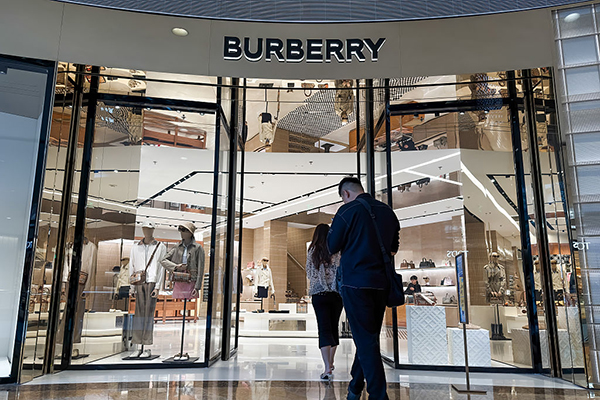
Shoppers enter a Burberry store at a shopping mall in Shenzhen, China. Photo: Cheng Xin/Getty Images.
Burberry has declared that its strategy is working, and there can be little doubt that the group’s new leadership has injected a breath of fresh air into the brand’s fortunes.
- Invest with ii: SIPP Account | Stocks & Shares ISA | See all Investment Accounts
Burberry Group (LSE:BRBY) described the full-year results in May as a meaningful inflection point, and with good reason. This followed a previous annus horribilis which included the change of chief executive, suspension of the dividend and a first-half loss which sent the shares into a tailspin. However, the famous brand is regaining momentum, and this latest trading update has reported a further increase in sales which represents the seventh consecutive quarter of improvement since the new CEO was installed.
Retail revenues grew by 5% to £455 million in the quarter, driven largely by particular strength in the Americas and Greater China, which added 12% and 9% respectively. Asia Pacific growth of 3% was achieved, despite a 2% drop in Japan which suffered from the continued decline of tourists from China, but offset by 11% growth in South Korea due to increased domestic and tourist spend.
One fly in the ointment came from the Europe, Middle East, India and Africa (EMEIA) region, where sales declined by 3% given the ongoing fallout from the Middle East conflict and lower tourist spend. The group noted that excluding the Middle East region, EMEIA sales declined by just 1% which, all things being equal, should provide a strong base after the cessation of hostilities whenever that may be.
- DIY Investor Diary: shifting from 25 holdings to 50
- The Income Investor: why I back Sainsbury’s to deliver the goods
However, for the group as a whole there were any number of highlights across many of its product categories, with new Rainwear customers increasing by 19%, a double-digit spike in Outerwear and women’s handbags showing a return to form. In terms of delivery channels, e-commerce increased by a percentage which was in the mid-teens and Burberry has maintained its outlook for the full year, including an upgrade to the Wholesale business where revenues for the first half are expected to rise by a high single-digit percentage.
In addition, annualised cost savings of £100 million are expected to become entrenched, and this will enable capital expenditure of £120 million as the group continues to invest selectively on the higher margin lines. There has been no mention of a return to the dividend payment, but at this stage of the group’s recovery this seems to be a prudent and understandable measure.
The progress is being achieved by measures on many fronts, including the attraction of Gen Z customers despite intense competition, which not only is a vindication of the new “Burberry Forward” strategy but is also a promising sign of the brand remaining relevant to a younger generation. Indeed, for this quarter there was a double-digit increase in Gen Z sales, with a particularly strong contribution from Greater China. There is also a particular emphasis on the outerwear for which it has become traditionally known, which is currently outperforming expectations.
Burberry’s general outlook comments have been optimistic but not cavalier. The group fully recognises that the transformation is still in its early stages, and that of course the fashion industry can be a fickle business. At the same time, a brand which had moved away from its traditional British traits of heritage and innovation, which had such appeal to overseas buyers and particularly tourists with an aspirational and stylish look, still needs to be fully reestablished. The inflationary impacts of the Middle East conflict, along with European tariffs announced by the US have tended to weigh on the luxury fashion sector which has fallen somewhat out of favour, in turn taking some of the shine from Burberry’s performance of late.
- The ISA strategy I used to build nest eggs for my kids
- Sign up to our free newsletter for investment ideas, latest news and award-winning analysis
The shares have had something of a roller-coaster ride, having fallen by 57% since the most recent peak in April 2023, but rising by 60% over the last two years. Over the last year, the general loss of favour in the sector has led to the shares missing out on the wider market rally, with the price falling by 8% as compared to a gain of 17.8% for the FTSE 100. The dip in the shares at the open is further proof that there are those who remain unconvinced of a turnaround. Even so, if momentum is maintained as evidenced by the last few trading updates, there will be increasing upward pressure on a market consensus which currently stands at a hold, albeit a strong one.
These articles are provided for information purposes only. Occasionally, an opinion about whether to buy or sell a specific investment may be provided by third parties. The content is not intended to be a personal recommendation to buy or sell any financial instrument or product, or to adopt any investment strategy as it is not provided based on an assessment of your investing knowledge and experience, your financial situation or your investment objectives. The value of your investments, and the income derived from them, may go down as well as up. You may not get back all the money that you invest. The investments referred to in this article may not be suitable for all investors, and if in doubt, an investor should seek advice from a qualified investment adviser.
Full performance can be found on the company or index summary page on the interactive investor website. Simply click on the company's or index name highlighted in the article.