Two-thirds of investors predict UK interest rate hike in November
Members of the ii Community social trading platform reveal what action they think the Bank of England will take in its first meeting after the Autumn Budget.
23rd September 2026 15:18
by Craig Rickman from interactive investor
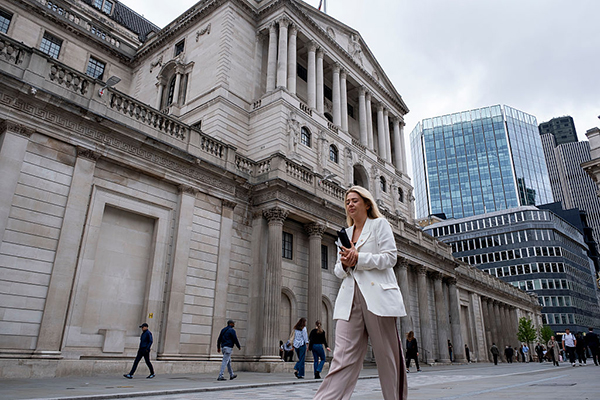
The Bank of England’s cautious approach to managing interest rates is increasingly coming under strain.
The Monetary Policy Committee (MPC) has kept rates on hold at 3.75% for six consecutive meetings, but there are mounting signs this prolonged pause might be about to end.
- Our Services: SIPP Account | Stocks & Shares ISA | See all Investment Accounts
The consumer prices index (CPI), the UK’s main measure of inflation, sped up to 3.1% in August, largely due to the global oil price shock triggered by the Iran war gradually feeding into the UK economy.
Not only is inflation moving further away from the central bank’s 2% target, but prices are expected to continue their upwards trajectory as the year plays out. The energy price cap increases again in October and could have a pronounced inflationary impact should a cold winter arrive.
Cut, hold or hike?
With the MPC facing some big decisions, especially with the next meeting arriving the week after this year’s Autumn Budget, we sought to gather the views of investors.
We conducted a poll on ii’s Community app, asking members what they believe will happen to rates at the 5 November meeting. At the time of writing, the poll had gathered 984 responses:
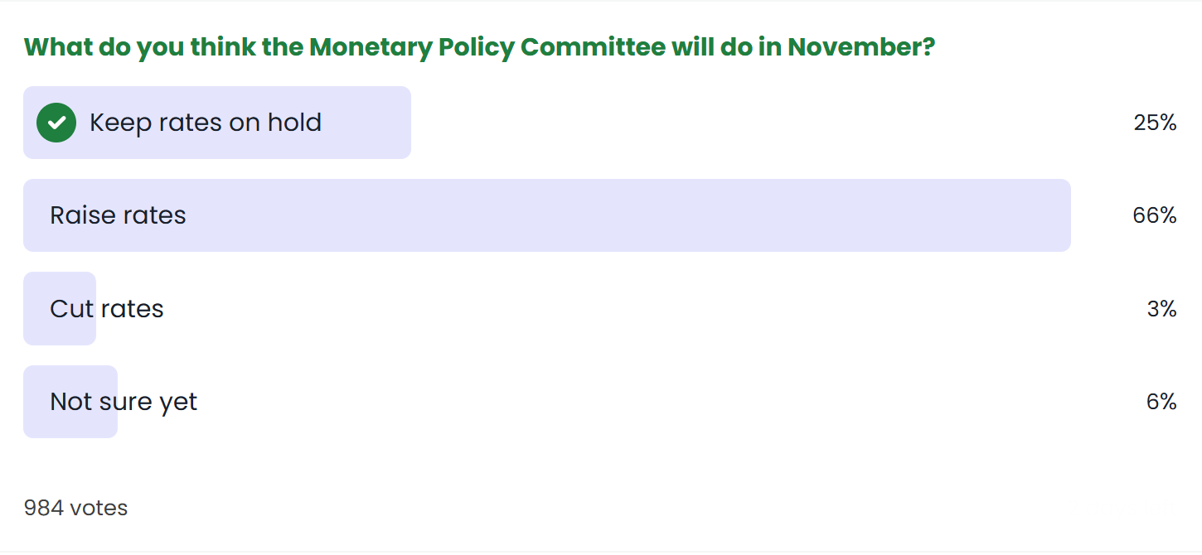
The results suggest the majority of investors believe fiscal policy will tighten, with two-thirds (66%) predicting the Bank Rate will rise for the first time since August 2023.
Elsewhere, one in four members believe the MPC will extend its cautious approach, keeping rates at 3.75% for the seventh meeting on the bounce, while a fraction of investors (3%) believe that rates will be cut.
Some 6% are unsure what the MPC will do, perhaps waiting to see how things pan out between now and the Autumn Budget, particularly with government borrowing costs firmly in the spotlight.
Signals of hikes becoming stronger
Earlier this month, the US Federal Reserve unanimously voted to increase rates, nudging up the benchmark range 0.25 percentage points from 3.5-3.75% to 3.75-4%. Citing its reasons for tightening fiscal policy, the Fed said that prices had been above its 2% target for five years.
The Bank of England didn’t follow suit the next day, but the mood around higher rates has shifted, with more MPC members signalling that increases are edging into their thinking.
Markets are pricing in three to four hikes by the end of 2027, which would shunt the Bank Rate into the 4.50% to 4.75% ballpark, with mortgage rates already ticking up in anticipation of this outcome.
Policymakers, however, have continued to adopt a ‘wait and see’ approach, holding out for richer evidence of second-round inflationary effects. Bank Governor Andrew Bailey warned that if persistent conflict in the Middle East triggers these to emerge, “it is likely that policy may have to tighten.”
However, the Organisation for Economic Co-Operation and Development (OECD) earlier today offered a glimmer of hope to borrowers, claiming that current rates are sufficient to keep inflation in check. In its interim outlook, the OECD slashed its 2026 inflation forecast for the UK to 3.1% from 3.7% in June.
These articles are provided for information purposes only. Occasionally, an opinion about whether to buy or sell a specific investment may be provided by third parties. The content is not intended to be a personal recommendation to buy or sell any financial instrument or product, or to adopt any investment strategy as it is not provided based on an assessment of your investing knowledge and experience, your financial situation or your investment objectives. The value of your investments, and the income derived from them, may go down as well as up. You may not get back all the money that you invest. The investments referred to in this article may not be suitable for all investors, and if in doubt, an investor should seek advice from a qualified investment adviser.
Full performance can be found on the company or index summary page on the interactive investor website. Simply click on the company's or index name highlighted in the article.