eyeQ: BP shares come with warning label
Experts at eyeQ use AI and their own smart machine to analyse macro conditions and generate actionable trading signals. Here’s a top-down view of the oil major.
13th October 2026 09:59
by Huw Roberts from eyeQ

“Our signals are crafted through macro-valuation, trend analysis, and meticulous back-testing. This combination ensures a comprehensive evaluation of an asset's value, market conditions, and historical performance.” eyeQ
- Discover: eyeQ analysis explained | eyeQ: our smart machine in action | Glossary
BP
Macro Relevance: 77%
Model Value: 565.14p
Fair Value Gap: +5.19% premium to model value
Data correct as at 13 October 2026. Please click glossary for explanation of terms. Long-term strategic model.
BP (LSE:BP.) is dominating the headlines this morning after a strong update. After years of being poorly run and over-leveraged, debt levels have been a key metric the market has been watching as new management take over the oil giant.
The hope was for a speedy recovery in BP's balance sheet and new CEO Meg O'Neill, who only took over in April, has delivered. Higher oil prices, surging profits from energy trading and oil refining both contributed to a large paydown in debt.
So far, so good from the bottom-up perspective. What about the top-down view?
Macro matters. A macro relevance score of 77% means big picture drivers like the economy, credit and bond markets all have a significant impact on the share price.
And the good news is the macro view is aligned with the micro - it is also constructive. eyeQ model value has been trending higher for three months now, rising 3.3% in the last month alone.
There is, however, a modest health warning. The stock price has started to run ahead of macro fundamentals. The 5.2% Fair Value Gap isn't yet quite big enough to trigger a bearish signal. But it is starting to get close.
This isn't a bearish call, but it is a warning that the macro landscape suggests these aren't the best levels to be chasing the stock higher.
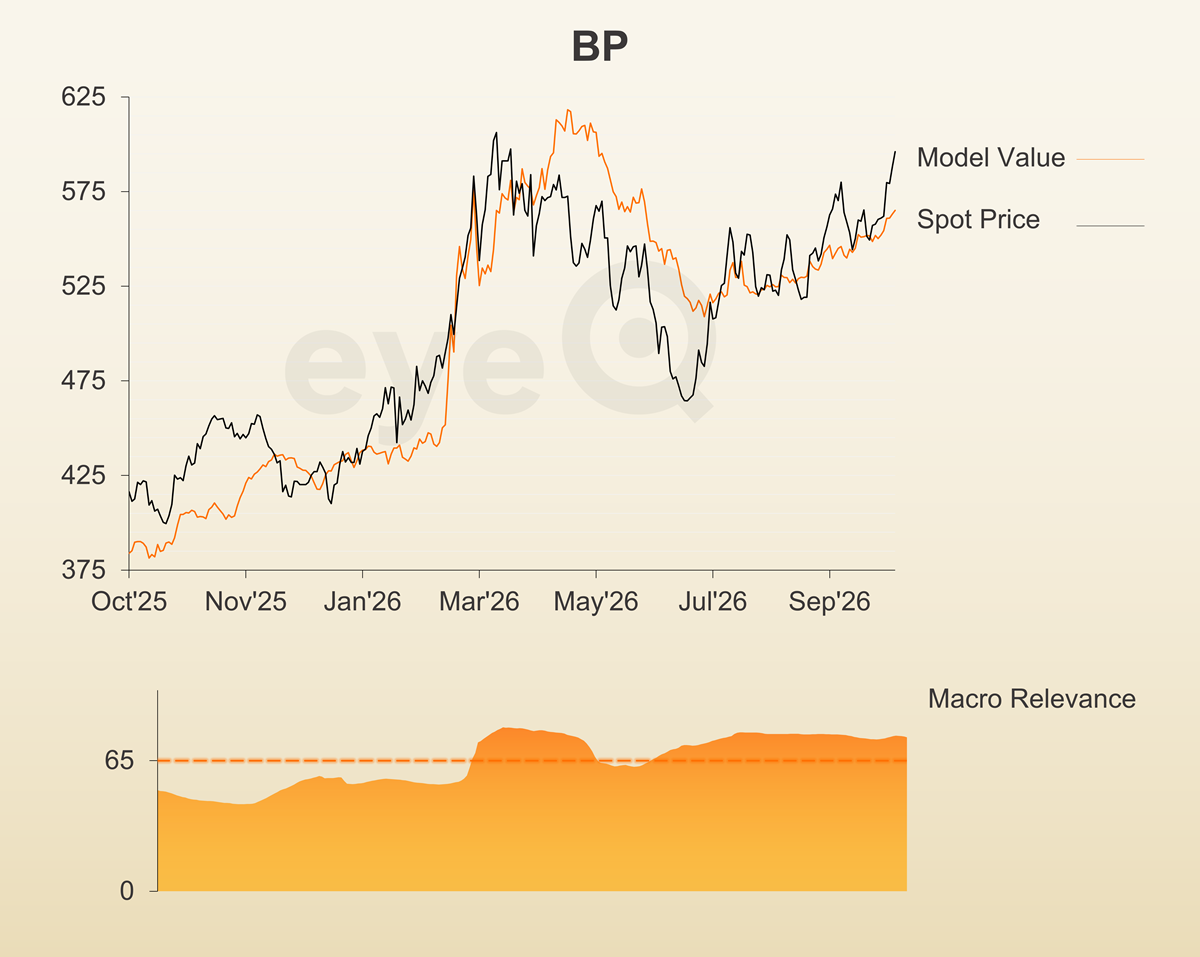
Source: eyeQ. Past performance is not a guide to future performance.
Useful terminology:
Model value
Where our smart machine calculates that any stock market index, single stock or exchange-traded fund (ETF) should be priced (the fair value) given the overall macroeconomic environment.
Model (macro) relevance
How confident we are in the model value. The higher the number the better! Above 65% means the macro environment is critical, so any valuation signals carry strong weight. Below 65%, we deem that something other than macro is driving the price.
Fair Value Gap (FVG)
The difference between our model value (fair value) and where the price currently is. A positive Fair Value Gap means the security is above the model value, which we refer to as “rich”. A negative FVG means that it's cheap. The bigger the FVG, the bigger the dislocation and therefore a better entry level for trades.
Long Term model
This model looks at share prices over the last 12 months, captures the company’s relationship with growth, inflation, currency shifts, central bank policy etc and calculates our key results - model value, model relevance, Fair Value Gap.
These articles are provided for information purposes only. Occasionally, an opinion about whether to buy or sell a specific investment may be provided by third parties. The content is not intended to be a personal recommendation to buy or sell any financial instrument or product, or to adopt any investment strategy as it is not provided based on an assessment of your investing knowledge and experience, your financial situation or your investment objectives. The value of your investments, and the income derived from them, may go down as well as up. You may not get back all the money that you invest. The investments referred to in this article may not be suitable for all investors, and if in doubt, an investor should seek advice from a qualified investment adviser.
Full performance can be found on the company or index summary page on the interactive investor website. Simply click on the company's or index name highlighted in the article.