eyeQ: this FTSE 100 stock has sold off too far
Experts at eyeQ use AI and their own smart machine to analyse macro conditions and generate actionable trading signals. Now it’s spotted a new bullish signal.
8th September 2026 10:02
by Huw Roberts from eyeQ

“Our signals are crafted through macro-valuation, trend analysis, and meticulous back-testing. This combination ensures a comprehensive evaluation of an asset's value, market conditions, and historical performance.” eyeQ
- Discover: eyeQ analysis explained | eyeQ: our smart machine in action | Glossary
National Grid
Macro Relevance: 80%
Model Value: 1,223.20p
Fair Value Gap: -7.25% discount to model value
Data correct as at 8 September 2026. Please click glossary for explanation of terms. Long-term strategic model.
National Grid (LSE:NG.), a popular income play for many investors, is back in a macro regime for the first time in two years. eyeQ's macro relevance score is rising strongly and now sits at 80%.
Unfortunately, the emerging macro picture is not especially friendly. Model value is down 2.2% in the last month and 13.5% from the early March highs. Sticky inflation and volatile bond markets are the two factors primarily responsible for that de-rating.
The consolation is the stock itself has sold off further and faster than macro conditions warrant. In fact, a -7.25% Fair Value Gap is enough to trigger a new bullish signal. That bull signal would carry more conviction if macro conditions stabilised and eyeQ model value turns higher.
For many, the key debate on NG as a stock is the debate about updating the UK power grid. The need for investment is clear but there's considerable uncertainty about how much, how fast and who bears the risk of such a massive project. Investors need to do their homework on that front, but macro has reasserted itself as a key driver of the share price and, at these levels, argues a fair degree of bad news is in the price already.
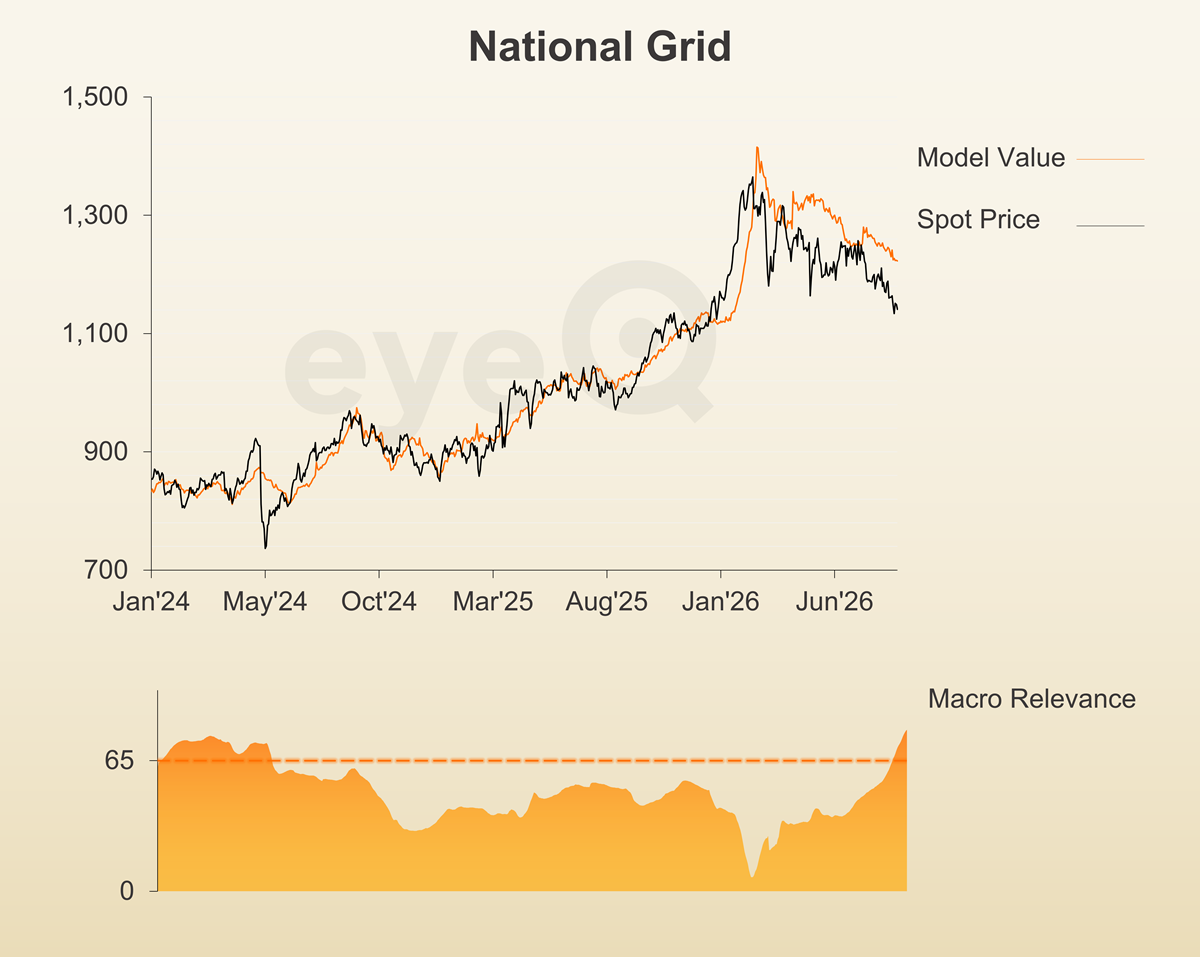
Source: eyeQ. Past performance is not a guide to future performance.
Useful terminology:
Model value
Where our smart machine calculates that any stock market index, single stock or exchange-traded fund (ETF) should be priced (the fair value) given the overall macroeconomic environment.
Model (macro) relevance
How confident we are in the model value. The higher the number the better! Above 65% means the macro environment is critical, so any valuation signals carry strong weight. Below 65%, we deem that something other than macro is driving the price.
Fair Value Gap (FVG)
The difference between our model value (fair value) and where the price currently is. A positive Fair Value Gap means the security is above the model value, which we refer to as “rich”. A negative FVG means that it's cheap. The bigger the FVG, the bigger the dislocation and therefore a better entry level for trades.
Long Term model
This model looks at share prices over the last 12 months, captures the company’s relationship with growth, inflation, currency shifts, central bank policy etc and calculates our key results - model value, model relevance, Fair Value Gap.
These third-party research articles are provided by eyeQ (Quant Insight). interactive investor does not make any representation as to the completeness, accuracy or timeliness of the information provided, nor do we accept any liability for any losses, costs, liabilities or expenses that may arise directly or indirectly from your use of, or reliance on, the information (except where we have acted negligently, fraudulently or in wilful default in relation to the production or distribution of the information).
The value of your investments may go down as well as up. You may not get back all the money that you invest.
Equity research is provided for information purposes only. Neither eyeQ (Quant Insight) nor interactive investor have considered your personal circumstances, and the information provided should not be considered a personal recommendation. If you are in any doubt as to the action you should take, please consult an authorised financial adviser.
Disclosure
We use a combination of fundamental and technical analysis in forming our view as to the valuation and prospects of an investment. Where relevant we have set out those particular matters we think are important in the above article, but further detail can be found here.
Please note that our article on this investment should not be considered to be a regular publication.
Details of all recommendations issued by ii during the previous 12-month period can be found here.
ii adheres to a strict code of conduct. Contributors may hold shares or have other interests in companies included in these portfolios, which could create a conflict of interests. Contributors intending to write about any financial instruments in which they have an interest are required to disclose such interest to ii and in the article itself. ii will at all times consider whether such interest impairs the objectivity of the recommendation.
In addition, individuals involved in the production of investment articles are subject to a personal account dealing restriction, which prevents them from placing a transaction in the specified instrument(s) for a period before and for five working days after such publication. This is to avoid personal interests conflicting with the interests of the recipients of those investment articles.