How will SpaceX affect tracker funds?
The blockbuster IPO has implications for passive funds - if limited at first, writes Dave Baxter.
15th June 2026 12:00
by Dave Baxter from interactive investor
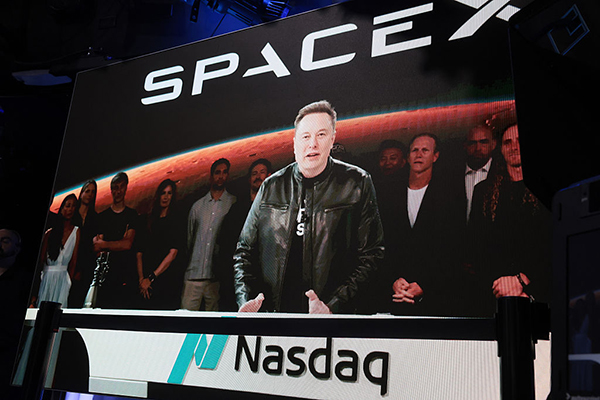
Elon Musk, founder of SpaceX, at the Nasdaq Marketsite at the launch of the IPO on 12 June 2026 in New York. Photo: Spencer Platt/Getty Images.
Anyone who runs a US or global equity fund now has a decision to make: whether to back the Space Exploration Technologies Corp Class A (NASDAQ:SPCX) narrative and buy the shares, or to exercise caution and shy away.
For passive funds, there is less of a choice, with many mainstream trackers due to include SpaceX in the near term. Passive providers are taking different approaches here, although the impact should be limited in the short term.
- Our Services: SIPP Account | Stocks & Shares ISA | See all Investment Accounts
Which passive funds will hold SpaceX?
Those who run the indices that passive funds invest in apply rules that govern which stocks do and don’t end up in the funds. But there have been some differences between the big beasts here.
Slightly controversially, Nasdaq has opted to fast-track SpaceX’s inclusion, meaning that so-called large IPOs can be included after 15 trading days, provided they meet certain criteria relating to their market capitalisation.
SpaceX does qualify, meaning that the shares should be included in the likes of the Invesco EQQQ NASDAQ-100 ETF GBP (LSE:EQQQ) in a few weeks.
FTSE Russell has also taken the fast-track route, meaning SpaceX should enter US indices such as the Russell 1000 after just five trading days.
MSCI, which governs the composition of trackers following the MSCI USA and MSCI World indices, will include SpaceX after just 10 trading days. Another provider, CRSP, waits five trading days.
The exception on this front is S&P Dow Jones, the name behind the S&P 500.
That company has stuck with a waiting period of a year, for starters. But importantly, it will also still apply a “financial viability screen” which requires a company to have made a profit in the last quarter, and an overall profit for the last four quarters, to companies looking to sit in the index.
This is an important test that SpaceX does not pass, meaning it will not make it into funds like the iShares Core S&P 500 ETF USD Acc GBP (LSE:CSP1).
- Investing in space: funds, trusts, and ETFs offering a route in
- The new space race: are private markets positioned for lift off?
It’s notable that Tesla Inc (NASDAQ:TSLA), another company associated with Elon Musk, IPOed in 2010 but didn’t make it into the S&P 500 until 2020 because of this requirement.
The composition of the S&P 500 is also determined by decisions made by the so-called Index Committee. To prevent lobbying, membership of the committee is kept anonymous.
How much exposure is there?
Specialists have already argued that the “fast track” approach to inclusion does a disservice to passive fund investors and forces them to hold a company before it meets certain important criteria.
That adds to other woes about the flotation, such as the fact that Musk will remain the dominant shareholder and cannot be ousted. Another concern is the sheer level of its valuation.
However, those who are wary of the IPO don’t need to panic about their passive exposure just yet, because it should be limited for a while.
While the figures will change depending on where SpaceX shares trade, Morningstar estimates made ahead of the IPO pointed to the company accounting for just 0.5% to 0.6% of the Nasdaq (although this could rise based on the IPO share price pop). That figure could be lower for broader regional markets.
Could this change?
Investors in investment trusts such as Scottish Mortgage Ord (LSE:SMT) and Baillie Gifford US Growth Ord (LSE:USA) will be waiting to see how much those funds sell down their SpaceX positions, once they can.
There are different lock-up periods that govern when insiders can sell: some can do it six months after the IPO (in December), while investors should also be able to sell some stock following upcoming quarterly trading updates.
As much as this affects the likes of SMT, it’s also important for passive funds. That’s because SpaceX’s weighting in indices is dictated by how much “free float”, or available shares it has. That amount is currently limited but will increase as and when the insiders sell their shares.
Investors might therefore need to look at how the figure changes over time.
Thematics and ‘ex-Musk’ funds
Thematic ETFs often launch in the hope of capturing a hot theme, and it’s notable that we have seen the arrival of both the iShares Space Technologies ETF USD Acc GBP (LSE:STRR) and the WisdomTree Space Economy ETF USD Acc GBP (LSE:WSPG) in recent weeks.
It seems likely that these funds could end up buying SpaceX, although it’s unclear how big a position they will take.
Thematic funds can sometimes end up having very big bets on the leading names in a given sector. Investors should also keep an eye on the VanEck Space Innovators ETF A USD Acc GBP (LSE:JEDG).
- Investing in themes: what investors need to know
- Sign up to our free newsletter for investment ideas, latest news and award-winning analysis
Finally, it will be interesting to see if concerns about SpaceX trigger further innovation.
In recent years we have seen the proliferation of funds that exclude China from emerging market indices, and of funds that try to diminish (or remove) the presence of the US tech stocks from the S&P 500, and of the US from the MSCI World index.
There has been speculation that we could see tracker funds which exclude SpaceX, or even Elon Musk’s companies, from their portfolios.
That should give investors further choice – and muddy the waters around the mantra of “just buy a tracker”.
These articles are provided for information purposes only. Occasionally, an opinion about whether to buy or sell a specific investment may be provided by third parties. The content is not intended to be a personal recommendation to buy or sell any financial instrument or product, or to adopt any investment strategy as it is not provided based on an assessment of your investing knowledge and experience, your financial situation or your investment objectives. The value of your investments, and the income derived from them, may go down as well as up. You may not get back all the money that you invest. The investments referred to in this article may not be suitable for all investors, and if in doubt, an investor should seek advice from a qualified investment adviser.
Full performance can be found on the company or index summary page on the interactive investor website. Simply click on the company's or index name highlighted in the article.