ii view: HSBC remains popular play on growth in Asia
Becoming a simpler, more agile bank and pursuing a series of targets for 2028 under CEO Georges Elhedery. Buy, sell, or hold?
2nd September 2026 11:34
by Keith Bowman from interactive investor
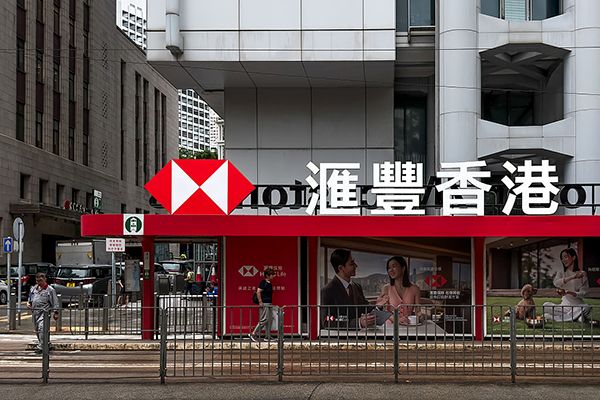
HSBC’s main building in Hong Kong’s central business district. Photo: Cheng Xin/Getty Images.
First-half results to 30 June
- Revenue up 11% to $37.7 billion (£27.9 billion)
- Pre-tax profit up 23% to $19.52 billion
- Capital cushion, or CET1 ratio of 14.1%, down from 14.9%
- Return on Tangible Equity (ROTE) of 18.2%, up from 14.7%
- Second interim dividend of $0.10 per share
- Total first-half dividend of $0.20, unchanged from H1 2025
- New share buyback of up to $1 billion and aiming to execute by Q3 results
Guidance:
- Continues to target year-on-year growth in revenue from 2026 to 2028, rising to 5% growth in 2028 compared with 2027 excluding notable items and on a constant currency basis
- Continues to target an average ROTE of 17% or better for 2026, 2027 and 2028
- Continues to target a dividend payout ratio basis of 50% in 2026, 2027 and 2028
Chief executive Georges Elhedery said:
"HSBC is becoming the stronger bank we set out to build. We are executing our strategic priorities with pace, precision and discipline. This is allowing our four businesses to focus on their core strengths, grow, work together more effectively and deepen customer relationships. The result is a bank capable of achieving more."
- Our Services: SIPP Account | Stocks & Shares ISA | See all Investment Accounts
ii round-up:
HSBC Holdings (LSE:HSBA) serves around 41 million customers across more than 50 countries and territories worldwide.
The UK headquartered bank operates across four divisions. Corporate and Institutional Banking generated most profit during this latest half year at 40%. That was followed by the Hong Kong division at 28%, the UK business 18% and International Wealth and Premier Banking the balance of 14%.
For a round-up of these latest results announced on the 4 August, please click here.
ii view:
Starting business in Hong Kong in 1865, HSBC is today one of the world’s largest banking and financial services organisations. The FTSE 100 giant employs over 200,000 people. A stock market value of £262 billion is comfortably ahead of UK headquartered rivals Lloyds Banking Group (LSE:LLOY), Barclays (LSE:BARC) and NatWest Group (LSE:NWG) all at under £70 billion.
For investors, an ongoing war in the Middle East has resulted in bad debt provisions given the bank’s exposure to the region. Elevated energy prices resulting from the war, pressuring inflation and potential interest rates rises may dampen economic activity and HSBC's lending levels. Political tensions between China and the US persist, with trade tariff negotiations ongoing, while a forecast price/earnings (PE) ratio above the three- and 10-year averages may suggest the shares are not obviously cheap.
- Insider: FTSE 250 directors lock in 7% yield
- Ten ‘alternative’ funds with big yields
- ii view: Standard Chartered goes from strength to strength
More favourably, exposure to the world’s second-largest economy, China, via the Hong Kong business is considerable and unrivalled by other UK listed banks. Targets including those for revenue and efficiency via Return on Tangible Equity (ROTE) are being pursued. Investments for growth include new wealth centres for customers across growth markets such as India and Vietnam, while HSBC’s balance sheet remains robust, with the capital cushion or CET1 ratio of 14.1% still within management’s medium-term target range of 14% to 14.5%.
In all, and despite ongoing risks, exposure to Asian growth markets and a prospective dividend yield of around 4% are likely to keep investors interested in this major financial services provider.
Positives:
- Robust balance sheet
- Attractive dividend yield (not guaranteed)
Negatives:
- Uncertain economic outlook
- Heightened political tensions between the West and China
The average rating of stock market analysts:
Strong hold
These articles are provided for information purposes only. Occasionally, an opinion about whether to buy or sell a specific investment may be provided by third parties. The content is not intended to be a personal recommendation to buy or sell any financial instrument or product, or to adopt any investment strategy as it is not provided based on an assessment of your investing knowledge and experience, your financial situation or your investment objectives. The value of your investments, and the income derived from them, may go down as well as up. You may not get back all the money that you invest. The investments referred to in this article may not be suitable for all investors, and if in doubt, an investor should seek advice from a qualified investment adviser.
Full performance can be found on the company or index summary page on the interactive investor website. Simply click on the company's or index name highlighted in the article.