HSBC continues record run as results impress
This banking giant flexed its financial muscles in these half-year results and shares are rewarded with a new high. ii's head of markets runs through the key numbers.
4th August 2026 08:25
by Richard Hunter from interactive investor
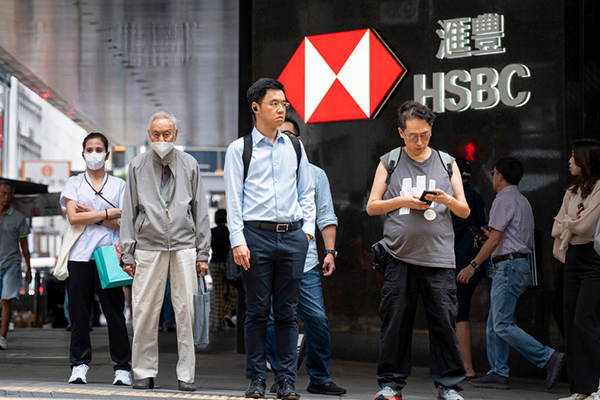
Pedestrians outside a HSBC bank branch in Hong Kong. Photo: Sebastian Ng/SOPA Images/LightRocket via Getty Images.
FTSE 100 leviathan HSBC Holdings (LSE:HSBA) has rounded off the UK bank sector reporting season in solid style, echoing the theme of a particularly strong second quarter which has been seen elsewhere in the sector.
- Our Services: SIPP Account | Stocks & Shares ISA | See all Investment Accounts
If there is a tinge of disappointment, it may relate to the credit impairments which blotted the copybook in the first quarter and a smaller than expected return to the share buyback programme, where the £1 billion number compares with general estimates of $2 billion and even some punchier speculation of £3 billion. Even so, the programme has returned as promised by the bank and adds to a respectable 3.5% dividend yield and handsome total return which shareholders have more recently enjoyed.
As has been the case for many other global banks this reporting season, the impact of the Middle East conflict has made an appearance in the numbers. HSBC has exposure to the region, let alone the broader economic impacts, and has modelled scenarios of increasing severity and duration which could lead to higher oil prices and inflation, slowing GDP growth and rising unemployment.
As such, a charge of $2.4 billion, compared to $2 billion the previous year, includes $300 million related to the current conflict. The figure is relatively contained given the non-repeat of items from last year, such as a $2.1 billion charge for losses related to its Chinese Bank of Communications stake and $1.4 billion of legal provisions contributed, with the commercial real estate situation in Hong Kong and mainland China remaining difficult.
However, in the overall context these headwinds do not detract from yet another example of HSBC flexing its financial muscles. Revenues rose by 11% in the half-year to $37.7 billion and pre-tax profit by 23% to $19.52 billion, including a second-quarter contribution of $10.1 billion which was 60% higher than the corresponding period and ahead of the $9.9 billion expected. Net profit also rose by 23% to $15.3 billion, with all income lines displaying strong growth.
Indeed, its four units each contributed to the rising profit number. The largest, Corporate and Institutional Banking, saw pre-tax profit growth of 37% to $7.25 billion, followed by its other businesses with gains of 26% to $5.14 billion for Hong Kong, 17% to $3.33 billion for the UK and 13% to $2.61 billion for International Wealth and Premier Banking.
The other key metrics also remain generally robust. The Return on Tangible Equity (ROTE) rose from 14.7% to 18.2%, Net Interest Margin increased from 1.57% to 1.61%, while Net Interest Income (NII) grew by 8% to $18.23 billion, driven by deposit growth, foreign exchange tailwinds and the benefit of structural hedge income.
Elsewhere, and despite the drag of the provisions, the cost/income ratio fell to 46.2% from 49.9% previously, with the CET1 ratio, or capital cushion, falling to 14.1% from 14.9%, although still within the group’s 14% to 14.5% target range. Lending and deposit balances also rose, with gains of $34 billion and $41 billion respectively to those balances.
- eyeQ: Burberry, M&G, Shell, Thermo Fisher Scientific
- Shares for the future: hedging my bets on this AIM stock
The group’s push towards the affluent sector received another boost, with another promising contribution from Wealth. Whereas HSBC had been moving towards becoming a business with a slavish reliance on interest rate movements and levels, the revised and increasing focus on the growth in affluent wealth, especially in Asia, is key to the new offering.
HSBC has been investing heavily in this move, giving it higher, but more diversified income streams. Apart from the longer-term potential for the key Chinese market, the group previously identified areas such as India and Vietnam as being some of the fastest growing economies at present.
The outlook numbers for the full year were largely maintained, with a fractional uplift to the projected NII estimate to over $46 billion, and it increasingly appears that any lingering disappointment from the first quarter was a blip towards HSBC’s aspirations.
- Can MPC voting history predict next interest rate move?
- Sign up to our free newsletter for investment ideas, latest news and award-winning analysis
The share price has risen by 74% over the last year, as compared to a gain of 19% for the wider FTSE 100 index, and by 151% over the last two years. And this morning it reached another record high in early deals. These gains mean HSBC is now the largest member of the FTSE 100, helped along by a general sector rerating. Given this stellar run and some slight disappointment on the buyback and provisions announcements, a marginal move in the price at the open is of little surprise.
However, while the group may not be at the top of the pack given the perception of more balanced growth elsewhere in the sector, the market consensus of the shares as a cautious buy nonetheless reflects the stability and major financial strength which investors especially appreciate in volatile trading times such as these.
These articles are provided for information purposes only. Occasionally, an opinion about whether to buy or sell a specific investment may be provided by third parties. The content is not intended to be a personal recommendation to buy or sell any financial instrument or product, or to adopt any investment strategy as it is not provided based on an assessment of your investing knowledge and experience, your financial situation or your investment objectives. The value of your investments, and the income derived from them, may go down as well as up. You may not get back all the money that you invest. The investments referred to in this article may not be suitable for all investors, and if in doubt, an investor should seek advice from a qualified investment adviser.
Full performance can be found on the company or index summary page on the interactive investor website. Simply click on the company's or index name highlighted in the article.