JD Sports forced to cut profit outlook for 2027
FTSE 100 retailer lowers guidance as weak North America trading and cost-of-living pressures weigh on results.
20th August 2026 08:30
by Richard Hunter from interactive investor
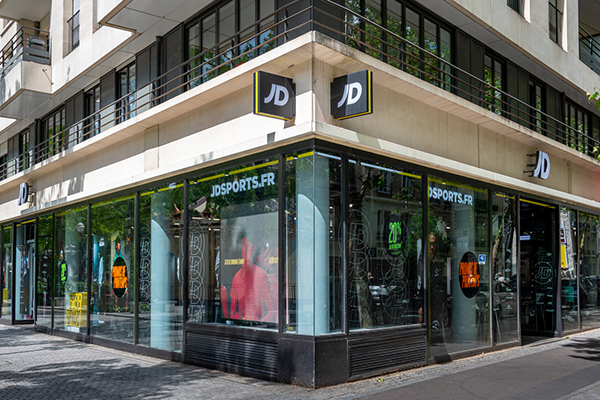
A JD Sports store in Boulogne-Billancourt, Paris. Credit: HJBC/iStock.
JD Sports’ fortunes were long overdue a break, but this update misses such an opportunity by a fair margin.
Several profit warnings in the previous year put a lid on any share price appreciation, and this latest downgrade will do little to cheer investor spirits. The group has reduced its adjusted pre-tax profit outlook for the full year to a range of £700-£800 million, down from a previous £750-£850 million, and in comparison to the £852 million which it recorded last year. Its guidance for free cash flow remains unchanged at £460-£520 million, but this will be of scant solace to a company caught up in factors largely outside its control.
- Invest with ii: Open a Low Cost SIPP | What is a SIPP | Interactive investor Offers
Its strategy remains intact, but the delivery is proving to be a stumbling block. Group sales are dominated by footwear (60% of the total) and apparel (30%), whereas by region North America (35%) and Europe (34%) are its largest markets. JD Sports Fashion (LSE:JD.) has strengthened its presence in these countries with relatively recent purchases, namely the £900 million acquisition of US retailer Hibbett and a £450 million takeover of French company Courir.
Numbers for the quarter make for difficult reading, with group like-for-like sales down by 3.1%, comprising falls in North America and Europe of 6.8% and 2.7%, while the lesser-contributing regions, the UK (26% of group sales) and Asia Pacific (5%) made some small progress with gains of 0.8% and 1.4% respectively. Within the overall numbers, there was a glimmer of light for online sales, which rose by 2.6% over the period, while replica football kit sales in the UK were stronger given the World Cup competition.
However, the situation in its largest market of North America is of some concern, where weaker consumer sentiment, deferred “back-to-school” demand from July was pushed back into the first half of August and the loss of brand heat at key supplier Nike have all played a part. This comes after some signs of life in the first quarter, where the sales decline seemed to be stabilising, but the weak second quarter has dragged like-for-like sales down by 4% for the half-year.
More broadly, JD has no direct exposure in the Middle East but second-round effects such as the inflationary impact are in evidence. Lower-income shoppers are under pressure due to rising energy costs and any cost-of-living demands on individual budgets, particularly in its core younger market. More positively, Sportswear continues to take share within apparel due to rising participation in athletics, particularly among higher-income consumers who tend to have a greater propensity to spend regardless of the economic backdrop.
The group has needed to sacrifice some margin with promotional activity of its own to stem the sales decline, although it has upgraded its e-commerce capabilities, improved its global supply chain and automated one of its larger distribution centres. Even so, the highly promotional market has required more concentrated spend, although this has shown some signs of limited success.
- ii view: is BAE Systems now an investment staple?
- Sign up to our free newsletter for investment ideas, latest news and award-winning analysis
In all, JD Sports remains between a rock and a hard place, with no obvious signs of the “tough” backdrop subsiding. The profits downgrade is a blow to its aspirations and the sharp share price decline at the open comes after a flat performance over the last year, as compared to a gain of 16% for the wider FTSE 100, and a decline of 37% over the last two years.
More positively, the ongoing £200 million share buyback programme is a statement of the group’s confidence in its prospects and for investors there remains some lingering hope given the green shoots which the acquisitions bring. The faltering price has left the shares on an extremely low valuation in historic terms, which some may see as a potential entry point, and indeed the market consensus of the shares as a cautious buy reflects some guarded optimism despite the more obvious immediate woes.
These articles are provided for information purposes only. Occasionally, an opinion about whether to buy or sell a specific investment may be provided by third parties. The content is not intended to be a personal recommendation to buy or sell any financial instrument or product, or to adopt any investment strategy as it is not provided based on an assessment of your investing knowledge and experience, your financial situation or your investment objectives. The value of your investments, and the income derived from them, may go down as well as up. You may not get back all the money that you invest. The investments referred to in this article may not be suitable for all investors, and if in doubt, an investor should seek advice from a qualified investment adviser.
Full performance can be found on the company or index summary page on the interactive investor website. Simply click on the company's or index name highlighted in the article.