Plunging FTSE 100 takes lead from China
7th January 2016 12:56
by Lee Wild from interactive investor
It feels like the August crash all over again. As summer drew to a close, China's decision to devalue the local currency - the yuan, or renminbi - unsettled an already vulnerable domestic stockmarket. Global shares slumped in sympathy. A currency war now looms, but what should investors make of this latest rout?
Only last February the made a record high, finally beating the marker set during the internet boom 15 years earlier. It soon charged above 7,000, eventually setting what turned out to be the current best at 7,122 late April.
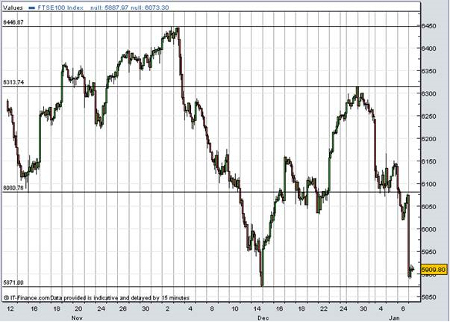
But just three-and-a-bit trading sessions into 2016, the FTSE 100 has plunged as much as 365 points, or 5.7%. It sunk up to 186 points, or 3%, on Thursday alone.
And it's China that continues to haunt us. The Shanghai index has plunged by 7% twice this week, triggering a suspension of share trading. The market was shut for the day after just 29 minutes Thursday, and that included a 15-minute trading halt after an initial 5% slump! The index now sits at 3,125, down from 5,178 last June, and the 2,850 August low looks in serious danger.
Our technical analyst John Burford said on Monday: "I expect further weakness in the near-term because we are in a third-wave down and these are usually long and strong. If you look at the Shanghai index, the rally since August was a clear correction. We shall see the August lows broken soon." He might be right.
"Investors fear that China is using a weak currency as a prop for a failing economy."
Thursday's sell-off was sparked by the latest devaluation of the Chinese currency. The so-called fix for the yuan was set at 6.5646 to the dollar by the People's Bank of China (PBOC). That's down by 0.5%, the most in five months, to the lowest since March 2011.
It traded as high as 6.5937 compared with just 6.2095 in August 2015. Investors fear that China is using a weak currency as a prop for a failing economy. Politicians there are desperately trying to switch from an export-driven economy to one led by domestic consumption. But there's scant evidence of success so far.
(Click to enlarge)
Official stats put third-quarter gross domestic product (GDP) at 6.9%, but we reported in September comments from Citigroup's chief economist Willem Buiter that it could fall "to, or below, 2% by the middle of next year".
Electricity use, a decent indicator of economic activity, rose just 0.7% in the first 11 months of 2015, and both imports and exports fell in dollar terms in November - down 8.7% and 6.8% respectively.
A global recession starting in 2016, led by China, was Citi's global economics team's main scenario. "Uncertainty remains, but the likelihood of a timely and effective policy response seems to be diminishing," said Buiter.
Much of the turmoil in Chinese stockmarkets can rightly be blamed on a toxic mix of inexperienced retail investors and ineffective market regulation. That makes it difficult to predict just where this will all end, but the likelihood is, not well.
And companies affected by Chinese demand have fared worst this week. Posh coats and handbags maker is down sharply at a three-year low, miners , and have been smashed, and oil heavyweights and are on the ropes as Brent crude makes another 11-year low at under $35 a barrel.
A buying opportunity?
The overused pre-World War II slogan "Keep Calm and Carry On" springs to mind here. As our regular contributor, Justin Urquhart Stewart, keeps saying, investors should use market weakness to buy good quality companies at cheap prices.
He's right, of course. And pound-cost averaging - buying shares in equal sums at regular intervals - works well in a falling market.
Calling the precise bottom of the market is, however, impossible - but chartist and Interactive Investor contributor Alistair Strang has had a go. And his recent calls have been spot on.
"If my suspicion is indeed correct and 6,001 is now achieved, if broken it appears the next point we should hope for a bounce is just before 5,890," Alistair wrote in an article for us last night.
Well, the FTSE 100 bottomed-out at 5,887 early Thursday! It still looks weak, though, and Alistair has warned for the past three weeks that the index could trade down at 5,744, which would be a new three-year low.
This article is for information and discussion purposes only and does not form a recommendation to invest or otherwise. The value of an investment may fall. The investments referred to in this article may not be suitable for all investors, and if in doubt, an investor should seek advice from a qualified investment adviser.