Stockwatch: another shorted share now in a bull market?
Analyst Edmond Jackson believes the tide has turned positively for another share targeted by short sellers. Here’s why he thinks the share price uptrend will likely continue.
7th August 2026 11:16
by Edmond Jackson from interactive investor

Helped by an in-line trading update for its fiscal year to 31 July, the AIM-listed shares in research data and analytics technology group YouGov (LSE:YOU) are continuing to strengthen from a 154p low last March, up 5% this week to 277p.
It was nothing like yesterday’s 29% rise in marketing services group WPP (LSE:WPP), which I rated a “buy” on 28 July in anticipation of a squeeze on a crowded 8.5% short trade given decent interim results.
- Our Services: SIPP Account | Stocks & Shares ISA | See all Investment Accounts
But despite YouGov continuing to warn on profits at the 24 March half-year numbers, an 11% drop to a 10-year low of 154p laid the base for it to steadily creep up.
With 4.7% of its issued share capital loaned out versus a reasonably positive narrative and capable new CEO joining from November, YouGov’s risk/reward profile looks to favour upside if commercial momentum improves.
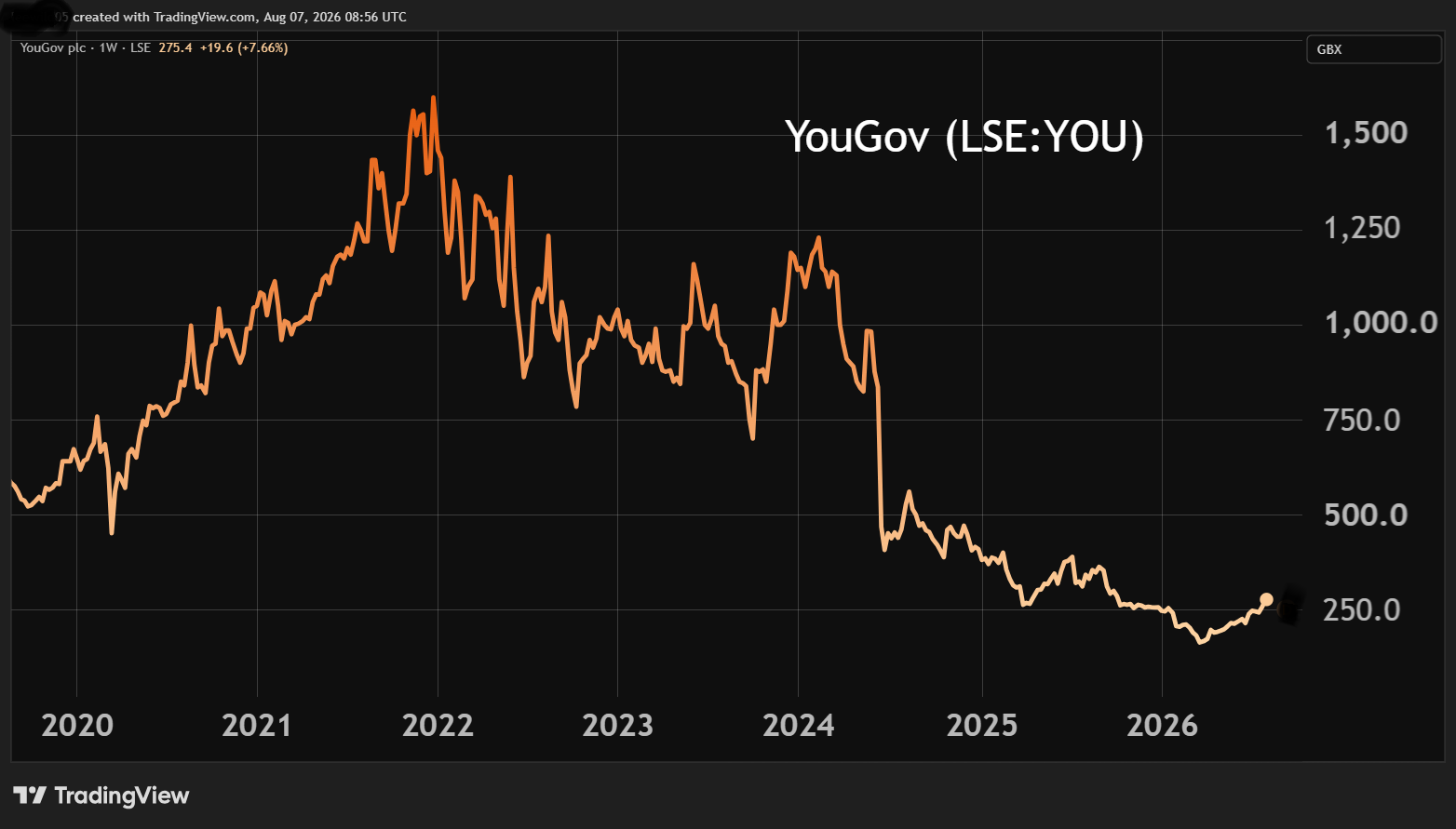
Source: TradingView. Past performance is not a guide to future performance.
Since the board perceives a disconnect between market value and intrinsic value, a share buyback programme is targeted in lieu of a dividend once YouGov is out of its closed period with respect to October’s annual results. This could also help the “market technical” situation - the balance between buying and selling.
I have had mixed success calling YouGov. I originally rated it a “buy” at 450p in April 2019 and again at 577p that July, although cautioning that a high price/earnings (PE) multiple would not last forever and the shares were for experienced traders only. They enjoyed a bull run to over 1,550p by late 2021 but there followed a sideways-volatile range of 800p to 1,150p.
- FTSE 100 broker upgrades: hot on L&G and Next shares
- How to protect your retirement from a stock market crash
- High excitement as Diageo chief spells out fresh strategy
At 820p in June 2024, I tilted again to a “buy” with a speculative, high-risk tag albeit potentially worth averaging into. In response to a profit warning, this proved premature, but this time around, and unless we get a recession, I think the commercial odds, overall valuation criteria and modest coiled spring of the short position, look favourable.
Earnings valuation relies on an adjusted view
Consensus forecasts anticipate near £35 million of net profit in respect of this latest fiscal year and over £40 million to July 2027, implying normalised earnings per share (EPS) growth of 39% and 23% respectively.
However, it is a snapshot view where earnings are expected to recover from a trough (normalised EPS over 33p was previously achieved in the July 2023 year), hence a highly attractive PEG ratio (PE to growth) of 0.4 is a bit cute given such earnings momentum probably will not be sustained.
It also hinges on accepting YouGov’s adjustments, which has not always been so. The 10-year record shows a material gap emerging between reported and normalised EPS chiefly since 2020:
YouGov - financial summary
year-end 31 Jul
| 2016 | 2017 | 2018 | 2019 | 2020 | 2021 | 2022 | 2023 | 2024 | 2025 | |
| Turnover (£ million) | 88.2 | 107 | 117 | 136 | 152 | 169 | 221 | 258 | 335 | 389 |
| Operating margin (%) | 4.9 | 7.1 | 10.1 | 14.7 | 10.0 | 11.2 | 13.6 | 17.2 | 3.3 | 8.1 |
| Operating profit (£m) | 4.3 | 7.6 | 11.8 | 20.0 | 15.2 | 19.0 | 30.0 | 44.4 | 10.9 | 31.4 |
| Net profit (£m) | 3.4 | 4.7 | 8.2 | 14.9 | 10.0 | 11.5 | 17.1 | 34.5 | -2.4 | 13.4 |
| EPS - reported (p) | 3.2 | 4.2 | 7.3 | 13.1 | 8.5 | 10.2 | 15.2 | 30.8 | -2.1 | 11.3 |
| EPS - normalised (p) | 3.8 | 4.5 | 7.8 | 12.1 | 12.1 | 13.7 | 19.1 | 33.5 | 14.1 | 19.6 |
| Operating cashflow/share (p) | 11.0 | 14.9 | 16.1 | 29.7 | 31.3 | 43.4 | 55.2 | 52.8 | 32.6 | 37.8 |
| Capital expenditure/share (p) | 5.7 | 7.1 | 7.3 | 10.7 | 16.6 | 21.1 | 15.6 | 15.5 | 16.7 | 14.8 |
| Free cashflow/share (p) | 5.3 | 7.8 | 8.8 | 19.0 | 14.7 | 22.3 | 39.6 | 37.3 | 15.9 | 23.0 |
| Dividends per share (p) | 1.4 | 2.0 | 3.0 | 4.0 | 5.0 | 6.0 | 7.0 | 8.8 | 9.0 | 9.3 |
| Covered by earnings (x) | 2.3 | 2.1 | 2.4 | 3.3 | 1.7 | 1.7 | 2.2 | 3.5 | -0.2 | 1.2 |
| Return on total capital (%) | 5.4 | 8.9 | 11.1 | 15.4 | 12.1 | 14.8 | 20.0 | 20.8 | 2.6 | 8.1 |
| Cash (£m) | 15.6 | 23.5 | 30.6 | 37.9 | 35.3 | 35.5 | 37.4 | 107 | 73.6 | 54.8 |
| Net debt (£m) | -15.6 | -23.2 | -24.8 | -26.8 | -26.0 | -22.3 | -25.2 | -96.0 | 165 | 167 |
| Net assets (£m) | 74.1 | 80.5 | 90.9 | 108 | 110 | 113 | 125 | 196 | 183 | 191 |
| Net assets per share (p) | 71.0 | 76.4 | 86.2 | 102 | 101 | 101 | 112 | 168 | 156 | 162 |
Source: historic company REFS and company accounts.
This relates to acquiring intangible assets where YouGov’s last reported net assets of £187 million constituted 224% goodwill and intangibles accumulated over years.
For example, in the first half of the 2026 year, YouGov capitalised £9.5 million spending on intangible assets in that period while amortising (writing down) £15.4 million going back to the July 2024 year. Then, YouGov bought the European Consumer Panel business – re-named YouGov Shopper – from GfK (a German marketing services group) for £270 million equivalent.
This acquisition doesn’t seem to have worked out as anticipated. Interim results cited group revenue 2% lower on an underlying basis albeit expected to return to growth by fiscal year-end, with the order backlog ahead of last year. Shopper’s adjusted underlying operating profit fell from £13.9 million to £6.8 million in the first half “impacted by additional investments to drive future growth and maintain competitiveness”. It explains the aspect of profit warning where £52-56 million adjusted operating profit was guided for versus around £60 million previously.
Amid such events it gets hard to be sure if earnings are really advancing; a factor attracting short sellers versus “clean” accounts. I still would not lose sight of YouGov’s strong market positioning in high-quality human data and strategic research projects, and reconciling profit to cash flow does offer some reassurance.
- The most widely held global income shares among fund managers
- FTSE 100 and FTSE 250 winners and losers in July 2026
- UK bank shares: new price targets for NatWest and Lloyds
The interim cash flow statement showed £37.1 million cash generated from operations (before working capital changes which impacted) versus £9.2 million spent on investment and £3 million on leases, leaving around £25 million which tallied with adjusted operating profit of £24 million.
With net debt of £160 million as of 31 January, YouGov’s current market value of £322 million implies an enterprise value of £482 million versus potentially around £40 million of post-tax annual cash flow. While that might not scream “value”, if the financial dynamics are in an overall improving trend on a two-year view it argues for short-closing – especially with the chart now indicating a steady uptrend. Some kind of shocker is needed to disrupt this, which could come from an extended Middle East war as I see this as less likely to derive from the company.
This is how I derive a positive financial risk/reward profile.
New CEO adds to potential positives
We have just seen how the appointment of a new chief executive is already honing WPP with the share price responding positively.
Yesterday, it was announced that Wayne Levings will take up the role at YouGov, having spent the last 17 years in various CEO roles of geographic subsidiaries of Kantar, one of the world’s largest evidence-based data, insight, analytics and consultancy companies.
WPP owns 40% of Kantar and Bain Capital 60%, and they have been actively breaking up and selling off parts, so perhaps Levings sees more potential and upside to run his own show at YouGov.
I tend to see the appointment of an outsider as potentially better than an internal candidate – offering scope for a fresher, more vigorous approach than one compromised by existing relations.
Five months ago, a new CFO was appointed, hence it is unclear whether the duo opt to “clean up” aspects of YouGov’s accounting to establish a sound base going forward.
Yet the board firmly believes the shares are undervalued, hence the intention to begin buybacks in lieu of a dividend once out of the closed period in relation to October’s annual results. Terms of a banking facility have been amended partly to facilitate this.
- ii view: high yielder L&G ups annual profit hopes
- Sign up to our free newsletter for investment ideas, latest news and award-winning analysis
- ii view: WPP shares rocket 28% on unfolding recovery plan
Yesterday’s update also cited a term loan and revolving credit facility extended to April 2028, with full repayment originally due September 2027 replaced with a €20 million (£17.2 million) instalment due in October 2027.
Debt has been something of an issue for YouGov, and has also attracted short sellers, with net gearing last reported around 95%. “The extension provides flexibility as the company strategically reviews the Shopper business while continuing to invest in our products, panel and platform...margin and covenants remain unchanged, reflecting our strong credit profile...continued support from our longstanding banking relationships.”
A 5% share price rise yesterday might therefore have related to mitigating financial risk.
Also contributing could have been “something new” by way of announcing the launch of YouGov Parallax – which “combines digital twin simulation with real-world human verification to give clients full transparency when using AI-generated responses”. Forgive me for not unpacking that; you have to wonder if this is part of staying competitive rather than offering a genuine financial advance.
The same might be said for its “support for the Model Context Protocol (MCP) standard which allows clients to connect data into their AI workflows”.
I therefore sense the share price uptrend will likely continue – assuming no major Middle East disruption – aided by short sellers buying back shares to close positions, hence I rate the shares a “buy”.
Edmond Jackson is a freelance contributor and not a direct employee of interactive investor.
AIM stocks tend to be volatile high-risk/high-reward investments and are intended for people with an appropriate degree of equity trading knowledge and experience.
These articles are provided for information purposes only. Occasionally, an opinion about whether to buy or sell a specific investment may be provided by third parties. The content is not intended to be a personal recommendation to buy or sell any financial instrument or product, or to adopt any investment strategy as it is not provided based on an assessment of your investing knowledge and experience, your financial situation or your investment objectives. The value of your investments, and the income derived from them, may go down as well as up. You may not get back all the money that you invest. The investments referred to in this article may not be suitable for all investors, and if in doubt, an investor should seek advice from a qualified investment adviser.
Full performance can be found on the company or index summary page on the interactive investor website. Simply click on the company's or index name highlighted in the article.
Disclosure
We use a combination of fundamental and technical analysis in forming our view as to the valuation and prospects of an investment. Where relevant we have set out those particular matters we think are important in the above article, but further detail can be found here.
Please note that our article on this investment should not be considered to be a regular publication.
Details of all recommendations issued by ii during the previous 12-month period can be found here.
ii adheres to a strict code of conduct. Contributors may hold shares or have other interests in companies included in these portfolios, which could create a conflict of interests. Contributors intending to write about any financial instruments in which they have an interest are required to disclose such interest to ii and in the article itself. ii will at all times consider whether such interest impairs the objectivity of the recommendation.
In addition, individuals involved in the production of investment articles are subject to a personal account dealing restriction, which prevents them from placing a transaction in the specified instrument(s) for a period before and for five working days after such publication. This is to avoid personal interests conflicting with the interests of the recipients of those investment articles.