Why ‘safe’ bond funds are suffering
Saltydog Investor reflects on another trying time for portfolios once viewed as defensive.
5th October 2026 13:44
by Douglas Chadwick from ii contributor

This content is provided by Saltydog Investor. It is a third-party supplier and not part of interactive investor. It is provided for information only and does not constitute a personal recommendation.
September proved to be another difficult month for investors.
Of the 35 Investment Association (IA) sectors that we regularly monitor at Saltydog Investor, only 10 made gains. That was the lowest number since March, when markets were hit by the US attacks on Iran and only the two money market sectors moved higher.
- Our Services: SIPP Account | Stocks & Shares ISA | See all Investment Accounts
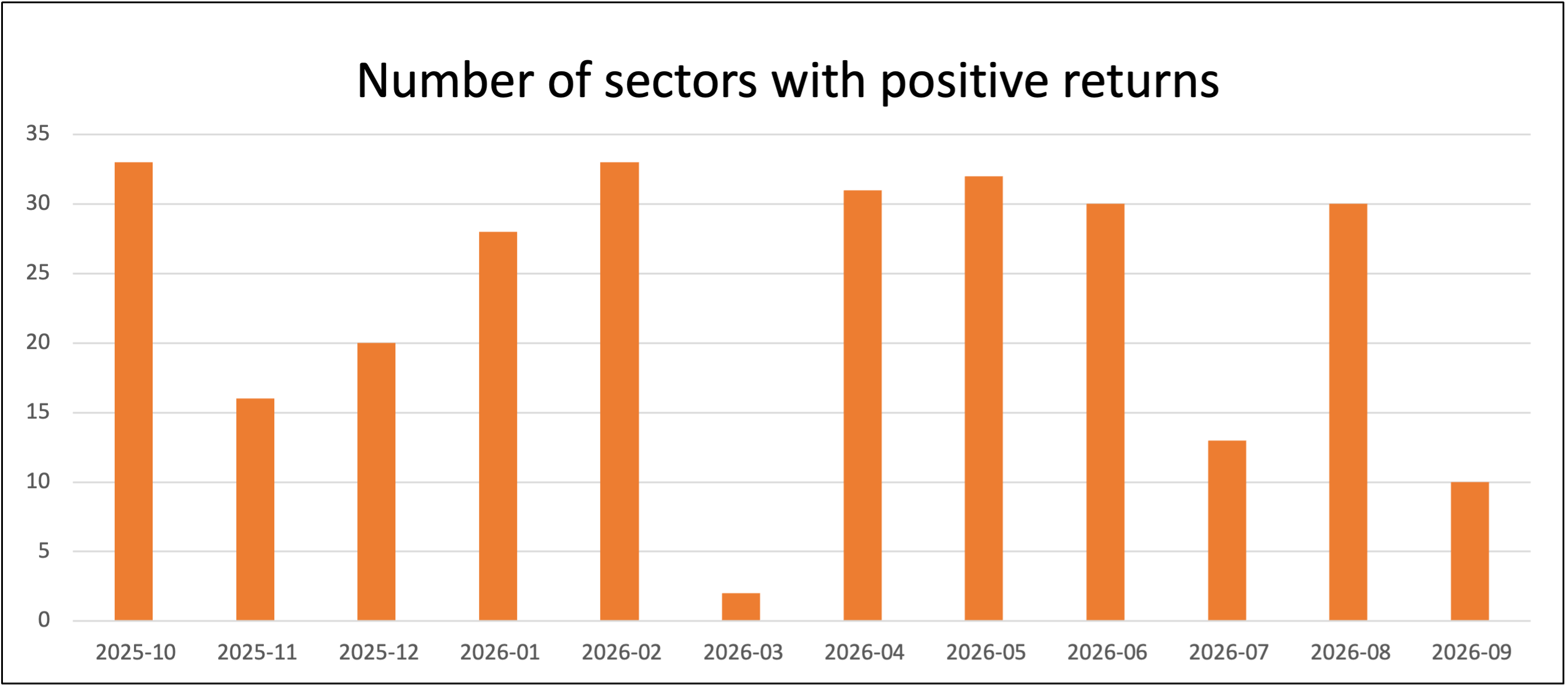
Data source: Morningstar. Past performance is not a guide to future performance.
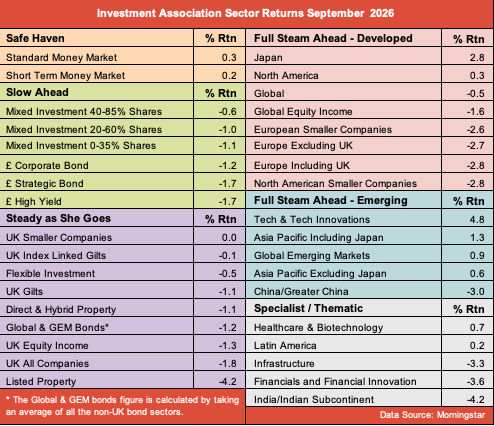
Despite the general downturn, there were still some notable successes in September. Technology & Technology Innovation was the best-performing sector, rising by 4.8%, while Japan gained 2.8%. Several Asian and emerging market sectors also made headway.
Past performance is not a guide to future performance.
However, most sectors went backwards. That included all the bond sectors in our “Slow Ahead” and “Steady as She Goes” groups.
For many investors, that may seem surprising. Bonds are traditionally seen as one of the safer parts of the investment world and can be particularly attractive to people looking for a steady income.
At its simplest, a bond is an IOU.
A government or company borrows money from investors and agrees to pay them interest for a set period. In most cases, the interest payments are fixed, and when the bond reaches the end of its term the original amount borrowed is repaid, assuming the issuer is able to do so.
For somebody buying an individual bond and holding it until maturity, that can provide a fairly predictable stream of income. However, bond funds work slightly differently.
Rather than owning one bond and waiting for it to mature, a bond fund will normally hold a large portfolio of different bonds. Some will mature and be replaced, while others may be bought and sold by the fund manager. Their prices are determined by the secondary bond market and can move up and down from day to day.
One of the most important influences on those prices is the level of interest rates and the yields available from newly issued bonds.
Bond prices and bond yields move in opposite directions. If interest rates rise and new bonds start offering more attractive returns, older bonds paying lower rates become less appealing. Their prices usually have to fall to compensate.
For example, imagine an existing bond paying 4% a year. If similar new bonds suddenly become available offering 5%, investors are unlikely to pay the same price for the older bond. Its market price will tend to fall until the return available to a new buyer becomes more competitive. The reverse can also happen. If interest rates fall and new bonds only offer 3%, an existing bond paying 4% becomes more attractive and its price can rise.
That relationship was particularly important in September. Bond yields rose as investors became more worried about inflation, with higher energy prices adding to the pressure. This reduced expectations of near-term interest rate cuts and pushed bond prices lower.
This is why bond funds can fall in value even though bonds are generally regarded as less volatile than equities.
At Saltydog Investor, several of the bond sectors sit in our lower-risk Slow Ahead group. £ Corporate Bond fell by 1.2% in September, while Sterling Strategic Bond and Sterling High Yield both dropped by 1.7%. There were also falls in our Steady as She Goes group, with UK Gilts down 1.1% and UK Index Linked Gilts slipping by 0.1%.
- Ian Cowie: my winners and losers in Q3
- Sign up to our free newsletter for investment ideas, latest news and award-winning analysis
There are considerably more IA bond sectors today than there used to be. In 2021, the IA replaced its old Global Bonds sector with a much larger number of more tightly defined sectors. The aim was to make it easier to compare similar funds, taking account of differences such as whether they invest in government or corporate debt, the level of credit risk, and the currency in which the bonds are issued.
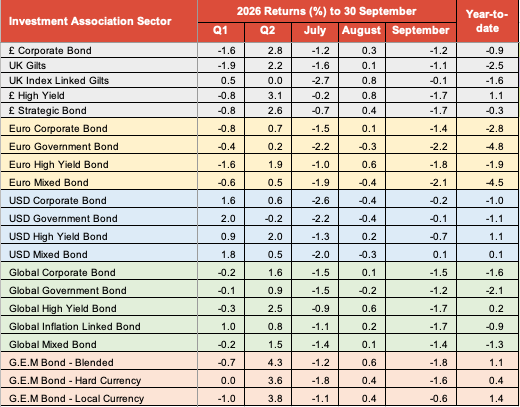
At Saltydog, we normally combine several of these overseas bond sectors into our own Global & Global Emerging Market (GEM) Bonds sector. This keeps our regular analysis manageable and makes it easier to see the broader trends. However, from time to time we split them back out, as we have done in the table below.
Data source: Morningstar. Past performance is not a guide to future performance.
The September figures show just how widespread the falls were. Of the 21 bond sectors, 20 went down during the month. The only exception was USD Mixed Bond, which edged up by just 0.1%.
Looking back through the year, Q2 was generally stronger than Q1, but conditions changed sharply over the summer. In July, all 21 bond sectors went down. August brought some improvement, before another broad downturn in September.
By the end of September, 14 of the 21 bond sectors were showing losses for the year to date. Euro Government Bond was down 4.8% and Euro Mixed Bond 4.5%. There were some exceptions. GEM Bond - Local Currency was up 1.4%, while Sterling High Yield and GEM Bond - Blended had both gained 1.1%.
Historically, bond funds have tended to be less volatile than equity funds and can still be useful for investors looking for income or diversification. However, lower risk doesn’t mean no risk, and September provided a useful reminder that bond funds can still fall when conditions in the wider bond market move against them.
For more information about Saltydog, or to take the two-month free trial, go to www.saltydoginvestor.com
These articles are provided for information purposes only. Occasionally, an opinion about whether to buy or sell a specific investment may be provided by third parties. The content is not intended to be a personal recommendation to buy or sell any financial instrument or product, or to adopt any investment strategy as it is not provided based on an assessment of your investing knowledge and experience, your financial situation or your investment objectives. The value of your investments, and the income derived from them, may go down as well as up. You may not get back all the money that you invest. The investments referred to in this article may not be suitable for all investors, and if in doubt, an investor should seek advice from a qualified investment adviser.
Full performance can be found on the company or index summary page on the interactive investor website. Simply click on the company's or index name highlighted in the article.