5 smart steps to navigate pre-Budget uncertainty
Rumours about what policy reforms the government might reveal on 28 October are starting to pick up. Craig Rickman explores how investors can manage the speculation.
12th August 2026 13:50
by Craig Rickman from interactive investor
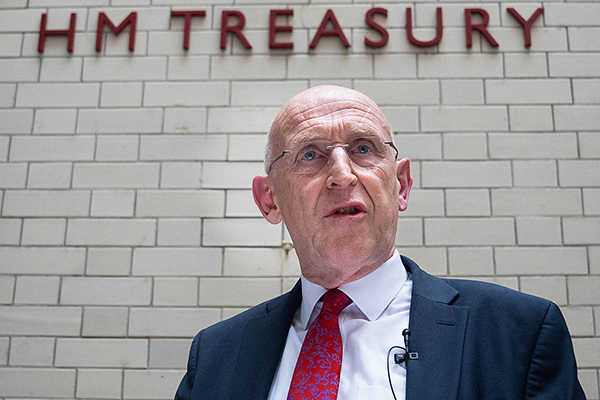
Chancellor John Healey addressing staff at HM Treasury in London last month. Photo: Stefan Rousseau/POOL/AFP via Getty Images.
It’s becoming a deeply unwanted annual ritual.
Pre-Budget speculation about what’s inside the chancellor’s red box is far from a novel theme, but rumours during the current parliament has hit extraordinary and damaging levels.
Before the Autumn Budgets held in 2024 and 2025, reports about punishing tax hikes and policy changes ran wild, leaving few stones unturned in the pension and wealth tax systems.
- Our Services: SIPP Account | Stocks & Shares ISA | See all Investment Accounts
The government’s move to a single fiscal event every year, downgrading the Spring Statement to a forecast, was designed to improve consumer confidence, yet the opposite has occurred. It’s given the uncertainty more time to breathe.
There are some key differences this time around, notably we have a personnel shake-up at the government’s helm. Prime Minister Andy Burnham is yet to warn of a “painful” Budget, a comment made by his predecessor in 2024 that jolted the rumour mill into overdrive.
That said, Chancellor John Healey has confirmed that this year’s Budget will take place on Wednesday 28 October, and waves about possible tax hikes have already begun to ripple. Some economists have warned Healey may need to raise around £25 billion to fund the government's spending pledges. While one would hope the speculation is less extreme this time around, things will inevitably pick up as the event draws closer.
Taxpayers are familiar with the drill by now: turn down the noise and resist making hasty moves based on what might happen. But this can be easier said than done, especially when the rumours arrive thick and fast, and home in on areas that directly impact your specific circumstances.
So, how can you steady yourself and make sure you react in the right way?
Let’s break it in five steps.
1) Look beyond the headlines
Not all speculation is created equal. There’s a big difference between policy ideas that the current government can viably entertain and those that are far-fetched.
According to a recent headline, Andy Burnham is being urged to raise the top rate of income tax to 52%, a suggestion from Bright Blue, a right-centre think tank.
This was one proposal within a wider piece of research that’s a hefty 336 pages long, which focuses on improving the framework for self-employed workers on low incomes. One way to achieve this, Bright Blue claims, is to reform the national insurance (NI) regime, which could be funded by increasing income tax rates across the various bands.
Essentially, the think tank advocates bringing the level of tax on employees back to what it was before NI rates were cut a few years ago.
- How the experts would invest a SIPP at every life stage
- Pension age to rise? How you can still retire on your terms
- How to prepare for tax grab on cash returns
To be clear, this is purely a suggestion on how to reform public policy rather than a clear signal of what’s on the table. There’s nothing to suggest the government is considering Bright Blue’s proposal or will take the concept on board. We can expect to see more proposals surface from think tanks and other organisations over the next couple of months.
In any case, if Healey sticks to Labour’s manifesto pledge not to increase the headline rates of income tax, NI and VAT during this parliament, which he confirmed he will, such a radical policy is out of the question.
As such, the message here is that, whenever you encounter a pre-Budget tax reform headline, the best response is to take a step back and weigh up whether it could plausibly come to pass later this year.
2) Consider the speed reforms realistically could take effect
Some of the recent nervousness has not necessarily been about whether things will change at the Budget. Rather, it’s that any reforms will take effect immediately, giving investors no time or scope to react.
The decision to hike the headline rates of capital gains tax (CGT) without notice will have done little to assuage investor fears that the same tactic could be adopted in other areas of the tax system at future Budgets – notably pensions.
We should note, however, there’s a marked difference between bumping up wealth tax rates and implementing complex retirement policy reform.
Take the pension tax-free cash saga, for example. If you knew that any cuts to the maximum you can draw from your pensions without paying tax would take either a few months or a couple of years to be introduced, your inclination to act before the Budget would ease dramatically; perhaps even disappear. You might condemn the prospect of a stingier tax-free sum, but you almost certainly wouldn’t make any panic decisions before any change was announced.
As you may recall, a few months before the 2024 Budget, the Fabian Society, a left-wing think tank, recommended a slew of controversial pension tax changes. This included bringing most pensions into the scope of inheritance tax (IHT) and cutting the maximum tax-free cash from £268,275 to £100,000.
We now know that the IHT change was announced later that year and will be introduced in April 2027. The reforms proved far from popular, but the two-and-a-half year breathing space means those affected have had time to digest the policy and start to rejig their affairs. The IHT changes to farms, businesses, and AIM shares took 18 months to enact.
- How ISA tax rules are changing from April 2027
- What you need to know about upcoming salary sacrifice changes
- Pension tax-free cash: do you have a plan for yours?
We also know that the tax-free lump sum was spared, and survived last year’s Budget too, despite the rumours resurfacing.
Speculation about reforms to pension tax emerge before every Budget, but there are no concrete signals to suggest it’s on the cards for this year’s event. Even if this does come to pass, history tells us changes don’t usually take effect overnight. The cuts to salary sacrifice announced last year, which will be introduced in April 2029, offer the most recent example.
A further and crucial consideration when taking tax-free cash from your pension is that it’s an irreversible decision. Unlike most other financial transactions, there’s no 30-day cooling off period. You couldn’t draw your tax-free lump sum before the Budget, wait to see what’s unveiled, then reverse your decision if nothing changes. Anecdotally, some people who acted in this area before previous Budgets lived to regret their decision.
3) Only react with your long-term future in mind
Let’s revisit the 2024 increases to CGT, a situation that illustrates one of the challenges when it comes to managing pre-Budget speculation.
Mooted CGT hikes dominated the money pages ahead of Labour’s first Budget since regaining power. At their most extreme, it was believed rates could be equalised with the income tax system, vaulting the top rate to 45%. The government ultimately opted for a tamer hike, particularly at the top end, nudging up the basic and higher rates from 10% to 18% and 20% to 24%, respectively.
Although as mentioned above, the big story was that the increase took effect straight away - investors were afforded no window to capitalise on the lower rates.
Speculation about CGT rates going up have returned for this year’s Budget, although the strength of these rumours is unclear. But as a recent development in Scotland starkly underlined, raising tax rates doesn’t always lead to higher revenues as it can spark a change in consumer behaviour. As CGT is only payable when you sell or transfer an asset, investors could put disposals on the back burner in the hope that rates will revert in the future, tempering expected revenue.
- How to protect your retirement from a stock market crash
- Sign up to our free newsletter for investment ideas, latest news and award-winning analysis
- How to smoothly transition your investment portfolio into retirement
A tricky decision for investors holding assets that are liable to CGT – like shares held outside pensions and individual saving accounts (ISA) and second homes – might be whether to sell now or risk facing higher rates later this year. And let’s face it, while there’s nothing to suggest CGT rates will rise in October, we can reasonably assume they won’t reduce.
The is an area where it’s vital to make decisions with your long-term future in mind. For instance, if you planned to sell some shares within the coming months for whatever reason, acting before the Budget to avoid the prospect of higher taxes is unlikely to cause any harm.
By contrast, if you intended to retain the asset for several years and are purely looking to sell now to lock in the current rates in fear they’ll go up, that may be best avoided.
4) Use it as an opportunity to review your finances
It’s hard to take the positives from frenzied pre-Budget uncertainty. Recent history shows it increases the risk of people making knee-jerk moves that could potentially inflict lasting damage.
Yet, if we were to root around for any silver linings, with money and tax in the spotlight it can spark the motivation to give our finances they attention they need to lift them to a firmer footing.
There are plenty of positive steps you can take over the next couple of months, no matter what happens at the end of October. Making the most of your annual ISA and pension allowances, using any tax-free exemptions that are relevant to your personal goals, and drawing up a plan for how best to draw your pensions will rarely fail to be smart moves.
While the tax system and pensions and savings landscape will always evolve, the principles for sound financial planning remain constant. You can’t control how the government reshapes the UK’s fiscal framework, but you can control the financial choices you make, both before and after annual Budgets.
5) Take expert advice
As peppered throughout this article, most of the time doing nothing and waiting until after the event is the safest tactic, basing big decisions squarely on the current set of rules. However, if you’re especially concerned about what to do between now and 28 October, to calm any pre-Budget nerves it can be wise to seek expert advice.
No one has a crystal ball, but financial planners can look at your specific situation and use sophisticated modelling tools to calculate the potential pros and cons of taking certain action before Chancellor Healey steps up to the despatch box later this year.
These articles are provided for information purposes only. Occasionally, an opinion about whether to buy or sell a specific investment may be provided by third parties. The content is not intended to be a personal recommendation to buy or sell any financial instrument or product, or to adopt any investment strategy as it is not provided based on an assessment of your investing knowledge and experience, your financial situation or your investment objectives. The value of your investments, and the income derived from them, may go down as well as up. You may not get back all the money that you invest. The investments referred to in this article may not be suitable for all investors, and if in doubt, an investor should seek advice from a qualified investment adviser.
Full performance can be found on the company or index summary page on the interactive investor website. Simply click on the company's or index name highlighted in the article.