AGM alert: Vodafone, United Utilities, SSE
The mobile phone firm’s shares are to determine a bigger chunk of CEO variable pay after the FTSE 100 company unveiled plans for a growth-focused incentive scheme.
26th June 2026 10:25
by Graeme Evans from interactive investor
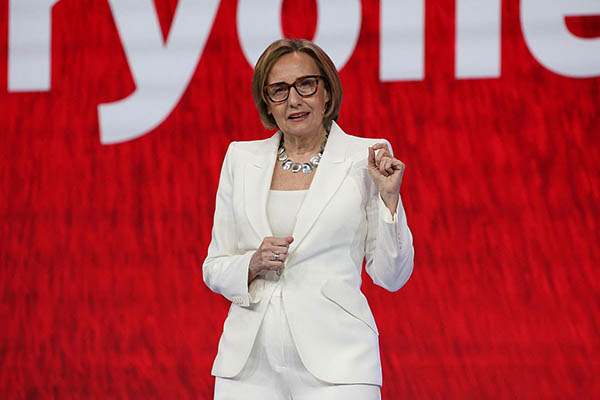
Vodafone’s CEO Margherita Della Valle on stage during the Mobile World Congress on 2 March in Barcelona. Photo: Lluis GENE/AFP via Getty Images.
Vodafone shares are to determine a bigger chunk of CEO Margherita Della Valle’s variable pay after the mobile phone giant unveiled plans for a growth-focused incentive scheme.
- Our Services: SIPP Account | Stocks & Shares ISA | See all Investment Accounts
The proposed market value share options in relation to 30% of long-term incentives have no performance metrics apart from the need for shares to move above their exercise price.
Della Valle’s maximum opportunity under Vodafone Group (LSE:VOD)’s new three-year remuneration policy is £12.04 million, rising to £14.17 million when including 50% uplift in the value of the long-term incentives and 50% growth beyond the exercise price for the options.
The company said the changes strengthened alignment between management and shareholders, as well as supported the group’s ability to attract and retain high-calibre talent within the technology sector and in markets beyond the UK.
Vodafone’s new remuneration policy is subject to a vote of shareholders at the company’s AGM at the end of July.
Vodafone
When: 10.30am, Monday 27 July.
Where: Storey Club, Paddington Central, 4 Kingdom Street, London, W2 6BD.
How to participate: A live webcast will be available, with shareholders also able to submit questions as long as these are received by 6.30 pm on Thursday, 23 July. The deadline for proxy voting instructions is 10.30am, Wednesday 22 July. More AGM details can be found here.
Who’s in the chair? Jean-François van Boxmeer, who spent 15 years as chief executive of Heineken, was appointed in November 2020.
How did the company do in the year to 31 March? Total revenue increased 8% to 40.5 billion euros (£35.1 billion), reflecting the impact of organic service revenue growth of 5.4% and the consolidation of Three UK. Adjusted earnings rose 3.8% to 11.4 billion euros (£9.9 billion), or by 4.5% on an organic basis. A dividend of 2.3625 eurocents is due to be paid on 30 July, increasing the total for the year by 2.5% to 4.6125 eurocents. The sterling conversion will be determined by the exchange rate on 23 July
How have shares performed? Up 55% to 113.3p (104.95p on Thursday).
How much is the boss paid? Margherita Della Valle got a total of £10.1 million in relation to 2025/26, up from £4.8 million the year before and the largest sum for the CEO’s role in the past decade. The latest figure included cash and deferred shares worth £1.67 million after the annual bonus scheme paid 64.5% of the maximum opportunity. The 70% vesting of long-term incentives contributed £6.1 million, with 40% of this figure attributable to share price appreciation over the period, and a further £874,000 relating to dividends that would have been paid over the three years. A 3% increase on 1 July will take Della Valle’s salary to £1.33 million.
How was variable pay determined? The annual bonus scorecard featured four growth-focused measures, including service revenue and adjusted earnings. Customer-focused metrics accounted for the rest. Three-year adjusted free cash flow performance resulted in 100% vesting for this part of the long-term incentive scheme. There was no vesting under the metric for relative total shareholder return as the result was below the median of the peer group.
What’s in the new remuneration policy? Market value share options (MVSO) will replace a portion of the long-term incentive plan but with no increase to the overall variable incentive opportunity for executive directors. The MVSOs will be equivalent to 30% of the maximum long-term incentive opportunity level, with options set to vest three years after grant and remain exercisable for a further seven years. The maximum annual bonus opportunity remains 200% of salary, with the face value of long-term incentives at award totalling 500% and now split 350% for the existing plan and 150% for the MVSOs.
How will MVSOs operate? The ultimate value realised will depend on share price growth above the exercise price. Whilst this award has no explicit performance metrics, the nature of options where value can only be derived if the share price improves acts as a performance condition.
Why the change? A growth-focused incentive strengthens alignment between management and shareholders. In addition, share options support the group’s ability to attract and retain high-calibre talent, particularly within the technology sector and in markets beyond the UK.
What’s the opportunity for the CEO? The maximum scenario is £12.04 million, rising to £14.17 million when including 50% uplift in the value of the long-term incentive award and 50% growth beyond the exercise price in the case of MVSO awards.
How did last year’s AGM go? The annual remuneration report was approved with 97.65% of votes in favour. The last binding vote on the remuneration policy took place at the 2023 AGM and received 95.18% support.
How’s the company doing on diversity? The gender split of the board is 54% female, including two senior roles. Two members of the board are from an ethnic minority background.
United Utilities
When: 11am, Friday 17 July.
Where: Dovestone Conference Centre, Lingley Mere Business Park, Lingley Green Avenue, Great Sankey, Warrington WA5 3LP.
How to participate: The company is opting for an in-person meeting as very few shareholders used electronic links on the two previous occasions they were provided. Proxy votes must be received by 11am on Wednesday 15 July. More AGM details can be found here.
Who’s in the chair? David Higgins, who is the former chief executive of Network Rail and Olympic Delivery Authority, was appointed in January 2020.
How did the company do in the year to 31 March? Underlying revenue increased 20% to £2.6 billion, reflecting higher regulatory revenues. Underlying operating profit lifted 35% to £1.06 billion and earnings per share by 42% to 107.1p. Capital investment increased 41% to £1.5 billion, with regulatory commitments achieved on time in the year. Operationally, 80% of key performance metrics were improved during the year. A final dividend of 35.78p a share is due to be paid on 3 August, increasing the total for the year by 3.5% to 53.66p a share.
How have shares performed? Up 30% to 1,315p (1,299p on Thursday). On 30 April, more than 60 million new shares were issued at a price of 1,312p in order to raise £800 million towards £2.5 billion of incremental investment in the five-year AMP8 regulatory cycle up to 2030. The move ensures the company is fully funded for the upgraded £11.5 billion programme, while maintaining gearing within the 55-65% target range.
How much is the boss paid? Louise Beardmore got £2.5 million in 2025/26, up from £1.4 million as no bonus was permitted the previous year. This year’s annual bonus was £830,000 based on 76.6% of the maximum opportunity, while the 61.2% vesting of long-term incentives contributed £712,000. Her annual salary of £870,000 is due for review later this year.
What’s different about this year’s remuneration arrangements? Recognising that water industry pay is a contentious matter of public interest, the board has said that none of the pay received by executive directors will be paid for by customers. This goes beyond its previous commitment that customers would not pay for performance-related outcomes.
- What a Burnham premiership could mean for your long-term wealth
- Trading Strategies: an overlooked FTSE 100 stock to consider
How was variable pay determined? Stretch targets were achieved in seven out of the 13 measures in the annual bonus scorecard. These included underlying operating profit, as well as the outcomes for sewer flooding incidents and storm overflow activations. The vesting outcome on long-term incentives granted in 2023 was based 50% on return on regulated equity and the rest on a basket of customer and environmental measures.
What happened to last year’s bonus? The bonus outcome of 44.8% of maximum was subject to Ofwat’s new pay prohibition rule, the final details of which had not been published by the time the 2025 annual report was signed off. A breach at one of the company’s water reservoirs in 2024 meant the CEO’s previously disclosed bonus of £417,000 was reduced to nil.
Why is the remuneration policy being updated after only a year? The timing of Ofwat’s final determination for AMP8 meant the remuneration committee decided to roll forward the existing policy broadly unchanged at last year’s AGM. However, it now needs to ensure that it has a policy in place that reflects the scale and ambition of the new five-year regulatory period and the level of risk involved which is substantially different from all previous AMPs.
What’s changing in the policy? United Utilities Group Class A (LSE:UU.) is planning the introduction of an AMP8 allowance for executive directors, payable in shares. It has been set at £435,000 a year for the CEO and £280,000 a year for the CFO, fixed for the duration of AMP8. Their maximum bonus opportunity has been reduced to 100% of salary from 130% previously and to 175% of salary for the long-term incentives plan compared with 200% in the current policy.
Why the AMP8 allowance? United points out that AMP8 is significantly larger than previous regulatory plans, with record investment and major environmental programmes focused on improving river health and reducing storm overflow activations. It believes the allowance will have a retention effect because it provides a degree of certainty for the executives, while ensuring long-term alignment with shareholders.
What’s the maximum opportunity? Under the revised policy, over 62% of remuneration will be performance-related and over 56% will be delivered in shares which must be held for the long term. The CEO’s maximum opportunity is £3.8 million, rising to £4.6 million in the event that this is accompanied by 50% share price growth. Mid-performance will realise £2.6 million.
What’s the remuneration committee say? “We recognise that the proposals are somewhat unusual in the context of UK-market norms but believe that the unique circumstances which our sector faces (including competing stakeholder priorities and an ever-evolving regulatory environment) warrant adoption of a tailored approach.”
How did last year’s AGM go? The three-year remuneration policy was approved with 99.41% of votes in favour, while the annual remuneration report got 99.43% support.
How’s the company doing on diversity? The gender split of the board is 45% female, including one senior role. One director is from a minority ethnic background.
SSE
When: 12.30pm, Thursday, 16 July.
Where: Perth Concert Hall, Mill Street, Perth PH1 5HZ and virtually.
How to participate: Those shareholders joining online will be able to watch the meeting, ask questions, and vote in real time. Proxy voting instructions should be returned by no later than 12.30pm, Tuesday 14 July. More AGM details can be found here.
Who’s in the chair? Former BP executive John Manzoni was appointed in April 2021.
How did the company do in the year to 31 March? A record year for capital investment worth £3.6 billion was driven by spending on regulated electricity networks, with lower deployment of capital across the other businesses and no acquisitions. Adjusted earnings per share of 153.5p fell 5% but was towards the upper end of guidance in the face of mixed weather conditions and a complex operating environment. A final dividend of 47.3p is due to be paid on 17 September, lifting the payment for the year by 7% to 68.7p.
How have shares performed? Up 63% to 2,595p (2,419p on Thursday).
How much was the boss paid? Martin Pibworth got a total of £3.8 million, including three and a half months as chief commercial officer prior to his CEO appointment in July last year. The annual bonus scheme contributed £1.27 million based on 85% of the maximum opportunity, while the 63% vesting of long-term incentives was valued at £1.48 million.
- DIY Investor Diary: how I mix tech and dividends
- Sign up to our free newsletter for investment ideas, latest news and award-winning analysis
How was variable pay determined? Overall variable pay rose by 17% compared to last year. Payouts from the annual bonus scheme were broadly in line with the previous year and were based on targets of adjusted earnings per share, cashflow and operational performance, as well as personal objectives and sustainability indices. Total shareholder return performance, which accounts for half the award under the long-term incentives scheme, was around the 70th percentile against both the FTSE 100 Index and a European utilities peer group. The value of these awards were boosted by a 33% increase in share price over the three-year period.
What about this year’s pay? Pibworth’s base salary has increased to £1.05 million, up 15% from £970,000 as part of the phased approach agreed on appointment as chief executive. Under policy changes approved at last year’s AGM, the CEO’s maximum opportunity under the annual bonus scheme has increased from 175% to 200% of base salary. The maximum under the long-term Performance Share Plan has risen from 275% to 300% of base salary.
What about the former boss? Alistair Phillips-Davies retired last July after 28 years at the group, including 12 as chief executive. He was treated as a good leaver for the purpose of outstanding share awards under the long-term incentive scheme. He received a total of £2.9 million in relation to 2025/26, including an annual bonus of £406,000 and £2.1 million from the vesting of long-term incentives.
How did last year’s AGM go? The three-year remuneration policy was approved with 97.22% of votes in favour, while the annual remuneration report got 98.40% support.
How’s the company doing on diversity? The proportion of women on the board was 45.5% at the end of the financial year, including the role of senior independent director. Two directors are from an ethnic minority background. SSE (LSE:SSE) said its median gender pay gap was broadly stable at 11.9%, having fallen from 18% in 2022.
These articles are provided for information purposes only. Occasionally, an opinion about whether to buy or sell a specific investment may be provided by third parties. The content is not intended to be a personal recommendation to buy or sell any financial instrument or product, or to adopt any investment strategy as it is not provided based on an assessment of your investing knowledge and experience, your financial situation or your investment objectives. The value of your investments, and the income derived from them, may go down as well as up. You may not get back all the money that you invest. The investments referred to in this article may not be suitable for all investors, and if in doubt, an investor should seek advice from a qualified investment adviser.
Full performance can be found on the company or index summary page on the interactive investor website. Simply click on the company's or index name highlighted in the article.