What a Burnham premiership could mean for your long-term wealth
Keir Starmer’s departure appears to have paved the way for the new Makerfield MP to become prime minister. So, what do we understand about his potential policies that could impact your investments and retirement?
25th June 2026 11:33
by Craig Rickman from interactive investor
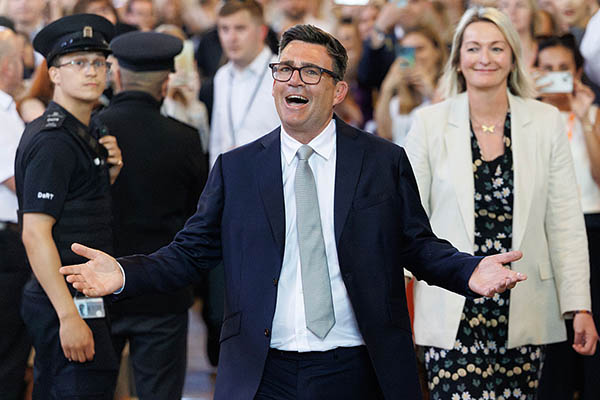
Andy Burnham, Labour MP for Makerfield, celebrates after his swearing-in at the Houses of Parliament on 22 June. Photo: Dan Kitwood/Getty Images.
The UK will soon welcome its seventh prime minister in just 10 years after Keir Starmer announced on Monday plans to stand down from his premiership after serving 717 days.
Sir Keir’s replacement is yet to be confirmed but the smart money is on new Makerfield MP, Andy Burnham, a man who’s made no secret of his designs to lead the Labour Party and the country.
- Our Services: SIPP Account | Stocks & Shares ISA | See all Investment Accounts
Burnham’s bid is strengthened by the backing from several notable MPs, including Deputy Prime Minister David Lammy, and former Secretary of State for Health and Social Care Wes Streeting.
Streeting’s decision not to challenge Burnham for the UK’s top political post might be telling. He was considered a worthy rival to the outgoing Greater Manchester mayor and is another who wants to climb the rungs of government. But it’s believed that Streeting may be posturing for the chancellor of the exchequer gig, on the assumption and indeed likelihood that Rachel Reeves will be replaced by the new prime minister as part of a cabinet rejig. Despite this, Reeves has endorsed Burnham’s bid.
According to reports, former Labour leader Ed Miliband has designs on becoming chancellor, but ministers are wary about the risks involved, specifically to businesses.
There is of course no guarantee that Burnham will grab the keys to Number 10. Nominations to launch a leadership campaign open on 9 July, affording time to any willing opponents to drum up the required support from fellow MPs. Al Carns, Labour MP for Birmingham Selly Oak, is apparently ready to throw his hat into the ring, although Darren Jones, the chief secretary to the prime minister and another figure previously understood to be keen, has ruled himself out. If no opponents emerge, Burnham could become prime minister as soon as 17 July.
In any case, it’s worth examining the potential policies from the two frontrunners for prime minister and chancellor, Burnham and Streeting, and unpack the possible impact on your long-term wealth.
Honouring the fiscal rules
Burnham has reportedly committed to Reeves’ self-imposed fiscal rules, the main one of which, the stability rule, dictates tax receipts and other revenues must cover day-to-day spending by 2029-30. Some headroom is available, but only £9.9 billion, which isn’t a huge amount given the Treasury pockets around £1 trillion in tax annually.
At the most recent fiscal event, held in November last year, the chancellor unleashed a package of measures that beefed up its fiscal margin, claiming earlier this year that it stood at £23.7 billion, providing a cushion against higher spending or borrowing. But there are concerns the headroom may have been squeezed over the past few months with the energy shock pushing up government debt costs.
Many have warned that Burnham must be clear about his tax and spending plans to avoid unsettling the bond markets.
CGT to enter the firing line again?
A controversial policy that Streeting has recently trailed is equalising rates of capital gains tax (CGT) with income tax, a move that would shunt the top bracket of CGT to 45%, the highest in Europe.
Back in May, he described the policy as a “wealth tax that works”, adding that it could rake in an extra £12 billion a year for the Treasury.
Those calculations, however, might be ambitious.
The notion that higher headline tax rates equate to equally large receipts doesn’t always stack up. CGT is only payable when you dispose (sell, gift, transfer) of an asset, so investors often cling on to them in the hope that rates will revert in the future. An additional consideration here is that lower CGT rates tend to encourage investment, helping to boost economic growth, something the country and the government badly needs.
- How to make early retirement a possibility
- Tax on cash but money market funds spared in ISA rule change
While CGT revenues dwarf in comparison to those garnered from other levies like income tax and national insurance (NI), they still make a meaningful contribution to the public purse. At the October 2024 Budget, Reeves jacked up the headline rates on sales of shares and other assets to 18% and 24% in the basic and higher brackets, respectively, equalising them with rates on second homes.
Meddling with the CGT framework wouldn’t find favour with investors, who in addition to facing stiffer rates have also seen the annual exemption hacked from £12,300 to £3,000, leaving less scope to shield profits from HMRC. Another thing to bear in mind is that CGT hikes can take effect immediately, as was illustrated just a couple of years ago, running the risk of investors seeking to sell off assets ahead of this year’s fiscal event should the rumour mill gather pace.
A feature that could make CGT reform more palatable would be to implement some kind of taper relief or indexation - like the systems that operated between 1982 and 2008 – to at least protect gains from inflation. But Streeting hasn’t mentioned that thus far.

Wes Streeting (left) has said he will support Andy Burnham rather than pursue a leadership bid himself. Credit: Leon Neal/Getty Images and Christopher Furlong/Getty Images.
Reforming income tax
On a positive note, Burnham said on a recent Question Time panel that he would consider raising the personal income tax allowance to support working people. This has been frozen at £12,570 since 2021-22 and is set to remain at that level until 2030-31, dragging more lower earners into the tax net.
However, when Burnham’s Makerfield campaign team was quizzed in May about its views on Labour’s manifesto pledge not to raise income tax, national insurance (NI) and VAT on working people, they were non-committal. But it’s understood he has since backed the promise.
If Burnham’s past comments are anything to go by, one way he may offset any increase to the personal allowance is to restore the 50% income tax rate, which applied on annual earnings above £150,000 between 2010 and 2013. For the past 13 years, the additional rate has been 45% but now kicks in once income exceeds £125,140.
Jacking up the top rate of income tax in England and Wales would be another hit to six-figure earners, who are already seeing take-home pay squeezed by frozen thresholds, a punitive 60% effective tax rate on income between £100,000 and £125,140 due to the gradual withdrawal of the personal allowance, and the tax-free childcare cliff edge.
- How the experts would invest a SIPP at every life stage
- Sign up to our free newsletter for investment ideas, latest news and award-winning analysis
While it’s scant consolation for those potentially impacted, a 50% top rate of tax would make pension contributions more attractive for those who earn enough to land in that bracket.
Possible overhaul for inheritance tax
The Makerfield MP has previously spoken about his desire to scrap inheritance tax (IHT). Burnham said a few years ago that he would like to introduce a 10% levy across all estates to fund social care. Whatever your take on the idea, it would certainly make a fiendishly complicated IHT system simpler.
In theory, smaller estates would pay more tax, while larger estates would pay less. But it’s a bit more complicated than that. That’s because not everyone enjoys the same tax-free thresholds.
Under the current system, the first £325,000 is tax free, and if you leave a home to direct descendants, such as children or grandchildren, you can get an extra £175,000 due to the residence nil rate band. As transfer between married couples and civil partnerships are tax free, and the survivor can inherit any unused nil rate band and residence nil rate band, on the second death they could pass on up to £1 million without lumping their offspring with an IHT bill. On anything above, IHT is charged at 40%.
As such, an estate worth £1.2 million could still pay more IHT under the proposed framework.
- Is inheritance tax planning now a midlife pursuit?
- Pensions and IHT: the countdown to new tax rules has started
While the arguments for improving and simplifying the IHT framework are strong, any changes wouldn’t be straightforward or happen overnight.
Big decisions around the state pension
Burnham’s advisers are reportedly keen on axing the triple lock, a generous arrangement that uprates the state pension every year by the highest of inflation, average earnings or 2.5%.
However, Burnham has publicly pledged to keep the policy, presumably at least until the end of this parliament to honour the government’s election manifesto commitment. In any case, meddling with such a political hot potato might be best avoided in his early tenure to keep voters onside, if his leadership bid is successful, of course.
The longer-term outlook for the triple lock is less certain, with critics arguing that it’s financially unsustainable. But equally there’s a broad acceptance that the annual full state pension, which is currently £12,547, isn’t sufficient to provide the income foundation people need in later life.
- New state pension proposal highlights challenges for younger workers
- How much do you need to secure a comfortable retirement?
There’s a more pressing matter at hand for whoever becomes the new prime minister regarding the state pension. At last year’s Autumn Budget, Reeves said that people whose sole retirement income is from the state pension will not pay tax from April 2027 when the triple lock inevitably shunts the full amount above the £12,570 personal allowance.
But the current chancellor is yet to reveal the mechanics of such a policy, which despite being controversial, has obvious complications. For instance, why should people with a small amount of personal income pay tax on the state pension while those who don’t be spared?
The incoming prime minister and chancellor, should Reeves be displaced, must choose whether to push through the idea, scrap it entirely, or take a different approach. Raising the personal allowance for everyone, something that as noted above Burnham supports, is an obvious solution – although unless the figure ticks up annually would only prove a sticking plaster.
Elsewhere, Burnham has expressed his support for the WASPI (Women Against State Pension Inequality) campaign but ruled out paying compensation, which is understood to cost around £10 billion; a further blow for the women born in the 1950s who’ve campaigned hard but faced rejection after rejection.
The final point to flag on pensions, is whether a change of leadership will prompt a rethink to the wave of policy reforms as part of the Pension Schemes Act. But Torsten Bell, the current pensions minister, said yesterday at an event near Westminster that “the Labour Party are entirely committed to what is an excellent pensions reform agenda”.
These articles are provided for information purposes only. Occasionally, an opinion about whether to buy or sell a specific investment may be provided by third parties. The content is not intended to be a personal recommendation to buy or sell any financial instrument or product, or to adopt any investment strategy as it is not provided based on an assessment of your investing knowledge and experience, your financial situation or your investment objectives. The value of your investments, and the income derived from them, may go down as well as up. You may not get back all the money that you invest. The investments referred to in this article may not be suitable for all investors, and if in doubt, an investor should seek advice from a qualified investment adviser.
Full performance can be found on the company or index summary page on the interactive investor website. Simply click on the company's or index name highlighted in the article.