Bond Boss: more income and less drama - is this a smarter play?
Jonathan Mondillo outlines how to tap into higher income potential, without relying on the riskiest parts of the bond market.
14th August 2026 09:18
by Jonathan Mondillo from Aberdeen

For many investors, the bond market appears to offer a simple choice. Investment-grade bonds provide greater security, but typically lower yields. High-yield bonds offer more income potential, but with greater credit risk and larger price swings.
There is, however, a middle path.
A blended global credit strategy can combine different sources of bond income within one portfolio. The aim is not to maximise yield by taking as much risk as possible. It is to build a strong core of higher-quality credit, selectively add higher-yielding opportunities and adjust the portfolio’s overall risk as market conditions change.
- Invest with ii: Investing in Bonds | Free Regular Investing | Open a SIPP
Start with a strong credit core
Credit ratings provide an indication of an issuer’s ability to meet its financial obligations. Investment-grade ratings range from AAA to BBB, while high yield begins at BB and extends to lower-rated B and CCC issuers.
The area where BBB meets BB is often called ‘crossover credit’. This can provide an attractive foundation for a bond portfolio because BBB and BB issuers are often established businesses with access to funding and a track record of managing their operations through different economic conditions.
Their bonds typically offer higher yields than more highly rated investment-grade debt, without requiring investors to move into the weakest parts of the high-yield market, where historical defaults have been concentrated.
Over the 25 years to 30 June 2026, a hypothetical 50/50 blend of global BBB and BB bond indices delivered a cumulative return approaching that of global high yield, but with materially lower annualised volatility. Over the long term, BBB and BB issuers have experienced much lower default rates (missed debt payments) than the broader high yield market. Defaults are not a complete measure of risk, but the comparison illustrates that the relationship between yield and risk is not linear.
In simple terms, investors may be able to capture a meaningful increase in yield before reaching the most vulnerable end of the credit market.
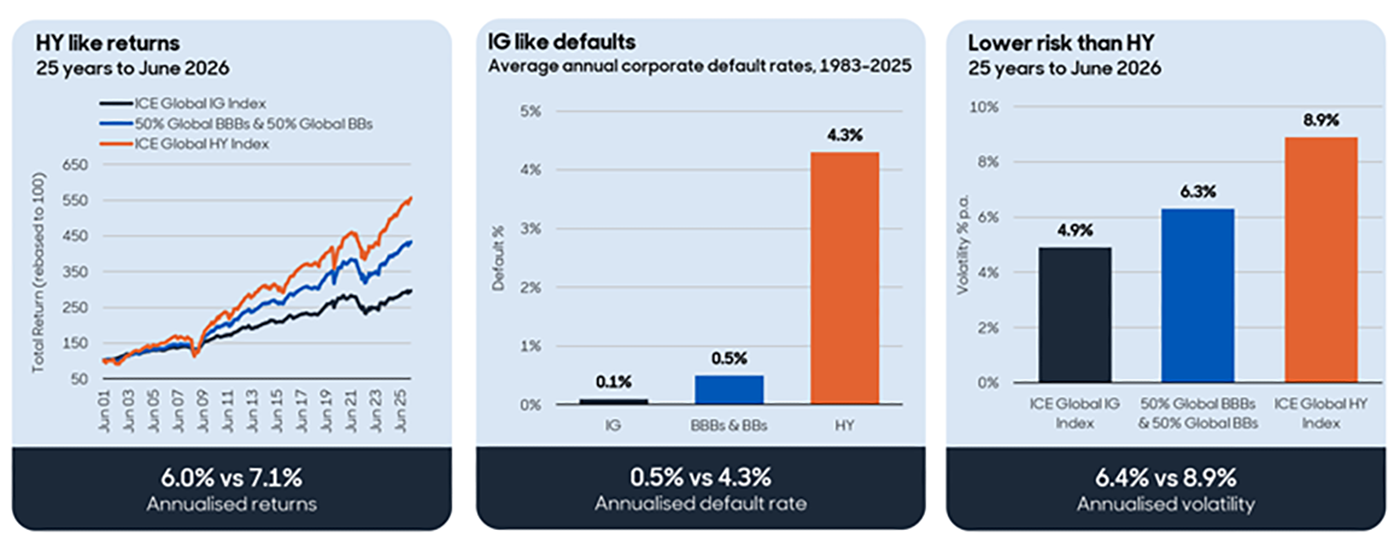
Source: Aberdeen. LHS chart – ICE indices based on USD hedged index data; middle chart – S&P Global, 2024 Annual Global Corporate Default and Rating Transition Study, 1981-2024; RHS chart – ICE indices based on USD hedged index data, 30 June 2026.
Add higher-yielding opportunities selectively
Crossover credit can provide the portfolio’s foundation, but it does not have to be the only source of return.
A flexible global strategy can also invest selectively in areas such as lower-rated corporate bonds, emerging market debt, specialist bank and insurer bonds, and corporate hybrid bonds that combine features of debt and equity. These investments can potentially increase the portfolio’s yield and return potential.
The key is to treat them as selective additions rather than allowing them to dominate the portfolio.
When prices look attractive and the underlying companies are getting stronger, it may make sense to hold more of these higher-yielding opportunities. When the additional yield appears too small relative to the risks, exposure can be reduced.
This flexibility is important. A blended global credit strategy should be able to adjust its exposures as market conditions and valuations change. Each holding must justify its place based on its yield, valuation, underlying fundamentals and contribution to overall portfolio risk.
Actively managing the risk
The balance between income and risk should not remain fixed because market conditions change. When valuations are attractive, a flexible strategy can increase exposure to higher-yielding opportunities. When the additional yield no longer provides sufficient compensation for the risks, it can take a more cautious approach.
This may involve reducing lower-quality credit or increasing exposure to cash and government bonds that are due to mature soon, to reduce the portfolio’s sensitivity to wider market weakness. The objective is not to avoid market volatility altogether, but to ensure that the risks taken remain proportionate to the potential reward.
Why going global matters
A global approach broadens the opportunity set across issuers, sectors, regions and different types of bonds, each offering its own balance of income and risk. It allows an active manager to compare similar risks across markets and invest where the potential return appears most attractive.
This matters because no single market consistently offers the best balance of yield and risk. At different points in the economic cycle, opportunities may be found in European corporate bonds, US credit, Asian issuers, emerging markets or specialist areas such as subordinated financial debt.
- 5 smart steps to navigate pre-Budget uncertainty
- Sign up to our free newsletter for investment ideas, latest news and award-winning analysis
Going global does not eliminate risk. Credit markets can become highly correlated during periods of stress, while emerging markets can be more sensitive to political developments, currency swings and changes in investor sentiment.
However, a genuinely global mandate reduces reliance on any single domestic market and creates greater scope for issuer and security selection. Detailed research can help identify the companies and individual bonds offering the most attractive balance of yield and risk, supported by a broader view of the economy, central bank policy, valuations and the credit cycle.
A more balanced source of bond income
For investors willing to accept more credit risk than a traditional investment-grade portfolio, blended global credit can potentially serve as a core allocation or as a more measured alternative to an outright high-yield investment.
The approach seeks to improve the balance between investment grade and high yield by combining a higher-quality credit core, selective sources of additional yield, broad global diversification and active control of overall market exposure.
Investors need not view bonds as a binary choice between safety and income. A carefully constructed global credit portfolio can offer a more balanced route – higher income potential, without relying on the riskiest parts of the bond market.
Jonathan Mondillo is global head of fixed income at Aberdeen.
ii is an Aberdeen business.
Aberdeen is a global investment company that helps customers plan, save and invest for their future.
These articles are provided for information purposes only. Occasionally, an opinion about whether to buy or sell a specific investment may be provided by third parties. The content is not intended to be a personal recommendation to buy or sell any financial instrument or product, or to adopt any investment strategy as it is not provided based on an assessment of your investing knowledge and experience, your financial situation or your investment objectives. The value of your investments, and the income derived from them, may go down as well as up. You may not get back all the money that you invest. The investments referred to in this article may not be suitable for all investors, and if in doubt, an investor should seek advice from a qualified investment adviser.
Full performance can be found on the company or index summary page on the interactive investor website. Simply click on the company's or index name highlighted in the article.