Bond Boss: the AI boom is coming to bond markets
Artificial intelligence has been an equity story so far. But the race to build data centres is increasingly being paid for with debt – and that makes it a bond story too.
17th July 2026 09:02
by Jonathan Mondillo from Aberdeen

For the past two years, artificial intelligence (AI) has been told almost entirely as a stock-market story: soaring share prices, eye-watering valuations and a handful of technology giants leading the charge.
Yet behind the headlines sits a quieter shift that matters just as much to investors who rely on income from their investments. The physical build-out of AI – the data centres, the power connections and the networks that make it work – costs enormous sums, and a growing share of that bill is being funded with borrowed money. That turns AI into a story for bond investors too.
- Invest with ii: Investing in Bonds | Free Regular Investing | Open a SIPP
From cash to credit
The scale is hard to overstate. The five biggest US tech companies investing in AI (“hyperscalers”) – Amazon.com Inc (NASDAQ:AMZN), Microsoft Corp (NASDAQ:MSFT), Alphabet Inc Class A (NASDAQ:GOOGL), Meta Platforms Inc Class A (NASDAQ:META) and Oracle Corp (NYSE:ORCL) – are on course to spend in the region of $600 billion (£445 billion) on infrastructure this year, the bulk of it AI-related.
Until recently, these companies funded that growth largely from their own pockets. That has changed. Data centre-related debt issuance roughly doubled to around $180 billion in 2025, according to S&P Global Market Intelligence. The hyperscalers alone sold more than $100 billion of bonds. Alphabet (owner of Google) even issued a rare 100-year sterling bond – a reminder that this is a UK story too, not just an American one.
For bondholders, this is both an opportunity and a change in the rules. For years, the market treated these AA and A-rated companies as “cash-plus” – rock-solid balance sheets that barely needed to borrow. Now they are issuing debt on a scale that forces investors to think harder about a company’s ability to repay its debts, the sheer volume of new supply of bonds, and the eventual profits on all that spending.
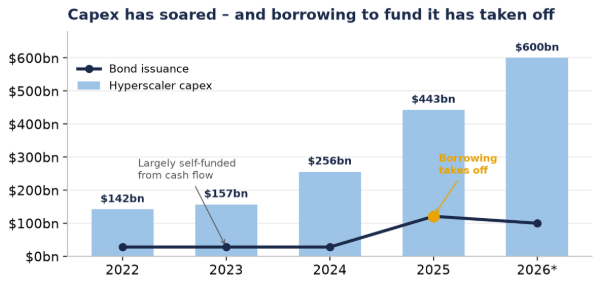
Chart 1: big-five hyperscaler capex ($bn); 2026 projected. Bond issuance averaged roughly $28 billion a year before 2025. Sources: Company filings, BofA Securities and analyst estimates.
What bond investors actually worry about
Buying a data-centre bond is not the same as buying a share from a technology company. Own the shares and you are betting on the chance that AI transforms profits. Own the bond and your best case is that you collect your regular payments and get your money back. You take the risk without the upside, so the questions you ask are different:
- Where will the electricity come from? Data centres are enormous consumers of power, and access to the energy grid can make or break a project
- Who is the tenant, and how good is their credit? Much of this debt is ultimately serviced by long-term contracts to use the space and computing capacity. The value of the bond depends on the strength of those tenants and their leases
- What if the technology moves on? If today’s computer chips are overtaken within a few years, a building financed over eight or 10 years could lose its purpose long before the debt is repaid.
These are less familiar risks – whether the project is completed on time and on budget, the quality of the tenant and the strength of the lease agreements underpinning the debt. They are closer to the questions you would ask about a toll road or a power station than about a typical corporate borrower. That is the key point: much of this is infrastructure-style debt, where the money comes from long-dated contracts and physical assets rather than a company’s day-to-day operations.
Public and private – two doors into the same theme
There are two main routes into this market, and active investment managers use both. The first is the public bond market, where the hyperscalers’ investment-grade bonds have become one of the largest single sources of new supply. The second is private credit: increasingly, data centres are financed through dedicated investment vehicles that raise money from private lenders and insurers, secured against the buildings themselves and the contracts with the technology giants that use them.
- Have delayed mega-IPOs intensified pressure on AI funding?
- Top stocks to insulate your portfolio from AI volatility
At Aberdeen, we invest in both publicly traded bonds and private credit, and we think that breadth matters. Being able to compare a stock-market-listed hyperscaler bond with a privately financed data-centre structure – and judge which offers better value for the risk taken – is exactly the kind of decision active management is for. A passive bond fund typically owns more of whoever issues the most debt; that is not the same as owning the right debt.
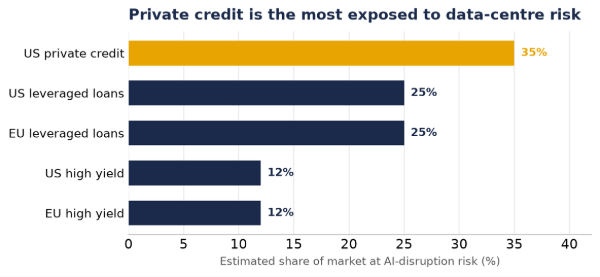
Chart 2: estimated share of each credit market exposed to data-centre and software risk (higher-case estimate). Source: Aberdeen Global Macro Research, Q2 2026 scenario analysis (data: UBS); illustrative of a downside scenario.
Where AI meets our own process
There is a neat symmetry here: the same technology reshaping the bond market is also changing how we analyse it. We use AI tools to sift far more research and market data than any team could read unaided, to identify patterns worth a closer look and, just as importantly, to challenge our own thinking – testing whether an investment idea stands up to the evidence. Used well, it does not replace judgement; it frees our analysts to spend more of their time on the decisions that genuinely add value.
In practice, it earns its keep on the everyday jobs: scanning for bonds that look cheaper or more expensive than they should be before the stock market opens; pressure-testing a broker’s pitch against our own numbers in minutes rather than hours; pulling risk and positioning across dozens of portfolios on demand; and drafting the first cut of routine research documents. In effect, it does much of the looking backwards – combing through the history and the data – so our analysts can spend more of their time looking forwards. The judgement stays with us; the legwork just gets faster.
Final thoughts…
AI is no longer only an equity story. As the build-out is increasingly financed with debt, it is opening up fresh opportunities – and fresh risks – for bond investors. The winners will not simply be those with the most “AI exposure”, but those who can tell a well-structured, well-secured bond from a fragile one. That is a job for careful, active analysis – and, increasingly, for the smart use of technology on both sides of the trade.
Jonathan Mondillo is global head of fixed income at Aberdeen.
ii is an Aberdeen business.
Aberdeen is a global investment company that helps customers plan, save and invest for their future.
These articles are provided for information purposes only. Occasionally, an opinion about whether to buy or sell a specific investment may be provided by third parties. The content is not intended to be a personal recommendation to buy or sell any financial instrument or product, or to adopt any investment strategy as it is not provided based on an assessment of your investing knowledge and experience, your financial situation or your investment objectives. The value of your investments, and the income derived from them, may go down as well as up. You may not get back all the money that you invest. The investments referred to in this article may not be suitable for all investors, and if in doubt, an investor should seek advice from a qualified investment adviser.
Full performance can be found on the company or index summary page on the interactive investor website. Simply click on the company's or index name highlighted in the article.