BT bull issues new share price target
A big chunk of this year’s rally has unwound following recent results, but one team of experts believes there’s significant upside. City writer Graeme Evans has the details.
2nd June 2026 15:35
by Graeme Evans from interactive investor

A bullish note on BT Group (LSE:BT.A) has countered the City’s bout of post-results jitters by lifting dividend forecasts and predicting a 45% upside for the widely held shares to 300p.
Berenberg analysts see scope for BT to pay a total dividend of 10p a share in relation to the 2028 financial year and 12p by 2030, which compares with the 2025-26 figure of 8.32p.
- Our Services: SIPP Account | Stocks & Shares ISA | See all Investment Accounts
The bank also lifted its target on BT shares from 250p to 300p as it factors in the rising probability that Openreach’s access business will benefit from deregulation from 2031.
The shares today stood at 203.8p, which represents a fall of 15% on their multi-year peak of 239.5p set on 11 May and compares with 231p on the eve of annual results on 21 May.
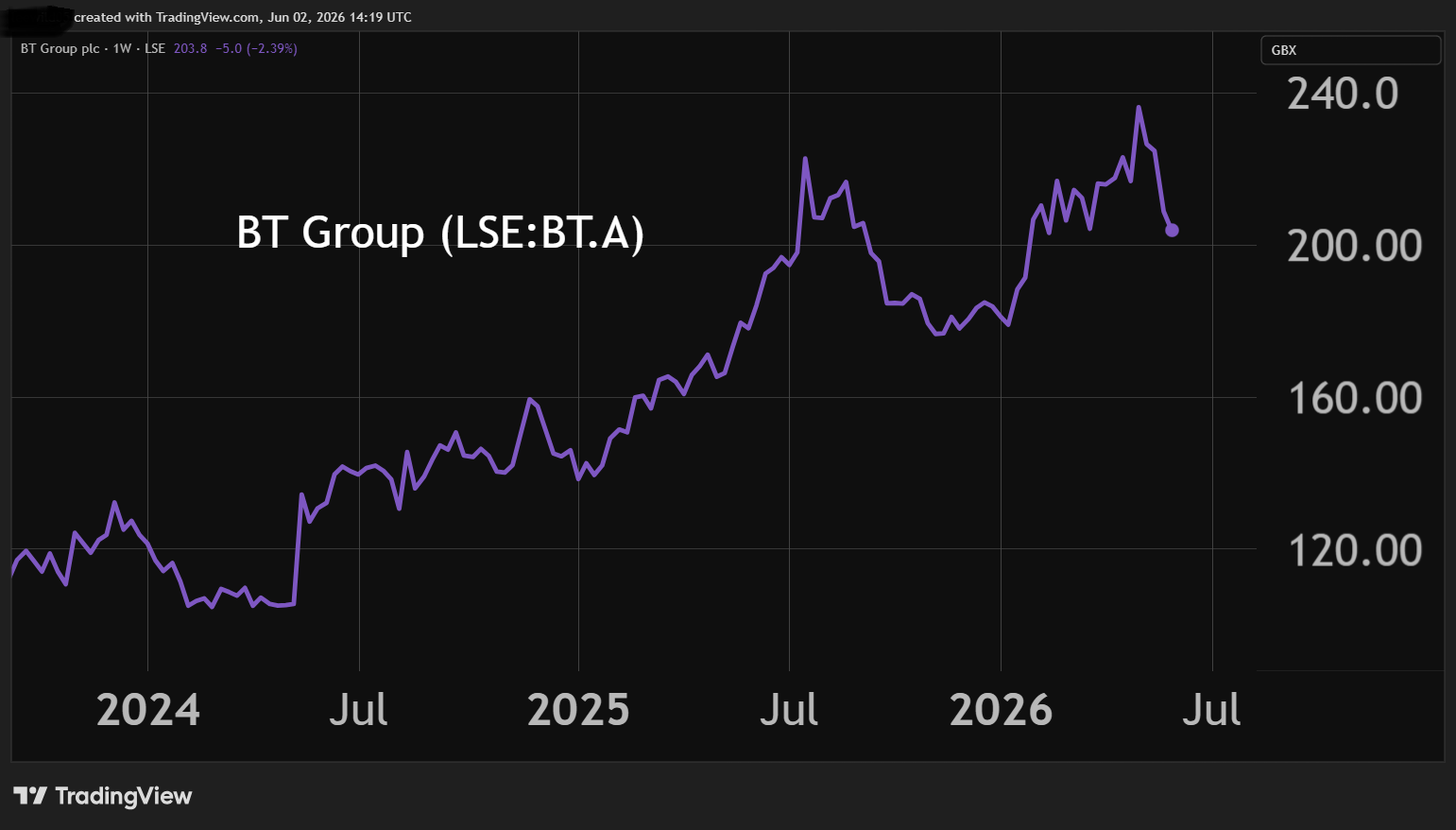
Source: TradingView. Past performance is not a guide to future performance.
Reports that the UK government would resist any move by Bharti Enterprises to increase its BT shareholding from 24.5% towards the 30% threshold have weighed on shares in recent days.
High expectations on possible free cash flow and dividend guidance in the build up to annual results were also blamed for unwinding the 37% advance of BT shares since November.
BT pushed back against some of the City’s dividend re-rating expectations when it said it intended to grow the payout by a low to mid-single digit percent in 2026-27 and onwards until its financial metrics were consistent with a BBB+ credit rating.
It said that residual cash flow will then be available for enhanced distributions.
Shareholders got a total of 15.4p in the 2018-19 financial year before the payout was cut completely during Covid and then restored with the award of 7.7p in 2021-22.
- City reacts to BT’s new dividend policy
- Sign up to our free newsletter for investment ideas, latest news and award-winning analysis
- Stockwatch: are Diageo shares really a recovery play?
The size of that distribution by ex-chief executive Philip Jansen reflected the impact of full-fibre and 5G investment costs, as well as the company’s five-year modernisation programme.
The prospect of falling capital expenditure as BT nears its target of 25 million full-fibre premises should underpin a doubling of annual free cash flow to £3 billion by the end of the decade.
However, UBS warns the one-off benefit of lower full-fibre expenditure and recently increased cost saving targets were being eroded by continued revenue declines and cost inflation.
It said today: “We think BT management is doing a good job in difficult circumstances; but the company is having to work harder to stand still at the EBITDA (underlying earnings) level.”
The bank highlights the difference between the risk-free rate of 4.85% on UK 10-year gilts and the less-attractive BT dividend yield of 4.1%. Assuming parity would imply a 16% drop for shares.
UBS added: “With weakening trends over the coming quarters, an expensive valuation in the near-term and a lack of positive catalysts, we see scope for the shares to de-rate to 175p.”
- Another AI rally as dotcom boom meets Gulf War
- Don’t miss the next big IPO: get the latest IPO news and updates straight to your inbox
- ii view: buy-to-let lender Paragon gets digital boost
However, Berenberg highlights reasons for optimism as it looks to the deregulation of Openreach’s access business as a key, long-term catalyst that could raise the value of BT shares.
It believes that deregulation at the next Telecoms Access Review in 2031 is becoming increasingly likely.
The bank said: “On our estimates, competition from the alt-nets should prove material and sustainable with Openreach’s share of broadband lines falling to around 58% on our estimates in the long term, down from 78% in 2022 and 66% at Q4 2026.”
Lee Wild, head of ii editorial, owns BT shares.
These articles are provided for information purposes only. Occasionally, an opinion about whether to buy or sell a specific investment may be provided by third parties. The content is not intended to be a personal recommendation to buy or sell any financial instrument or product, or to adopt any investment strategy as it is not provided based on an assessment of your investing knowledge and experience, your financial situation or your investment objectives. The value of your investments, and the income derived from them, may go down as well as up. You may not get back all the money that you invest. The investments referred to in this article may not be suitable for all investors, and if in doubt, an investor should seek advice from a qualified investment adviser.
Full performance can be found on the company or index summary page on the interactive investor website. Simply click on the company's or index name highlighted in the article.