Stockwatch: are Diageo shares really a recovery play?
Its Guinness brand is growing fast, and the shares have grabbed attention following a dramatic decline. Analyst Edmond Jackson discusses potential and his latest rating.
2nd June 2026 11:17
by Edmond Jackson from interactive investor
A sign for Guinness in London. Photo: Mike Kemp/In Pictures via Getty Images.
Have the FTSE 100 shares in premium drinks group Diageo (LSE:DGE) finally bottomed and offer substance for recovery?
The two-month chart shows a firm uptrend from a 24 March low of 1,363p, marking a 17% rise to over 1,600p, but latest sessions have seen a drop to 1,490p.
- Invest with ii: SIPP Account | Stocks & Shares ISA | See all Investment Accounts
Mind you, the four-year downtrend from around 4,000p involves a similar extent of volatility, just that rebound percentages get larger the lower shares go:
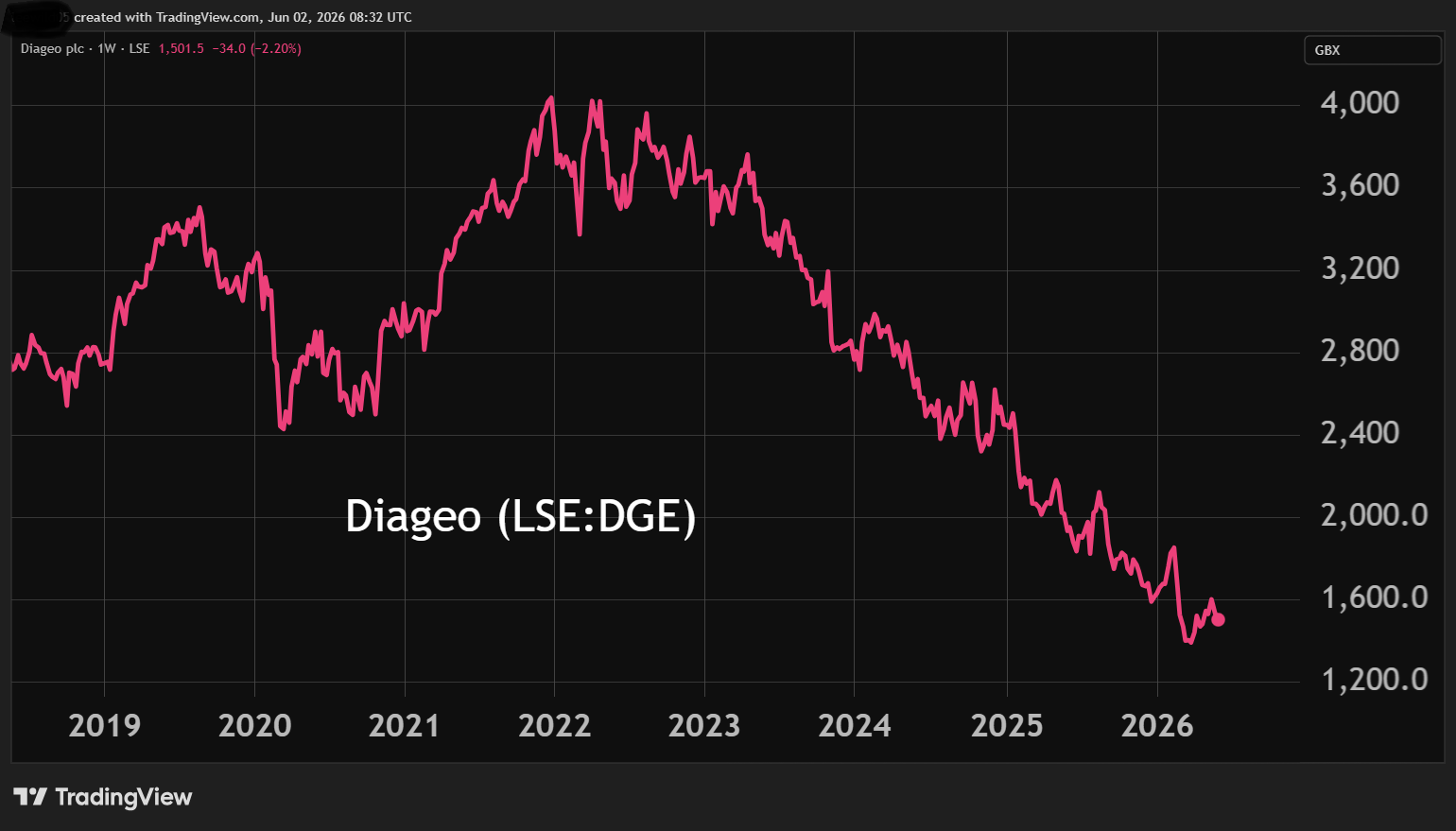
Source: TradingView. Past performance is not a guide to future performance.
A positive catalyst appears to have been a 6 May third fiscal quarter (January to March) update, helping the shares build on a wider market recovery after a sell-off in initial response to the Iran war. Possibly such an international share is just sensitive to this major story.
Despite mixed sales, Diageo beat expectations with a slight return to growth: net sales rose 2.3% to $4,477 million (£3,340 million), helped by “a positive hyperinflation adjustment”, although organic sales rose only 0.3%, hence behind inflation.
- Don’t miss the next big IPO: get the latest IPO news and updates straight to your inbox
- British American Tobacco on track as next-gen forecasts upgraded
In this context an “accelerated programme to deliver around $300 million of savings by end of fiscal 2026” (to 30 June) would represent 6.7% of sales, which is welcome.
Shares between two stools in terms of PE and yield
The forward price/earnings (PE) ratio is around 12.5x, however such growth is not expected. Instead, consensus anticipates a 13% earnings per share (EPS) declineto a sterling equivalent of 120p and a similar number in 2027.
It is a substantial de-rating from 20x in 2023 and higher in previous years when it seemed the market over-rated Diageo’s brands relative to earnings.
Consensus also anticipates another decline in dividend per share to around 45p equivalent, hence a prospective yield around 3.0% albeit with strong cover over 2.5x. Yet with net gearing around 180%, debt reduction looks a more vital priority than returns, especially if interest rates grind higher with inflation should the Iran war persist.
Diageo - financial summary
year end 30 Jun
reporting in US$
| 2020 | 2021 | 2022 | 2023 | 2024 | 2025 | |
| Turnover ($ million) | 14,799 | 17,128 | 20,539 | 20,555 | 20,269 | 20,245 |
| Operating margin (%) | 18.0 | 29.4 | 28.2 | 28.8 | 29.3 | 20.6 |
| Operating profit ($m) | 2,662 | 5,038 | 5,793 | 5,911 | 5,931 | 4,173 |
| Net profit ($m) | 1,774 | 3,578 | 4,319 | 4,445 | 3,870 | 2354.0 |
| Reported earnings per share (cents) | 75.4 | 153 | 186 | 196 | 173 | 106 |
| Normalised earnings per share (cents) | 169 | 148 | 213 | 227 | 174 | 185 |
| Operating cash flow per share (cents) | 124 | 210 | 225 | 160 | 182 | 194 |
| Capital expenditure per share (cents) | 37.4 | 35.9 | 62.7 | 62.4 | 67.4 | 72.4 |
| Free cash flow per share (cents) | 86.6 | 174 | 162 | 98 | 115 | 121 |
| Dividend per share (cents) | 88.0 | 97.6 | 101 | 102 | 100 | 63.0 |
| Covered by earnings (x) | 0.9 | 1.6 | 1.8 | 1.9 | 1.7 | 1.7 |
| Cash ($m) | 4,211 | 3,865 | 2,948 | 2,250 | 1,485 | 2,647 |
| Net debt ($m) | 17,184 | 17,000 | 17,135 | 19,105 | 20,620 | 21,754 |
| Net asset value ($m) | 8,397 | 9,537 | 9,494 | 9,856 | 10,032 | 11,090 |
| Net assets per share (cents) | 360 | 408 | 417 | 439 | 452 | 499 |
Source: company accounts.
So, the de-rating doesn’t imply to me that Diageo shares necessarily are due an upwards mean reversion. It could be that drinking trends are shifting and significant repositioning is needed from a 60% reliance on premium spirits to warrant a price of 2,000p to 3,000p again. This could take years.
Whatever is happening in the US?
Growth is proclaimed “strong” across Europe, Latin America, Caribbean and Africa – all up at least high single digits – but that’s offset by a high single-digits fall in the US, which represents 40% of group sales.
This US disappointment I find a bit hard to swallow. In “luxury consumer” it contrasts with Watches of Switzerland Group (LSE:WOSG), which on 14 May guided its full year to 3 May higher due to a strong US performance amid buoyant demand for its luxury products. Revenue rose 11% at constant currency or 8% at the reported level, with a strengthening trend. “The US continues to be our primary engine of growth,” the company said.
Perhaps manufacturing lead times for high-quality watches are trickier in response to variations in demand than for alcohol, yet both are luxury lifestyle items and the US stock market – which often influences wealthier Americans’ propensity to spend – has been overall resilient in the Iran war context.
It therefore looks as if weak US sales relate to a cultural shift where alcohol consumption has fallen from 62% to 54% - the lowest in 90 years – as younger people abstain or drink less often. Yet ironically, data also suggests spirits have seen continual steady increases in consumption versus beer and wine. Younger people’s preference for convenience drinks such as hard seltzers and pre-mixed cocktails is also driving a shift which Diageo is responding to.
Is the US setting a wider trend?
Elsewhere, and especially in developing countries, perhaps premium spirits have more social status appeal among the nouveau riche than in the US.
With Scotch at 24% of group revenue, public taste needs to be in favour for Diageo to grow. This segment is led by Johnnie Walker, which has been particularly successful in the Middle East and central Europe lately. There is also Bell’s, Buchanan’s and J&B, plus Canadian whisky at 6% of revenue under the Crown Royal brand and international malts, plus US whisky similarly at 6%.
Tequila and Agave is the fastest-growing spirits category at 11% of revenue, helped by super-premium brands such as Don Julio and Casamigos. Vodka such as Smirnoff, represents 9% and also at 9% are “other spirits” such as those with regional and niche appeal. Then a collection of 5% revenues: rum including Captain Morgan; liqueurs, strongly represented by Baileys Irish Cream; and gin such as Gordon’s.
- eyeQ: a new bull signal for cheap auto giant
- Sign up to our free newsletter for investment ideas, latest news and award-winning analysis
Guinness is a success story rising towards 15% of group sales, showing double-digit growth in the UK, Ireland and Europe even as traditional beer markets have occasionally struggled. The stout – once regarded as an old man’s drink – has become a hit among younger drinkers and women, its alcohol-free and on-tap versions being a major draw for pub and bar customers. It has led an 8.8% rise in overall European sales and achieved double-digit growth in China. But is it enough to justify a “buy for Diageo?
Early signs of progress in adapting to new trends are shown by Latin American and Caribbean sales up 16%, helped especially by the ready-to-drink (RTD) market involving pre-mixed beverages, and Smirnoff Ice. Yet spirits such as Kenya Cane drove 17% sales growth in Africa.
It can seem quite tricky to rationalise the performance of contrasting drinks and different locations, but since RTD’s constitute only 4-5% of group revenue, they certainly have a way to go to rebalance Diageo’s portfolio away from spirits.
Can new CEO have enough far-reaching effect?
It is a classic question: do you back the leader or primarily the economics of the business?
Sir Dave Lewis, appointed from 1 January 2026, gained respect for improving Tesco (LSE:TSCO) as CEO from 2014 to 2020. It took three years for the shares to respond, but since early 2023 the doubled from around 225p to 450p and 436p currently. Prior to this, he spent nearly three decades at Unilever in marketing and business performance roles.
Lewis also chaired Haleon (LSE:HLN), the FTSE 100-listed consumer healthcare company from its creation in 2022 to end-2025. But its shares have traded volatile-sideways since listing in July 2022 and the yield has only been 2% or so.
I therefore feel more attuned to whether Diageo is strategically positioned for drinking trends of the future. Meanwhile, Lewis is reportedly preparing a senior management shake-up to revive growth and strengthen competitiveness. RTD products are to be expanded – both alcoholic such as cocktails, spritzes and alcopops, and non-alcoholic drinks like ready-teas and coffees, juices, smoothies and sports drinks.
Berkshire Hathaway dumped Diageo this year
I wouldn’t necessarily read a lot into Berkshire Hathaway’s Diageo exit earlier this year, me being old enough to recall the fascination I felt when the Americans originally invested in Guinness Plc during the early 1990s, then sold out after the shares underperformed.
Guinness merged with Grand Met in late 1997, becoming Diageo, which Berkshire again invested in, presumably along a rationale of its brands constituting a strong “franchise” as Buffett describes them.
One lesson I draw is that brand power is not altogether the key to successful investing, the industry context and indeed valuation being potentially more significant.
I could be missing an upturn, but a “buy” stance would lack conviction. I would like to see more by way of revitalised sales. “Hold” seems appropriate.
Edmond Jackson is a freelance contributor and not a direct employee of interactive investor.
These articles are provided for information purposes only. Occasionally, an opinion about whether to buy or sell a specific investment may be provided by third parties. The content is not intended to be a personal recommendation to buy or sell any financial instrument or product, or to adopt any investment strategy as it is not provided based on an assessment of your investing knowledge and experience, your financial situation or your investment objectives. The value of your investments, and the income derived from them, may go down as well as up. You may not get back all the money that you invest. The investments referred to in this article may not be suitable for all investors, and if in doubt, an investor should seek advice from a qualified investment adviser.
Full performance can be found on the company or index summary page on the interactive investor website. Simply click on the company's or index name highlighted in the article.
Disclosure
We use a combination of fundamental and technical analysis in forming our view as to the valuation and prospects of an investment. Where relevant we have set out those particular matters we think are important in the above article, but further detail can be found here.
Please note that our article on this investment should not be considered to be a regular publication.
Details of all recommendations issued by ii during the previous 12-month period can be found here.
ii adheres to a strict code of conduct. Contributors may hold shares or have other interests in companies included in these portfolios, which could create a conflict of interests. Contributors intending to write about any financial instruments in which they have an interest are required to disclose such interest to ii and in the article itself. ii will at all times consider whether such interest impairs the objectivity of the recommendation.
In addition, individuals involved in the production of investment articles are subject to a personal account dealing restriction, which prevents them from placing a transaction in the specified instrument(s) for a period before and for five working days after such publication. This is to avoid personal interests conflicting with the interests of the recipients of those investment articles.