Nvidia losses reach 30% as US reacts to hot inflation data
There’s little relief for chip giant as selling pressure persists, while the latest US inflation print has implications for interest rates. Graeme Evans reports.
10th November 2026 15:46
by Graeme Evans from interactive investor

CEO of Nvidia Jensen Huang. Photo: Joel Saget/AFP via Getty Images.
NVIDIA Corp (NASDAQ:NVDA) shares today came under fresh selling pressure after the recovery of Wall Street tech valuations was dealt a setback by bets on further Federal Reserve interest rate hikes.
The chip giant was already at a seven-month low prior to this week’s disclosure of an independent investigation into chief executive Jensen Huang and the launch of plans by Google owner Alphabet Inc Class A (NASDAQ:GOOGL) to expand its range of AI chips.
- Invest with ii: Buy US Stocks from UK | Most-traded US Stocks | Cashback Offers
With sentiment further dented by today’s hot US inflation reading, Nvidia lost more ground to stand as low as $170 in early dealings. The shares have now lost a fraction over 30% since reaching a record high above $243 in early October.
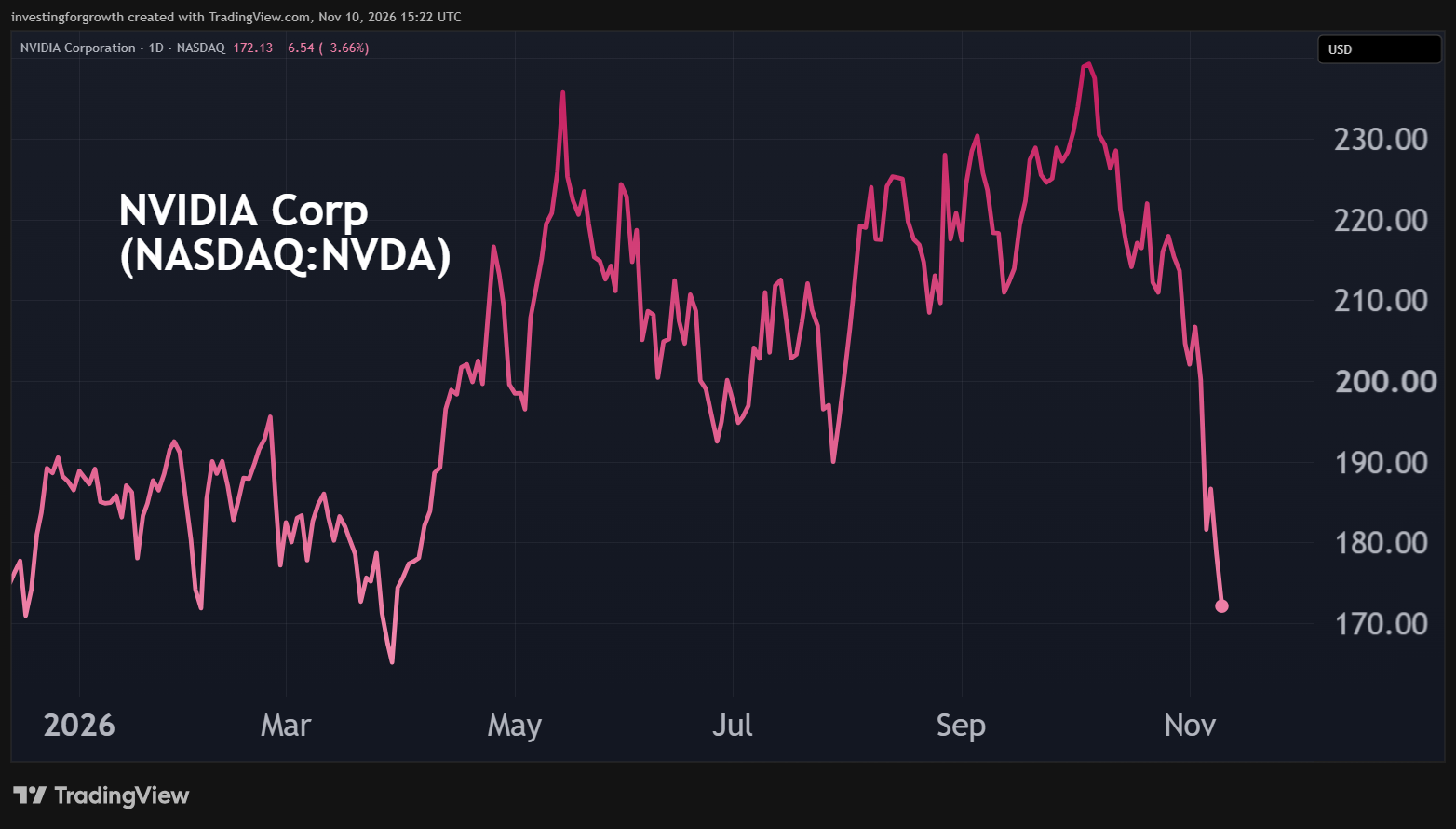
Source: TradingView. Past performance is not a guide to future performance.
Nvidia’s third-quarter earnings are due on 17 November but even if strong results reaffirm the AI growth story, they may not fully remove the stock’s governance discount.
This follows the weekend reports that Huang may have been the target of a potential foreign intelligence operation involving a woman he had a relationship with.
Saxo chief investment strategist Charu Chanana said: “Huang has transformed Nvidia from a small chipmaker into a multi-trillion-dollar company.
“His leadership is a competitive advantage, but the absence of a publicly identified successor creates key-person risk. The investigation’s findings, particularly whether sensitive information was compromised, will be crucial.”
- Tech sell-off: what’s going on and key questions for fund investors
- Fund Focus: meet the ‘winners’ of the tech sell-off
Nvidia’s 4.3% reverse yesterday came even though the Philadelphia semiconductor index rose 6.85% in its best daily performance since July and the wider S&P 500 index jumped 2.3%.
The best session since April’s Iran war ceasefire left the US benchmark close to where it was prior to last week’s sell-off, which was triggered by fears the Democratic sweep of Congress in US midterm elections will slow the AI investment cycle.
The risk-on mood of yesterday’s session was further helped by a sharp fall in the price of oil, leading to the sharpest daily decline in the Vix fear index since April 2025.
However, the S&P 500 index and Nasdaq returned to the red in today’s session after monthly inflation figures reinforced expectations of a back-to-back US interest rate rise.
Month-on-month growth in the consumer prices index (CPI) of 0.4% topped forecasts after the previous month’s 0.65% rise drove September’s annual rate to 3.7% from 3.4% in August.
Today’s inflation report featured no annual rate as comparisons were not possible due to the impact of last year’s government shutdown on October 2025 data collection.
- Has it paid off to invest differently in the US?
- Sign up to our free newsletter for investment ideas, latest news and award-winning analysis
- What the Democrat sweep means for portfolio
The Federal Reserve’s next policy decision is due on 9 December, having raised the target range for the federal funds rate by 0.25% to 3.75-4% at its September meeting.
Heightened fears of multiple increases over the next year meant the 10-year Treasury yield rose from a two-month low to near 5%.
Schroders’ senior economist George Brown said: “Another resilient inflation print adds to evidence that the US economy is running too hot for comfort.
“More worrying is that it comes just as the labour market is regaining momentum, threatening to turn an already troubling inflation outlook into an even bigger problem.”
Brown said developments left the Federal Reserve with further work to do, meaning it is likely to have to do more than just reversing last year’s insurance-led cuts.
Capital Economics said the strength of inflationary pressures in the last two monthly reports raised the risk that the Fed opts for a larger half-point move in December.
It added: “Our forecast has been for the Fed to hike by 25 basis points in December and hike once more after that in March, whereas markets have reintroduced a third hike into the curve.”
These articles are provided for information purposes only. Occasionally, an opinion about whether to buy or sell a specific investment may be provided by third parties. The content is not intended to be a personal recommendation to buy or sell any financial instrument or product, or to adopt any investment strategy as it is not provided based on an assessment of your investing knowledge and experience, your financial situation or your investment objectives. The value of your investments, and the income derived from them, may go down as well as up. You may not get back all the money that you invest. The investments referred to in this article may not be suitable for all investors, and if in doubt, an investor should seek advice from a qualified investment adviser.
Full performance can be found on the company or index summary page on the interactive investor website. Simply click on the company's or index name highlighted in the article.