Stockwatch: another chance to buy this UK bank share?
Despite an uncertain economic outlook and imminent Autumn Budget, analyst Edmond Jackson takes another look at a previous share tip. Here’s what he thinks now.
9th October 2026 12:43
by Edmond Jackson from interactive investor

At 155p and on a chart view, the shares in FTSE 250 stock Metro Bank Holdings (LSE:MTRO) can look as if they’re mean-reverting to around 140p, representing the upward trend-line over the last two years.
- Our Services: SIPP Account | Stocks & Shares ISA | See all Investment Accounts
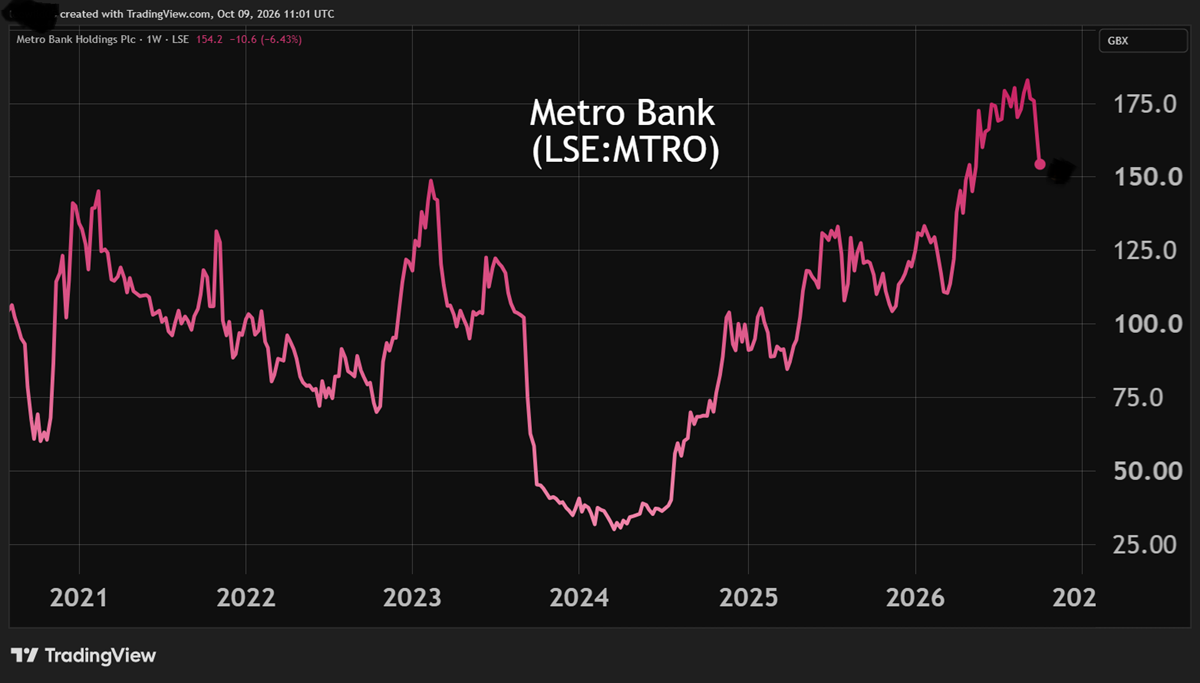
Source: TradingView. Past performance is not a guide to future performance.
Consensus forecasts for strong earnings growth in 2027 – earnings per share (EPS) up from an anticipated 12.8p in 2026 to 22.3p in 2027 – and based on £171 million net profit, implies a 15-month forward price/earnings (PE) ratio of 7.0x.
A maiden dividend of 1.1p is also projected in respect of 2027, a negligible yield but, with 20x earnings cover, it should grow if earning power is sustained. Obviously, if the UK economy – to which Metro is wholly exposed – was to falter, this would be a dampener, and I suspect such fears are behind the current fall. Bank shares do classically lead financial markets and economic expectations, hence a significant aspect to trading them reflects your macro view.
For comparison, Barclays (LSE:BARC) looks as if it has definitively replaced an uptrend with downtrend:
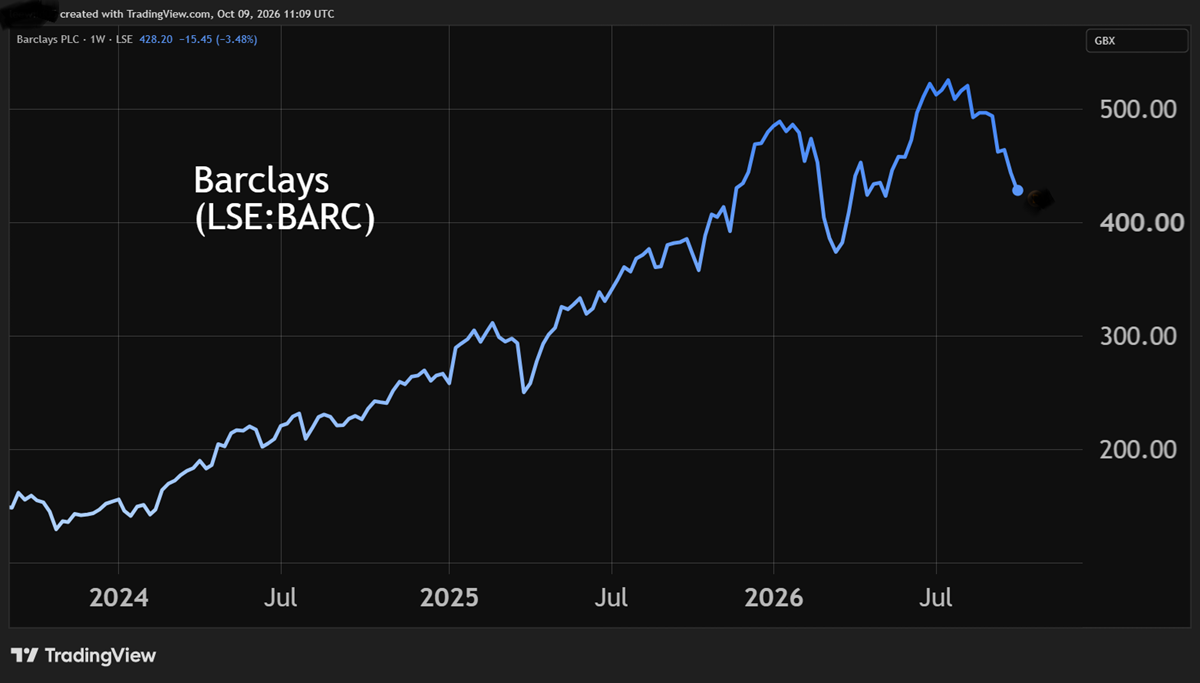
Source: TradingView. Past performance is not a guide to future performance.
Whereas NatWest Group (LSE:NWG) looks more like Metro in the sense of mean-reversion to an uptrend since 2024:
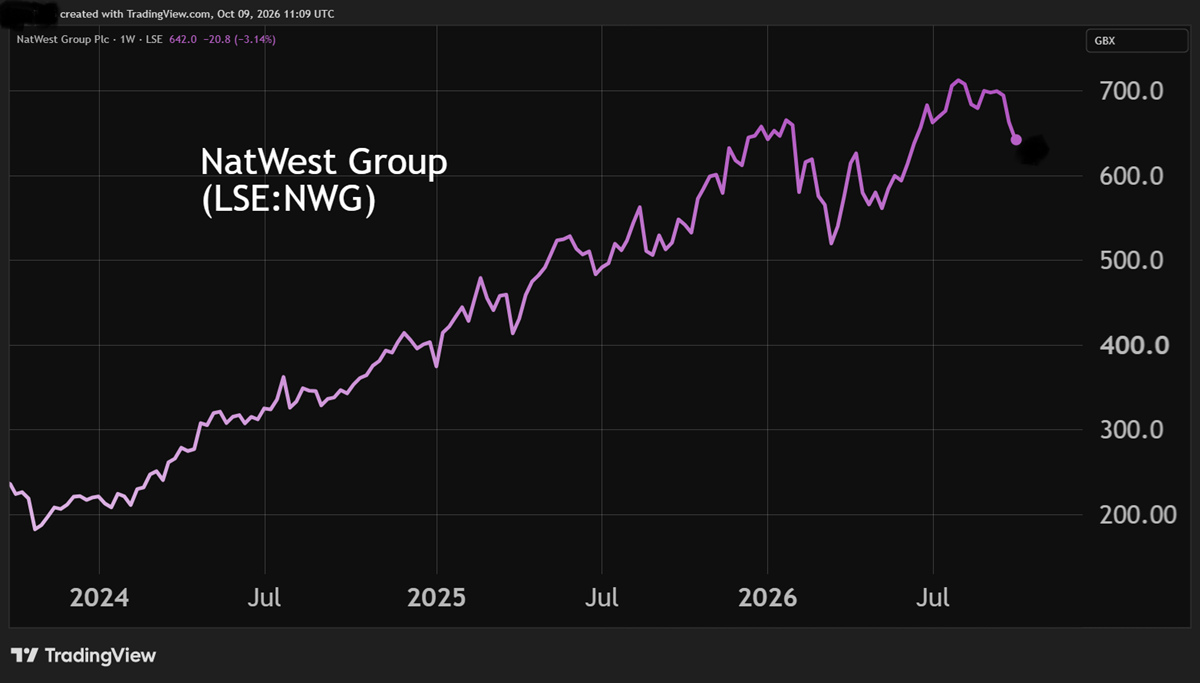
Source: TradingView. Past performance is not a guide to future performance.
What is a bit curious is bank shares falling just when bond yields, hence the interest rate outlook, are tightening. The usual sense is higher interest rates boosting a bank’s net interest margin. It looks as if the market is more concerned by the effect of higher borrowing costs on mortgage demand and commercial/personal demand for loans – especially if the economy falters under high energy costs.
Metro directors average up before latest drop
On 11 September, the chief financial officer (CFO) bought £50k worth of Metro shares at 183p, so the shares currently sit at a 14% discount to what a key insider considered value. This price had not been seen since early 2020. Moreover, Jaime Bacal (the Colombian billionaire banker and investor who owns over 52% of Metro, and who led a £925 million recapitalisation and rescue in late 2023) bought an additional £860k worth at 172p on 2 September. Possibly, the CFO was influenced by this, but I believe it’s still important to take note when a far less wealthy individual – attuned to inner finances – makes a meaningful purchase.
The CFO also bought £230.2k worth at 115p in March when Bacal added £612k worth at 114.5p and the chairman since 2020 added £19.5k at 111p - i.e. not a maiden purchase to prove a point soon after joining.
- Case study: managing a £1.25m pension and ISA portfolio in midlife
- ii most-bought investments: September 2026
Recent buying came after the 4 August half-year results which headlined a £61 million underlying pre-tax profit, the most profitable half in Metro Bank’s history and a 34% increase year-on-year. A record 43% growth in core lending had been achieved by growing market share, which might offset or at least mitigate a softer economy if it can continue to any material extent.
Also, a 7.5% return on tangible equity was achieved, up from around 4% in 2025, and guidance for the current financial year and beyond was affirmed. Management targeted this performance measure over 13% in the current fourth quarter, rising above 15% in 2027 and greater than 18% in 2028 “firmly positioning Metro Bank as one of the UK market leaders”.
Obviously, the market did not swallow this. From around 180p just before the results, Metro shares were volatile, falling to 165p late-August then rallying to 183p by 11 September. Again, I think this shows the key near-term factor is perception of the economy where both are shifting.
Metro Bank Holdings - financial summary
Year end 31 December
| 2015 | 2016 | 2017 | 2018 | 2019 | 2020 | 2021 | 2022 | 2023 | 2024 | 2025 | |
| Turnover (£ million) | 120 | 195 | 294 | 404 | 422 | 434 | 420 | 531 | 669 | 416 | 601 |
| Operating profit (£m) | -56.8 | -17.2 | 18.7 | 40.6 | -131 | -311 | -245 | -70.7 | 30.5 | -212 | 87.2 |
| Operating margin (%) | -47.3 | -8.8 | 6.4 | 10.0 | -31.0 | -71.8 | -58.3 | -13.3 | 4.6 | -51.0 | 14.5 |
| Net profit (£m) | -49.2 | -16.8 | 10.8 | 27.1 | -183 | -302 | -248 | -72.7 | 29.5 | 42.5 | 69.7 |
| Reported earnings/share (p) | -61.3 | -21.8 | 12.6 | 28.3 | -124 | -175 | -144 | -42.2 | 13.4 | 6.3 | 7.7 |
| Normalised earnings/share (p) | -53.0 | -17.2 | 13.9 | 31.6 | -89.6 | -122 | -116 | -34.6 | 0.1 | 15.9 | 9.3 |
| Operating cashflow/share (p) | 680 | 1,522 | 2,670 | 160 | -1,109 | 604 | 1,655 | -687 | 284 | -205 | -160 |
| Capital expenditure/share (p) | 99.1 | 186 | 198 | 235 | 135 | 63.8 | 47.0 | 30.7 | 17.2 | 8.9 | 12.0 |
| Free cashflow/share (p) | 581 | 1,336 | 2,471 | -75.1 | -1,244 | 552 | 1,608 | -718 | 267 | -172 | 28.3 |
| Cash (£m) | 282 | 500 | 2,212 | 2,472 | 2,989 | 2,993 | 3,568 | 1,956 | 3,891 | 2,811 | 2,185 |
| Net debt (£m) | 280 | 153 | -2,091 | -1,879 | -1,807 | -1,870 | -2,542 | -899 | -1,772 | -1,540 | -1,243 |
| Net assets (£m) | 407 | 805 | 1,097 | 1,403 | 1,583 | 1,289 | 1,035 | 956 | 1,134 | 1,183 | 1,484 |
| Net assets per share (p) | 507 | 1,001 | 1,240 | 1,440 | 918 | 748 | 600 | 554 | 170 | 176 | 220 |
Source: historic Company REFS and company accounts
Metro transitions from low to higher-margin mortgages
The bank proclaims how its strategy towards higher-yielding specialist mortgages explains margin expansion, as if Metro is relatively insulated to the average cost of five-year UK fixed-rate mortgages hitting 6% for the first time in three years. Half-year results showed them having surged 137% year-on-year to £1.7 million, helping explain the margin expansion.
This is in a 30 June context where net loans constituted £9.1 billion, up 4% year-on-year, with commercial lending up 30% to £4.0 billion and specialist mortgages lending up 73% to £2.2 billion.
The specialist mortgages are tailored to segments where higher margins can be exacted. For example, professional people where enhanced income multiples up to 6x on the mortgages are offered. There’s also buy-to-let, although my sense is the economics and regulatory aspect to that market have made it less attractive unless you really know what you are doing. Metro also cites loans for houses in multiple occupation, multi-unit freehold blocks and other specialist areas beyond my ken to judge. Ultimately, the question is how resistant such mortgage demand is to adverse economic change: might it reduce if there is any kind of tipping point in the UK economy after the Budget?
- Tesco shares hit multi-month high after latest upgrade
- Favourite gold mining shares and a tip to pick winners
Metro is also involved in “near-prime” mortgage lending, for example to the self-employed and individuals with less-than-perfect credit histories. This can sound like a rebadging of “sub-prime” at the root of the 2008 financial crisis, but you would think the bevy of risk managers all over modern banking would better know what prudent exposure is. This segment does still constitute a market.
Among specialist mortgages, there is also large-loan, high-value residential and specialist borrowing up to £10 million.
Commercial lending must be affected by weaker economy
At 45% of Metro’s loan book, commercial lending targets companies from around £250,000 to £50 million turnover – offering commercial loans and mortgages, asset financing and leasing, and invoice finance. There are bespoke financing options for property developers and investors covering purchase, refinance and equity release.
Within the interim statement there was not much elucidation of the 30% year-on-year increase in such lending, and there seems a caveat about growth “continuing offset by attrition, particularly in commercial real estate and portfolio buy-to-let” – which does not exactly follow but you get the sense where the strains are.
Effectively we are required to take a view on the economy, which effectively depends how the Budget is received. Should taxes rise materially there seems little doubt that demand for credit will reduce, lending standards will tighten and both provisions and credit risk will rise.
- The Income Investor: why I like this FTSE 100 share’s 6% dividend yield
- Sign up to our free newsletter for investment ideas, latest news and award-winning analysis
Metro likes to say it targets small-to-medium sized enterprises (SME’s), which can be a virtue symbol. However, banks often shift to perceived safer prospects in a downturn. Net lending even across healthy industries tends to slow as credit availability tightens. If investors can earn 5-6% from relatively lower-risk government bonds, it also pushes up cost of capital.
The market’s prevarication is shown by a 2p drop in Metro early yesterday, reversed by the close but is down 2p again to 155p in early dealings. Essentially, do you trust a PE of 7x or await the Budget on 28 October? Metro offers no yield compensation for holding risk.
Are poor customer reviews much relevance?
I do not have service experience of Metro and note a 2.4/5 “Poor” rating on Trustpilot based on 479 reviews in the context of 2.7 million total customers. Well, things go wrong in any business and people do vent online.
NatWest scores 1.4/5 based on 1,182 reviews relative to over 20 million UK customers, which includes me. It was understandable how many NatWest branches had to close, but customer “service” nowadays seems reduced to a chatbot. In a recent episode I could not speak to anyone and gave up, perhaps that’s how all banks are now.
Yet Metro’s CEO claims its relationship banking model is delivering a clear competitive advantage, despite having only 78 UK branches with three new store leases signed.
Near-term dilemma
I last wrote about Metro in May 2025 at 112p, noting how “macro questions remain very significant”, yet the bank and its shares overcame fears of stagflation and even recession last year. I maintained a “buy” stance having originally taken it at 53p in August 2024.
It is timely to review Metro in a possibly shifting macro context where the Budget run-up could mean further downside for all bank shares. It would appear the risk context is rising and Metro’s customer base not necessarily being as resistant to this.
This and especially post-Budget, could be another buying opportunity, but I think it appropriate to temper the rating to “hold” until we see how the chancellor intends to navigate UK fiscal challenges.
Edmond Jackson is a freelance contributor and not a direct employee of interactive investor.
These articles are provided for information purposes only. Occasionally, an opinion about whether to buy or sell a specific investment may be provided by third parties. The content is not intended to be a personal recommendation to buy or sell any financial instrument or product, or to adopt any investment strategy as it is not provided based on an assessment of your investing knowledge and experience, your financial situation or your investment objectives. The value of your investments, and the income derived from them, may go down as well as up. You may not get back all the money that you invest. The investments referred to in this article may not be suitable for all investors, and if in doubt, an investor should seek advice from a qualified investment adviser.
Full performance can be found on the company or index summary page on the interactive investor website. Simply click on the company's or index name highlighted in the article.
Disclosure
We use a combination of fundamental and technical analysis in forming our view as to the valuation and prospects of an investment. Where relevant we have set out those particular matters we think are important in the above article, but further detail can be found here.
Please note that our article on this investment should not be considered to be a regular publication.
Details of all recommendations issued by ii during the previous 12-month period can be found here.
ii adheres to a strict code of conduct. Contributors may hold shares or have other interests in companies included in these portfolios, which could create a conflict of interests. Contributors intending to write about any financial instruments in which they have an interest are required to disclose such interest to ii and in the article itself. ii will at all times consider whether such interest impairs the objectivity of the recommendation.
In addition, individuals involved in the production of investment articles are subject to a personal account dealing restriction, which prevents them from placing a transaction in the specified instrument(s) for a period before and for five working days after such publication. This is to avoid personal interests conflicting with the interests of the recipients of those investment articles.