Stockwatch: is this major event a trigger to buy the shares?
After plenty of activity at this mid-cap struggler, analyst Edmond Jackson explains whether he thinks it’s a value trap or worth snapping up.
30th June 2026 11:54
by Edmond Jackson from interactive investor

FTSE 250 firm Telecom Plus (LSE:TEP) is an interesting case study in how even a financial success story can turn dire as industry economics force change.
When first listing its shares in 2000 at 190p, it was just an £18 million company listed on what was then known as the Ofex market. After transferring to the full list, shares enjoyed a superb bull run to over 1,850p by early 2014.
But the company then issued a major profit warning due to a plunge in wholesale energy prices resulting in smaller independent suppliers able to undercut the likes of Telecom Plus. Despite initiatives to widen the customer and service base, an altered marketplace hit margins and downgraded earnings. Might this precedent be relevant now?
- Our Services: SIPP Account | Stocks & Shares ISA | See all Investment Accounts
The shares found long-term support at 775p by May 2015, a month after I suggested averaging in to benefit from a 5.5% yield and re-rating prospects. Five directors had just bought £1.1 million worth of shares at around 780p.
There was a recovery to 1,500p by 2019, although shares succumbed to a sideways range with support above 1,000p. Then came a sharp rally from 1,030p in September 2021 to a 2,408p all-time high by November 2022. This was, however, a temporary rally related to energy price hikes due to the Ukraine war forcing smaller operators out of business.
Around this time, the company was paying a 57p per share dividend, and the further rise to 95p in respect of the March 2025 fiscal year affirmed the sense of a reliable utility share on a fine yield. Buyers at 775p would have locked in a 12.25% yield.
But while last Tuesday’s March 2026 annual results proclaimed a 6% increase in shareholder returns, the actual payout dropped to 50p a share and a £40 million buyback programme kicked off.
Over the last year, the shares have progressively fallen from around 2,000p to as low as 650p early last Tuesday morning. They currently sit at around 750p.
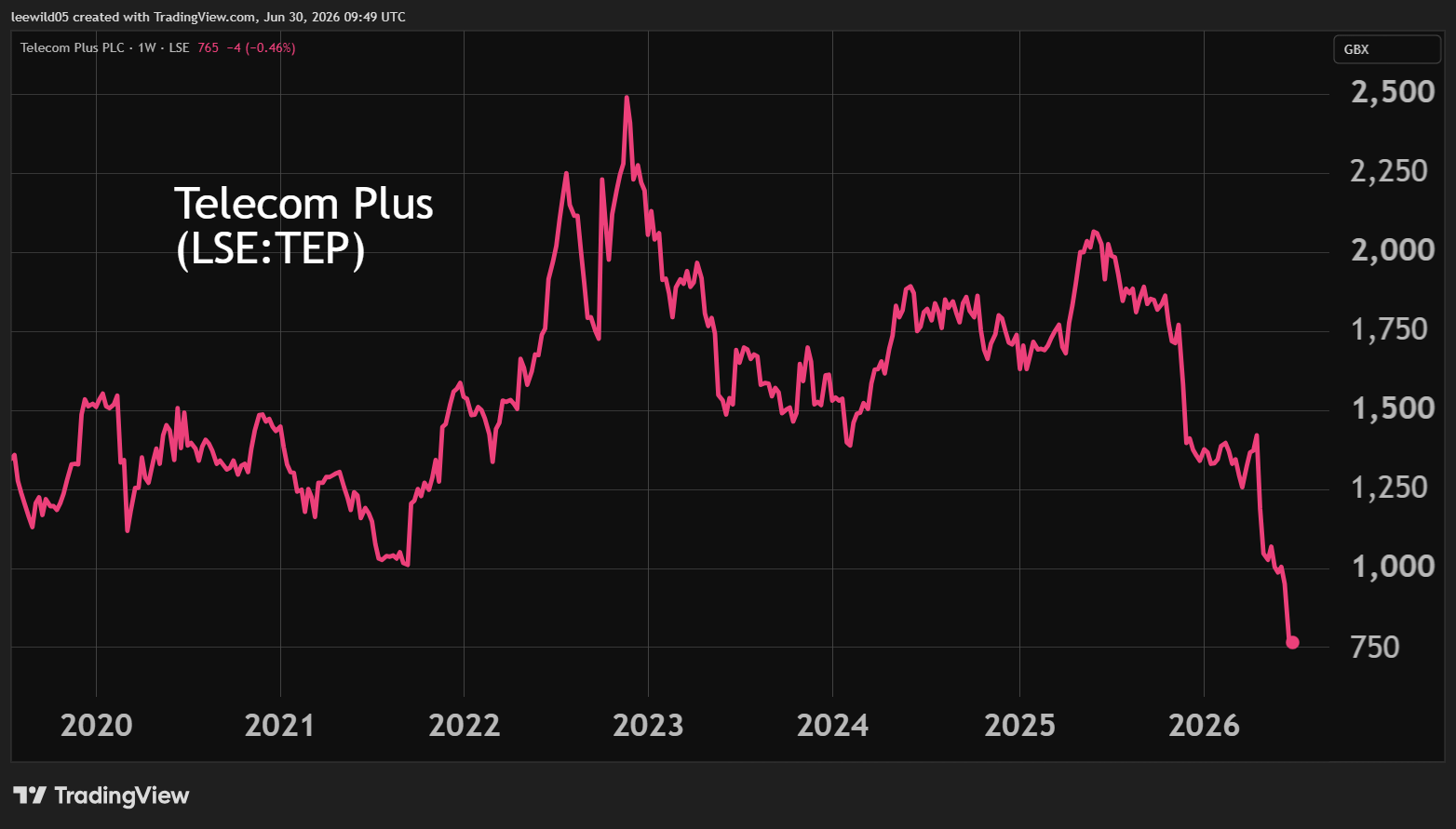
Source: TradingView. Past performance is not a guide to future performance.
Initial 33% drop following aggressive strategy shift
Annual results were in line with expectations: revenue rose 6%, adjusted pre-tax profit was up 5% and adjusted earnings per share (EPS) gained 3%. What hit the shares was a five-year plan to hopefully double multi-service customers to over 1 million by the March 2031 year, with a £55 million per year “investment” in price, cross-selling and enhanced services.
Yet, similar to food retailers citing “investment in price”, these can be weasel words that disguise a vital response to competition [and the] need to avoid losing further shareholder value. It is a somewhat negative response to change being forced than investment in a position of strength for further gains.
- Insider: FTSE 250 directors at Telecom Plus buy big at record low valuation
- The FTSE 100 stocks paying an extra £1bn of dividends in July
Guidance for the March 2027 year is a median £85 million adjusted pre-tax profit versus £132 million for this latest year, implying EPS of 80p, hence a forward price/earnings (PE) ratio of 9.4x.
Management entertains the prospect of £175 million adjusted pre-tax profit by 2031, a return on capital over 30% and shareholder distributions around £100 million, at least 50% by way of dividends.
Just two months ago in a financial year-end update, profit was guided to the lower end of an expected range, performance being mixed within 8% organic services growth: mobile up 29% albeit energy by less than 2%, broadband 4% and insurance down 8%. The shares fell 13% in response.
According to latest guidance, 80% of future pre-tax profit will be distributed, with half as dividends. A payout around 30p implies a 4.0% yield. I am a touch wary of the balancing act here while the board pursues this £55 million a year “investment” programme. It looks like the distributions and share buybacks are meant to prop up confidence in the shares, although it’s unclear whether everything can be achieved when the balance sheet doesn’t really support extra debt.
Also, the table shows that cash flow has been quite volatile despite the dividend re-rating from 57p to 94p, as if such growth was perhaps unsustainable anyway.
Free cash flow in March 2026 year looks to be around £67 million versus a dividend cost of £40 million, so it’s not clear how this reconciles with £55 million a year in investment.
Telecom Plus - financial summary
Year end 31 Mar
| 2021 | 2022 | 2023 | 2024 | 2025 | 2026 | |
| Turnover (£ million) | 861 | 967 | 2,475 | 2,039 | 1,838 | 1,941 |
| Operating profit (£m) | 45.8 | 49.8 | 89.5 | 106 | 116 | 125 |
| Net profit (£m) | 32.6 | 35.5 | 68.4 | 71.0 | 76.1 | 80.7 |
| Operating margin (%) | 5.3 | 5.2 | 3.6 | 5.2 | 6.3 | 6.5 |
| Reported earnings/share (p) | 41.4 | 45.0 | 85.2 | 88.8 | 95.1 | 99.9 |
| Normalised earnings/share (p) | 41.3 | 46.6 | 81.6 | 88.7 | 100 | 101 |
| Operational cashflow/share (p) | 55.1 | 65.0 | 294 | -166 | 136 | 146 |
| Capital expenditure/share (p) | 12.8 | 12.6 | 13.7 | 15.6 | 21.4 | 78.8 |
| Free cashflow/share (p) | 42.3 | 52.4 | 281 | -181 | 114 | 67.1 |
| Dividend per share (p) | 57.0 | 57.0 | 80.0 | 83.0 | 94.0 | 50.0 |
| Covered by earnings (x) | 0.7 | 0.8 | 1.1 | 1.1 | 1.0 | 2.0 |
| Return on total capital (%) | 14.8 | 16.2 | 27.8 | 25.7 | 25.9 | 25.0 |
| Cash (£m) | 25.1 | 29.6 | 194 | 57.8 | 79.0 | 91.5 |
| Net debt (£m) | 71.4 | 70.3 | -103 | 123 | 116 | 143 |
| Net assets (£m) | 213 | 206 | 231 | 233 | 252 | 267 |
| Net assets per share (p) | 270 | 261 | 290 | 295 | 316 | 333 |
Source: company accounts.
Can Telecom Plus carve out fresh market share?
Like many people, I was lured into the tentacles of Octopus Energy, helping its UK share grow from 6% to 25% in five years. I have lost interest in switching again. While in principle I might get slightly better prices, these are often upfront only, and the biggest factors – volatile energy prices and the government price cap – are separate to chasing the best deals. Energy has not soared to the extent that we were being warned about only two months ago, when it appeared prudent to switch to fixed-price plans.
Broadband, mobile and insurance all seem highly competitive, and Telecom Plus wants to expand in motor. Three years ago, I switched an elderly relative to Telecom Plus from BT, which were not sorting out a broadband fault, although she was unimpressed by a “welcome pack” detailing how much and when prices would rise after initially sweet terms.
In due respect, Utility Warehouse (the group’s marketing front for multi-services) scores 4.2/5 “Great” based on 79,000 Trustpilot reviews.
It’s unclear whether artificial intelligence (AI) is taking over price comparison, driving new account wins, [which] has weighed on shares in Mony Group (LSE:MONY). This operator is, however, employing AI towards ultimate control of customer relations in terms of which utility to be with. So, how does Telecom Plus’s “partner” sales model stack up by comparison, where partners (often customers) refer family and friends? The new strategy aims to scale this up to increase multi-service customers and does cite “rapid AI adoption”, although this looks overdue.
“Very positive results” were cited from early stage trials over recent months, hence management is confident and will report six-monthly on progress against targets.
Big director buys, or has it triggered a dead cat bounce?
Of £4.1 million worth of shares bought around 710p last Tuesday, £3.55 million were acquired by founder-chair Charles Wigoder, taking his stake to 11.4%. The CEO bought £194,000 worth at 703p and his wife £156,000 worth at 704p.
The market responded promptly with a further rise to 750p, which has held, the market viewing this as emphatic for value. Well, it could be, but if the directors were innocent when not sharing awareness of drastic actions required when updating on 28 April and with business significantly worsening since then, how reliable are 2031 projections?
Another prop – albeit speculative – is consolidation potentially making Telecom Plus a takeover target unless the Competition and Markets Authority (CMA) was to object.
- Trading Strategies: an overlooked FTSE 100 stock to consider
- eyeQ: should you follow Nancy Pelosi’s latest trade?
Note how £268 million net assets at 31 March comprised 66% intangibles and goodwill, in the context of £232 million gross debt (all long-term) versus £91 million cash. Current assets to current liabilities were a satisfactory 1.7x and the £15.3 million annual net interest charge was covered 8x by operating profit.
As to where the business is heading, its balance sheet seems OK-ish, although it’s unclear whether it firmly supports ambitious goals for “investment”, and shareholder returns seem also to depend on the trading scenario and whether Telecom Plus can gain share.
GLG Partners astutely raised its short position 0.10% to 0.70% (of the issued share capital) on 11 June. This was followed on 23 June, the day of annual results and strategy update, by D.E. Shaw, another hedge fund that had been actively managing a short around 0.5%, raising this to 0.62% and subsequently to 0.75% on 25 June. So, despite the rebound, these traders implicitly are sceptical.
I found the shares tempting at around the 650p low, if tricky in initial responses to gain a confident sense as to how the numbers might pan out. The shares might double or even halve in a worst-case scenario. A director buy on such a scale was going to create awe, but I think any disciplined approach needs more proof that this strategy can work and returns flow, hence I rate the shares a “hold”.
Edmond Jackson is a freelance contributor and not a direct employee of interactive investor.
These articles are provided for information purposes only. Occasionally, an opinion about whether to buy or sell a specific investment may be provided by third parties. The content is not intended to be a personal recommendation to buy or sell any financial instrument or product, or to adopt any investment strategy as it is not provided based on an assessment of your investing knowledge and experience, your financial situation or your investment objectives. The value of your investments, and the income derived from them, may go down as well as up. You may not get back all the money that you invest. The investments referred to in this article may not be suitable for all investors, and if in doubt, an investor should seek advice from a qualified investment adviser.
Full performance can be found on the company or index summary page on the interactive investor website. Simply click on the company's or index name highlighted in the article.
Disclosure
We use a combination of fundamental and technical analysis in forming our view as to the valuation and prospects of an investment. Where relevant we have set out those particular matters we think are important in the above article, but further detail can be found here.
Please note that our article on this investment should not be considered to be a regular publication.
Details of all recommendations issued by ii during the previous 12-month period can be found here.
ii adheres to a strict code of conduct. Contributors may hold shares or have other interests in companies included in these portfolios, which could create a conflict of interests. Contributors intending to write about any financial instruments in which they have an interest are required to disclose such interest to ii and in the article itself. ii will at all times consider whether such interest impairs the objectivity of the recommendation.
In addition, individuals involved in the production of investment articles are subject to a personal account dealing restriction, which prevents them from placing a transaction in the specified instrument(s) for a period before and for five working days after such publication. This is to avoid personal interests conflicting with the interests of the recipients of those investment articles.