Stockwatch: a rare growth share and possible takeover target
Amid strong performance and operating in an industry with a history of takeovers, analyst Edmond Jackson believes this growth business could attract interest too.
1st September 2026 11:01
by Edmond Jackson from interactive investor

The progress of sports supplements manufacturer Applied Nutrition (LSE:APN) since listing in October 2024 at 140p, is shaping up as a rare example of what the stock market salivates about.
It is in a sweet spot for demand – fitness junkies seemingly unable to breathe nowadays without a daily fix of creatine or whey powder. A taste of the high margins can be found in the 450g of Applied Nutrition Critical Whey currently “on offer” at Holland & Barrett at £16, down from £20. That can seem pricey but in terms of first-class proteins, meat has got a lot more expensive, while eggs and cheese boost cholesterol. Powder mixes can aid consistent protein supply.
- Our Services: SIPP Account | Stocks & Shares ISA | See all Investment Accounts
Its shares traded sideways until August 2025 when an update for the year to 31 July cited strong second-half trading and revenue growth of 24% to £107 million, ahead of expectations. After a rally from 130p to 170p, there was another consolidation phase before November’s annual results saw a re-rate to over 250p:
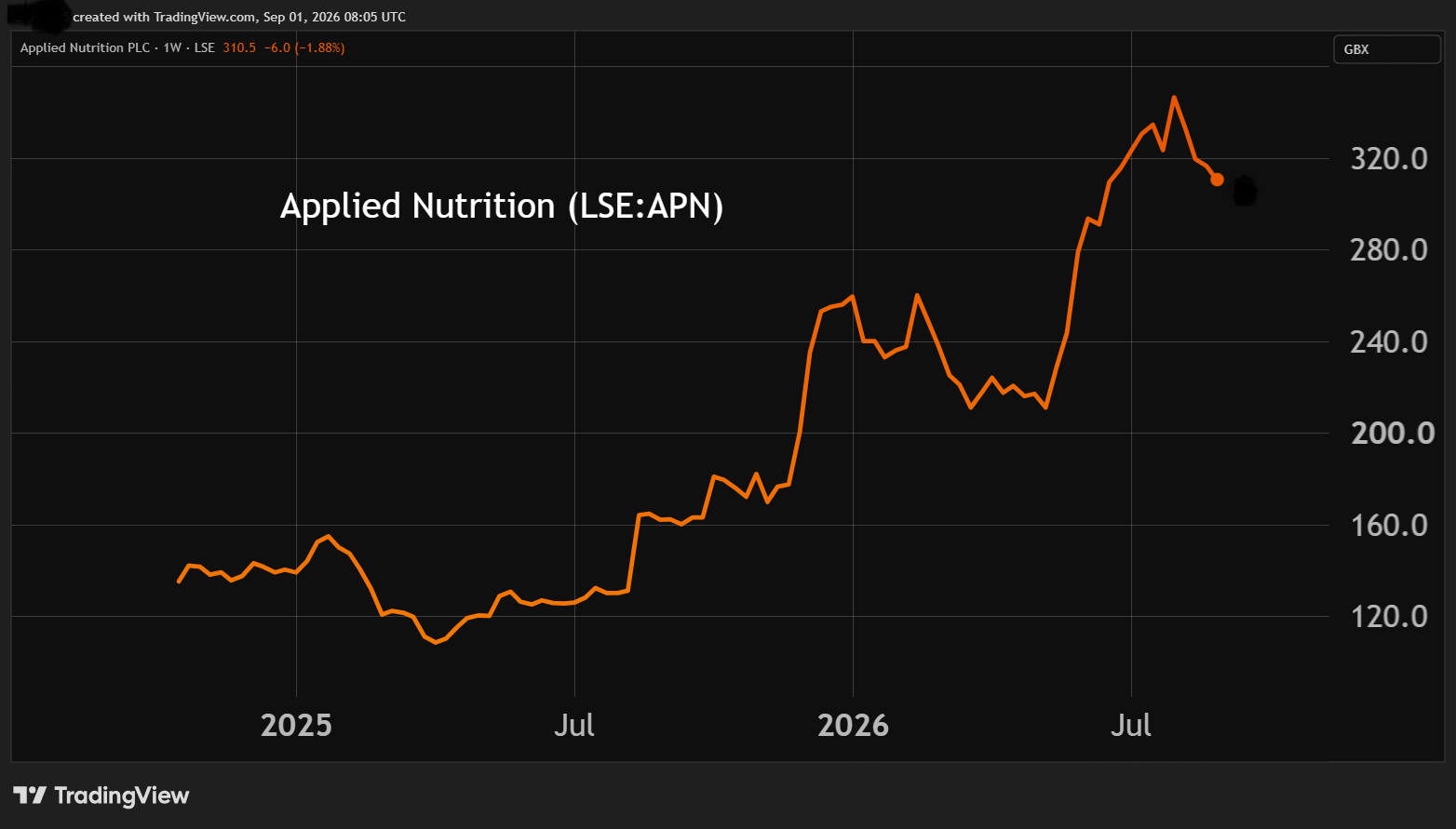
Source: TradingView. Past performance is not a guide to future performance.
Adjusted operating profit (before flotation costs) in the year to July 2025 rose 19% to £29.8 million on a 27.8% margin. Cash reserves were well over £18 million with only leases as debt. The only niggle was earnings per share (EPS) growth checked to 16% due to the £157.5 million raised at listing which rewarded early backers and founders rather than investment. CEO Thomas Ryder does, however, retain 34.3% and chief operating officer Steven Granite 5.8%, while JD Sports Fashion (LSE:JD.) sold down its 31.4% stake.
A trailing price/earnings (PE) ratio around 30x at 250p thus appearedhigh enough.
Growing into a high market rating
Another consolidation followed with a drift to 210p last May, but another rally materialised after a 1 June update raised guidance for annual revenue to £148 million, albeit profit was in line with forecast. The trigger was a $16 million (£11.8 million) acquisition of New York-based Nutrablend Group plus a significant US collaboration with Mondelez. While offering only two powder-based brands, Nutrablend was billed as a stepping stone for US expansion, offering production capacity up to $300 million revenue and synergy with UK facilities.
With the shares trending up from 300p, a third key upgrade arrived on 26 August by way of full-year update. It showed £163 million of revenue and £43.3 million adjusted EBITDA, both ahead of expectations and representing annual increases of 40% and 50% respectively.
The 2027 outlook was also upgraded for 13% EBITDA growth to about £49 million and 28% for revenue to £205 million. The top line will benefit from Nutrablend, although margin is expected to slip due to higher whey protein costs following a successful re-launch of Critical Whey.
However, the shares barely moved from around 315p, probably because they look to be on a 23x the latest earnings scenario, and the caution about whey prices gives a flavour of the growth rate normalising.
The valuation can also look full in the sense of 4x likely sales and over 11x book value, albeit quite inevitable when return on capital is over 50% - which also explains a lack of dividends.
Unless the company ends up having to issue a warning – say from a conflation of whey prices, unforeseen challenges in the US and a consumer recession – it looks capable of continuing to grow into its valuation.
Applied Nutrition - financial summary
Year-end 31 July
| 2022 | 2023 | 2024 | 2025 | |
| Turnover (£m) | 35.0 | 60.8 | 86.2 | 107 |
| Operating margin (%) | 28.4 | 29.5 | 27.6 | 26.2 |
| Operating profit (£m) | 10.0 | 17.9 | 23.7 | 28.1 |
| Net profit (£m) | 8.2 | 13.8 | 18.7 | 21.1 |
| Reported earnings/share (p) | 3.3 | 5.5 | 7.5 | 8.4 |
| Normalised earnings/share (p) | 3.3 | 5.5 | 7.1 | 7.9 |
| Operating cashflow/share (p) | 2.6 | 3.4 | 2.7 | 6.7 |
| Capital expenditure/share (p) | 0.1 | 0.4 | 0.4 | 0.4 |
| Free cashflow/share (p) | 2.5 | 3.0 | 2.3 | 6.3 |
| Dividend/share (p) | 0.0 | 0.0 | 0.0 | 0.0 |
| Return on capital (%) | 61.2 | 57.6 | 47.7 | 49.0 |
| Cash (£m) | 5.4 | 12.7 | 18.7 | 18.5 |
| Net debt (£m) | -4.3 | -10.7 | -16.9 | -15.5 |
| Net assets/share (p) | 6.0 | 11.5 | 19.2 | 21.7 |
Source: company accounts.
Catching and riding the waves in supplements
It amuses me how when I was a skinny teenager in the 1980s, body-building supplements deemed essential were desiccated liver and brewer’s yeast tablets, or a “Body Bulk” branded powder. These are long gone.
Yet craving supplements seems inherently human. Despite most nutritionists advising that extra vitamins are excreted and overdosing may even cause harm, annual global sales of the pills are projected to rise from around $65 billion to $106 billion by the early 2030s.
Creatine and whey are in fashion, yet complex powders strike me as rather highly processed food. One nutritionist I read suggested a mix of natural yoghurt with peanut butter and greens or fruit, as better for health. If you pour milk on to kefir grains to ferment, after a day it will separate into curds (you can strain for cheese) and whey. Four pints of milk are currently £1.65.
Applied Nutrition’s record of adept marketing suggests that it could identify early what become the next fads. If it can also motor with US expansion, avoiding upsets, this could be transformative. The US sports nutrition market is valued at roughly $18 billion to $22 billion, with a compounded annual growth rate around 7%. Protein powders, especially whey, are its largest aspect.
The company’s recent growth rates are also creditable given that they have been achieved in a context of subdued consumer spending. Perhaps it testifies to how fitness fanatics are a more durable source of spending, and also that history shows people emphasising appearance more in hard times.
Staying loyal to its Liverpool roots
Ryder, the 42-year-old founder-CEO, started with a retail store, opened more and got into wholesale before acquiring Applied Nutrition in 2014 as a declining local supplements brand. He began manufacturing from 2016 and, such has been the growth, his aim is to become “the world’s most trusted and innovative brand in the market”.
Creditably he has attracted proven professional management around his entrepreneurial vibe, such a blend of skills raising the odds that this company can leverage globally.
Steven Granite, chief operating officer since 2021, has a strong background in finance and led a private equity-backed food logistics company before this was sold to a European rival. Andy Bell, chair since February 2024, co-founded AJ Bell and is a keen believer in effective governance to build a small enterprise into bigger companies.
The set-up is business-to-business sales rather than direct-to-consumer, although there is a website and Applied Nutrition rates 4.6 out of 5.0 “Excellent” on Trustpilot. Even the 5% 1-star reviews seem chiefly about products not arriving and the like, which is inevitable.
A history of becoming acquisition targets
The sports supplements industry was founded in 1936 by Joe Weider, an entrepreneurial body-building son of Polish immigrants to the US. It was re-branded as Schiff Nutrition International and last May was acquired by SunWay Biotech, albeit only for up to $62 million according to performance. The company did encounter regulators as to some false claims for its products. However, its take-out value after 90 years was unexciting.
Science in Sport, which listed on AIM in 2013, also got taken over by private equity in June 2025 for £82 million. Yet despite “SiS” empty gel packets seemingly regular litter on running and cycling trails, its popularity among athletes did not translate into great financial progress. You could easily have been stop-lossed out as the company experienced fluctuating revenues and heavy expenses, hence net losses. Yet ultimately its takeover value was 4x listing value.
- Trading Strategies: rating Rolls-Royce’s share price potential
- Sign up to our free newsletter for investment ideas, latest news and award-winning analysis
In 2021, Nestlé bought core brands of The Bountiful Company for $5.75 billion, and last April Unilever (LSE:ULVR) paid $1.2 billion for Gruns, a US-based plant-oriented chewable vitamin and supplement maker.
Given I suspect that this will ultimately happen to Applied Nutrition, together with its strong skills set, I conclude broadly with a long-term “buy” rating.
If you want to try and get lucky on timing, I have noted how the chart manifests consolidations after re-rates linked to upgrades. If these are fading to “in-line” updates as the doubled price of whey protein over the last year tempers margin, then possibly the shares drift again. However, sales momentum helped by supermarket availability – such as via ASDA, B&M, Morrisons, and Tesco – may offset this risk.
Edmond Jackson is a freelance contributor and not a direct employee of interactive investor.
These articles are provided for information purposes only. Occasionally, an opinion about whether to buy or sell a specific investment may be provided by third parties. The content is not intended to be a personal recommendation to buy or sell any financial instrument or product, or to adopt any investment strategy as it is not provided based on an assessment of your investing knowledge and experience, your financial situation or your investment objectives. The value of your investments, and the income derived from them, may go down as well as up. You may not get back all the money that you invest. The investments referred to in this article may not be suitable for all investors, and if in doubt, an investor should seek advice from a qualified investment adviser.
Full performance can be found on the company or index summary page on the interactive investor website. Simply click on the company's or index name highlighted in the article.
Disclosure
We use a combination of fundamental and technical analysis in forming our view as to the valuation and prospects of an investment. Where relevant we have set out those particular matters we think are important in the above article, but further detail can be found here.
Please note that our article on this investment should not be considered to be a regular publication.
Details of all recommendations issued by ii during the previous 12-month period can be found here.
ii adheres to a strict code of conduct. Contributors may hold shares or have other interests in companies included in these portfolios, which could create a conflict of interests. Contributors intending to write about any financial instruments in which they have an interest are required to disclose such interest to ii and in the article itself. ii will at all times consider whether such interest impairs the objectivity of the recommendation.
In addition, individuals involved in the production of investment articles are subject to a personal account dealing restriction, which prevents them from placing a transaction in the specified instrument(s) for a period before and for five working days after such publication. This is to avoid personal interests conflicting with the interests of the recipients of those investment articles.