Stockwatch: why I’d still buy this turnaround story
Newly promoted to the FTSE 250 and having just shared a strong trading update, analyst Edmond Jackson asks whether this firm is manifesting sustainable growth.
28th August 2026 11:09
by Edmond Jackson from interactive investor

One of the most powerful concepts in equity investing is “recovery to growth” where a turnaround enjoys a status change from troubled business to solid growth. Both earnings and price to earnings (PE) can massively improve.
Initially, classic actions get taken by a new CEO such as cost-cutting, streamlining and better marketing. Shares rise from depressed lows in relief that the company can at least meet guidance, then expectations start to get beaten, hence further rises.
- Invest with ii: SIPP Account | Stocks & Shares ISA | See all Investment Accounts
Motoring and cycling servicer/retailer Halfords Group (LSE:HFD) is at just such a stage after Henry Birch took charge from April 2025, having previously been CEO of online retailer The Very Group from 2018 to 2022, and also the gambling company Rank Group (The) (LSE:RNK) from 2014 to 2018.
Halfords’ five-year chart is looking like the supposedly bullish “bowl” pattern, where disillusioned holders sell out on deteriorating news then, after a consolidation and improvements, fresh buyers move in:
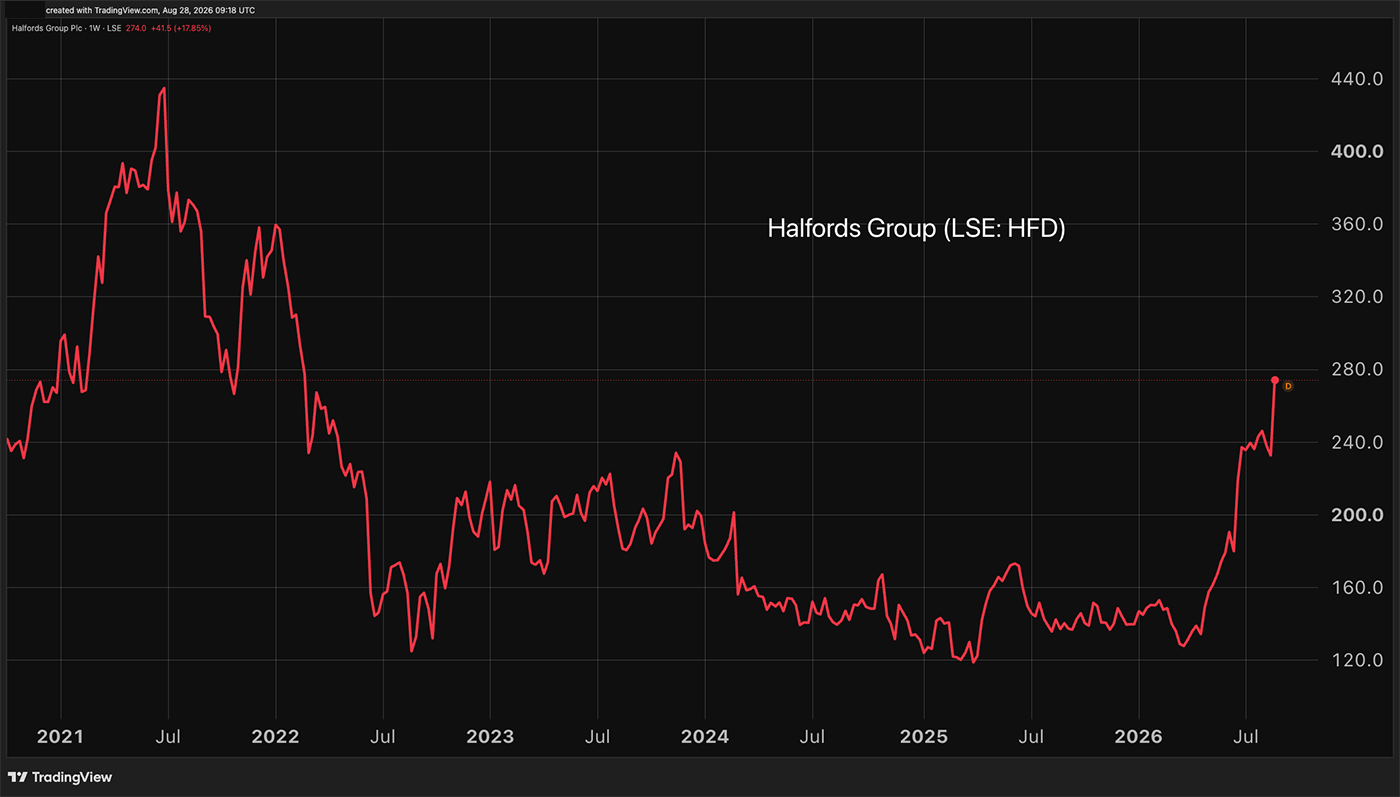
Source: TradingView. Past performance is not a guide to future performance.
In true long-term context, however, Halfords has exhibited major bouts of sideways’ volatility. From 230p to 540p by mid-2010 following the 2008 crisis, then a slump to 212p by mid-2012, then a rally over 550p by mid-2015, only to slump again near 70p with the onset of Covid in March 2020. A boom/bust in cycling products explains another rebound over 430p by mid-2021, then a plunge to 130p in mid-2022.
Amid a sideways’ consolidation in June 2024 I pitched a “buy” case at 145p after the annual results. A capitalisation barely over £300 million compared with around £1.7 billion annual revenue – a price/sales ratio under 0.2x – hence if operating margins could recover from 3% to nearer 5% as they were pre-Covid, serious profit could follow. Perhaps this was part of the attraction for Birch to join the firm.
At the end of last November he bought £100,000 worth of shares near 140p, also £28,000 worth at 147p in January when eight other directors similarly added £136,000 worth.
A recently consistent trend in financial upgrades
The shares took off from 133p last April after a financial year-end update guided underlying pre-tax profit near the upper end of a £36-£41 million expected range, driven by improved margins and cost margins. Autocentres saw like-for-like revenue up 5.8%, while within retail, motoring rose 2.9% and cycling by 6.4%.
It seems to me that auto services remain the crux for dependable earnings given that cycling is influenced by fickle weather and both face strong competition in online product sales.
The price rose further to 209p last June after prelims when April 2027 year guidance went to “around the top end of the consensus range”, but they did benefit from a change in accounting for profit – to exclude amortisation of acquired intangibles from underlying profit – hence a re-stated boost to adjusted earnings per share (EPS) from 2025 given that Halfords has been acquisitive in recent years.
The CEO heralded positive results from the first “optimise” phase of his Fit for the Future strategy, saying “this momentum underlines the significant potential that exists within the Halfords business...”
However, an overall 2.9% revenue rise to just over £1.8 billion barely matched inflation, and operating costs rose 7.6% due to higher labour costs and cost inflation. A 2.1% increase in the gross margin to 52.8% rescued underlying profit growth helped by better buying, changes in contractual arrangements with suppliers, and an overall foreign exchange tailwind.
- Monster payday for shareholders in September
- State pension could top £13k next year – but will you get it?
It was the kind of “much remains to be done” update typifying turnarounds, yet sentiment was improving after February’s shock of war in the Middle East. Investors made their own luck given that serial heatwaves have helped boost cycling sales.
Halfords shares jumped 11% to 267p yesterday after an update for the April to September first half, cited “momentum in the underlying business as we continue to deliver against our strategic priorities alongside a very strong performance in seasonal categories...” 2027 full-year underlying pre-tax profit guidance was again upgraded, into a £55-£65 million range ahead of recent consensus for £49-£55 million.
Assuming £60 million implies £45 million net profit on a standard tax charge equivalent to 20.6p EPS versus a recent consensus for 17.6p rising to 19.4p in April 2028. There might, however, be different views on adjusted profit, especially amid an accounting change.
At 267p, and reckoning on 12-month forward EPS roughly around 22p, this implies PE of 12x – hardly demanding and where twice earnings cover implies an 11p dividend, hence a 4.2% yield.
Halfords Group - financial summary
Year-end 31 Mar
| 2015 | 2016 | 2017 | 2018 | 2019 | 2020 | 2021 | 2022 | 2023 | 2024 | 2025 | 2026 | |
| Turnover (£ million) | 1,025 | 1,022 | 1,095 | 1,135 | 1,139 | 1,155 | 1,292 | 1,370 | 1,592 | 1,697 | 1,715 | 1,815 |
| Net profit (£ million) | 65.8 | 63.5 | 56.4 | 54.7 | 41.9 | 17.5 | 53.2 | 77.7 | 28.1 | 16.9 | -33.6 | 32.9 |
| Operating margin (%) | 8.5 | 8.1 | 6.7 | 6.2 | 4.8 | 2.9 | 6.2 | 7.9 | 3.0 | 3.1 | -1.1 | 3.1 |
| Reported earnings/share (p) | 33.3 | 32.3 | 28.6 | 27.5 | 21.0 | 8.7 | 26.3 | 36.4 | 13.6 | 12.8 | -15.4 | 14.6 |
| Normalised earnings/share (p) | 32.7 | 32.9 | 29.3 | 32.4 | 26.4 | 33.9 | 55.1 | 33.4 | 17.8 | 16.8 | 22.3 | 17.8 |
| Return on total capital (%) | 13.7 | 14.6 | 13.9 | 12.9 | 10.5 | 3.7 | 11.1 | 12.3 | 5.8 | 6.4 | -2.6 | 7.8 |
| Operational cashflow/share (p) | 60.9 | 42.7 | 36.6 | 39.8 | 39.7 | 36.1 | 89.2 | 56.4 | 68.1 | 74.1 | 89.4 | 82.7 |
| Capital expenditure/share (p) | 20.1 | 19.6 | 17.5 | 18.6 | 18.6 | 14.7 | 16.6 | 22.1 | 23.9 | 20.2 | 24.4 | 26.1 |
| Free cashflow/share (p) | 40.8 | 23.1 | 19.1 | 21.2 | 21.1 | 21.5 | 72.6 | 34.3 | 44.2 | 53.9 | 64.9 | 56.7 |
| Dividend per share (p) | 16.5 | 17.0 | 17.5 | 18.0 | 18.6 | 6.2 | 0.0 | 9.0 | 10.0 | 8.0 | 8.8 | 9.0 |
| Covered by earnings (x) | 2.0 | 1.9 | 1.6 | 1.5 | 1.1 | 1.4 | 0.0 | 4.5 | 1.4 | 1.6 | -1.8 | 1.6 |
| Cash (£m) | 22.4 | 11.9 | 16.5 | 27.0 | 27.0 | 9.8 | 116 | 67.2 | 46.3 | 41.9 | 19.1 | 19.3 |
| Net debt (£m) | 61.8 | 47.9 | 85.9 | 87.8 | 87.8 | 81.8 | 480 | 277 | 345 | 315 | 261 | 229 |
| Net assets (£m) | 368 | 405 | 408 | 422 | 410 | 409 | 366 | 418 | 551 | 563 | 500 | 514 |
| Net assets per share (p) | 185 | 204 | 205 | 212 | 206 | 206 | 184 | 210 | 252 | 257 | 228 | 235 |
Source: historic company REFS and company accounts.
But observe how 2027 financial year performance will be “further weighted towards the first half of the year as we accelerate investment in technology and marketing in the second half”.
Can this benefit growth or might there be an element of catch-up? When I shopped at Halfords last spring, only one of two items its online system told me were ready for collection were actually there when I arrived.
An especially wet autumn – as was the experience in 1976 after a drought and with some forecasters anticipating this currently – could also temper momentum.
Shares have ‘only’ recovered to the April 2022 level
267p compares with 350p looking more like a true median on the long-term chart, hence potential far-reaching effects of a capable new CEO argue for further upside. There seems some historic incomparability given online retail competition has got tougher versus times when the high street presence ruled, making me sceptical of a return to highs over 500p.
But despite wariness over how the accounting change is benefiting, and while inflation and employment costs seem liable to continue to weigh in, I re-iterate how if operating margins can continue to evolve towards 5%, it implies material earnings uplift.
Maintaining my sense of how the Autocentres are key to Halford’s medium-term future, despite rising adoption of electric vehicles (EVs) which need fewer repairs and have fewer parts, they still only constitute 4% of UK cars registered despite being 24% of the new car market. With 43% of cars now over 10 years old, servicing and repairs look a solid earnings base.
Halfords’ “Fusion” retail and garage service model – combining stores with garages and mobile units in a single location – is planned to scale further across the UK from 103 to 150 sites. Margin-enhancing add-ons such as advanced wheel alignment are being added, also partnering with platforms like Epyx is unlocking large-scale fleet contracts. EV and hybrid maintenance is also being targeted for specialised repair work and “Mobile Expert” vans expanded for an at-home service.
- Shares round-up: Greatland Resources, Computacenter, Halfords
- Sign up to our free newsletter for investment ideas, latest news and award-winning analysis
So, there are various growth initiatives in auto service, able to conflate usefully, despite Fusion originating in 2021 trials rather than being a [brainwave] of the new CEO.
Possibly cycling sales have moved on from lockdown-related boom/bust. I recently saw a Cycling Weekly promotion (albeit sponsored by Halfords?) suggesting that the retailer is now a place to go for serious bikes. In 2024, independent retailers had shrugged off Halfords’ quest to raise its number of premium mechanical bikes by 60% and premium electric bikes by 300% - areas it judges offers the best growth.
In early August, the shares re-rated from small cap to FTSE 250 status which can be seen as a watershed. Meanwhile, the crux for genuine growth status seems to hinge on whether the new CEO can exact meaningful growth from both auto and cycling-related sales, notwithstanding variable weather.
Possibly a wet autumn could offer a bit lower prices, especially if the market turns volatile, but on a two-year view I retain a “buy” stance.
Edmond Jackson is a freelance contributor and not a direct employee of interactive investor.
These articles are provided for information purposes only. Occasionally, an opinion about whether to buy or sell a specific investment may be provided by third parties. The content is not intended to be a personal recommendation to buy or sell any financial instrument or product, or to adopt any investment strategy as it is not provided based on an assessment of your investing knowledge and experience, your financial situation or your investment objectives. The value of your investments, and the income derived from them, may go down as well as up. You may not get back all the money that you invest. The investments referred to in this article may not be suitable for all investors, and if in doubt, an investor should seek advice from a qualified investment adviser.
Full performance can be found on the company or index summary page on the interactive investor website. Simply click on the company's or index name highlighted in the article.
Disclosure
We use a combination of fundamental and technical analysis in forming our view as to the valuation and prospects of an investment. Where relevant we have set out those particular matters we think are important in the above article, but further detail can be found here.
Please note that our article on this investment should not be considered to be a regular publication.
Details of all recommendations issued by ii during the previous 12-month period can be found here.
ii adheres to a strict code of conduct. Contributors may hold shares or have other interests in companies included in these portfolios, which could create a conflict of interests. Contributors intending to write about any financial instruments in which they have an interest are required to disclose such interest to ii and in the article itself. ii will at all times consider whether such interest impairs the objectivity of the recommendation.
In addition, individuals involved in the production of investment articles are subject to a personal account dealing restriction, which prevents them from placing a transaction in the specified instrument(s) for a period before and for five working days after such publication. This is to avoid personal interests conflicting with the interests of the recipients of those investment articles.