Stockwatch: the share poised to benefit from a new political alliance
With an update on the horizon, analyst Edmond Jackson explains why he thinks this small-cap is a buying opportunity.
20th October 2026 12:45
by Edmond Jackson from interactive investor

Cryptoassets are very high risk and you should be prepared to lose all your money before you invest
Last year, I drew attention to Greatland Resources Ltd (LSE:GGP) as a “buy” in April at an equivalent price of 284p (adjusting for a 20 for 1 share consolidation), and also in October at around 400p, with the rationale of it being a quality Australian gold miner through which investors could capitalise on rising gold prices.
- Our Services: SIPP Account | Stocks & Shares ISA | See all Investment Accounts
Gold is often tricky given sentiment plays such a role. Catching momentum can lead to great rewards but by the time the media has enough articles about why you need exposure, it may top out.
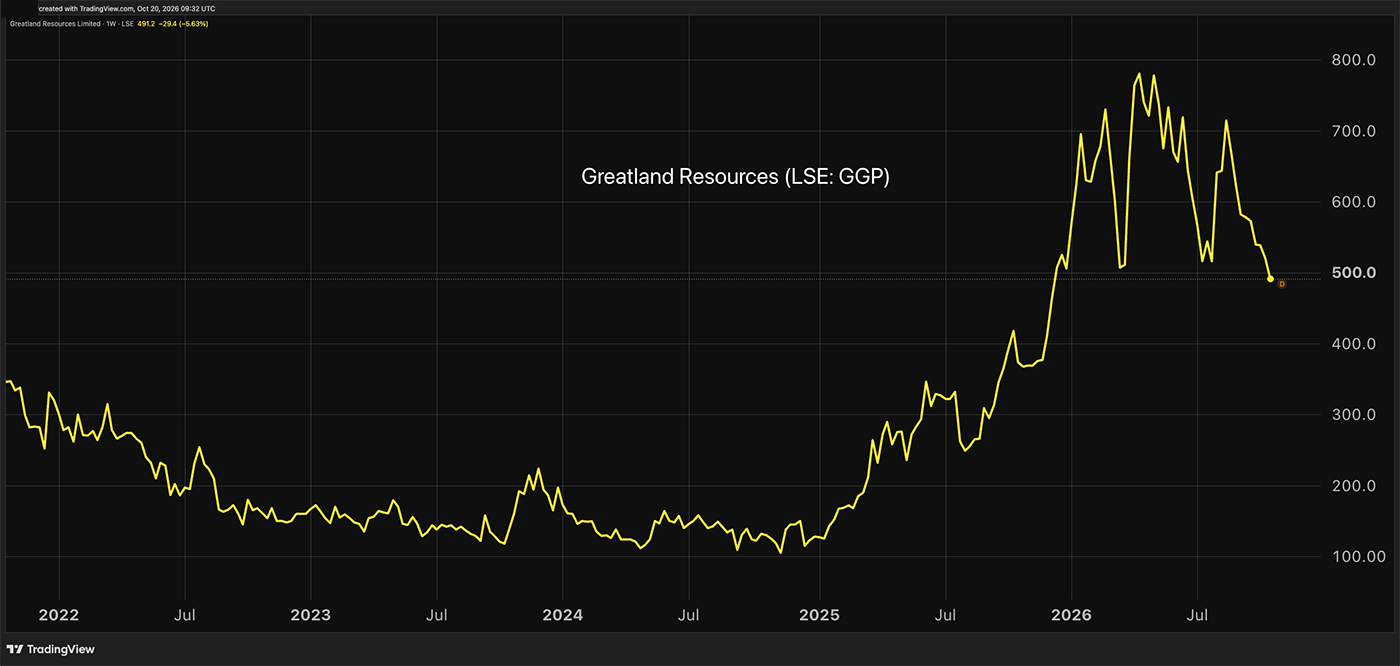
Greatland’s price continued to re-rate in 2026, testing 800p last May, as gold soared with the US/Iran war erupting. Thereafter, it performed inversely, say, to a wide range of retail shares, its price de-rating 38% from the high to 495p currently.
Source: TradingView. Past performance is not a guide to future performance.
Currently there seems to be no end to the chaos in the Gulf and high energy prices may finally bear down on economies; possibly with higher interest rates affecting the AI boom.
US President Donald Trump is applying pressure on Ukraine to capitulate, thereby raising political risk in Europe. France is in political and financial crisis, images of prestigious government buildings in flames, possibly with far-right parties capitalising and Europe trending towards this end of the spectrum, like America and Russia. So, does an effective new alliance of Trump and Vladimir Putin suggest another buying opportunity in gold?
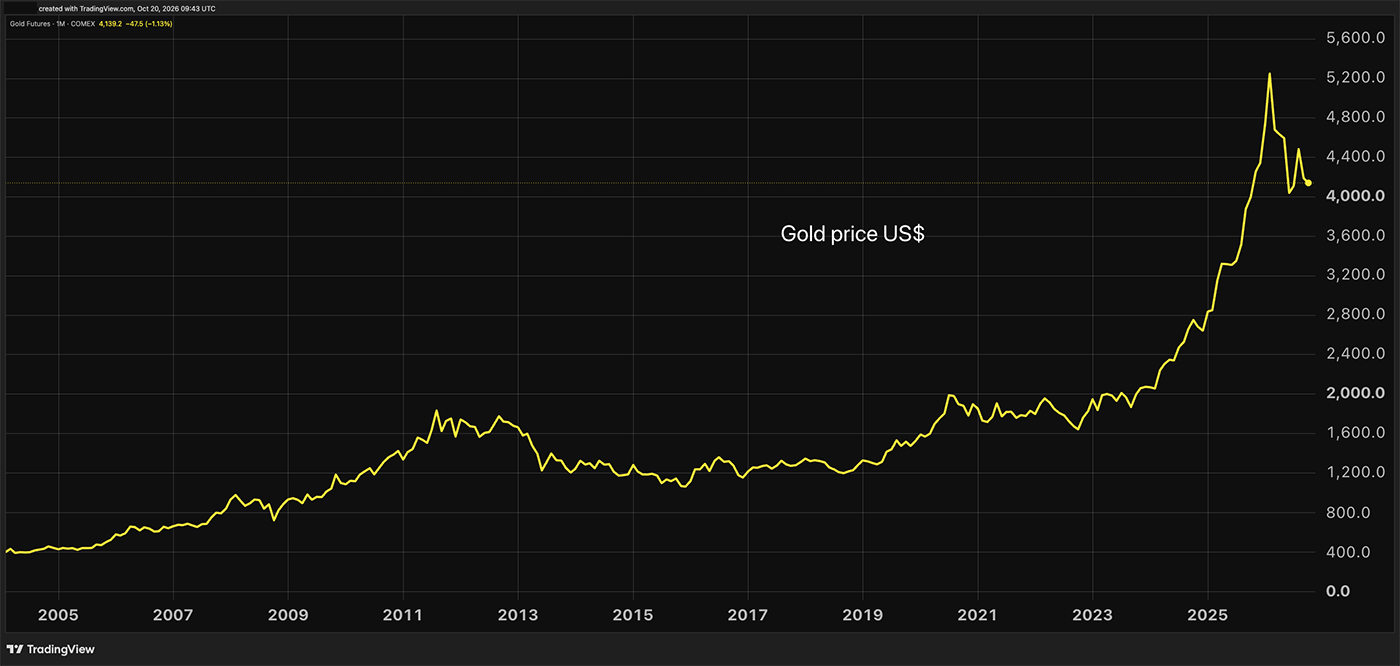
Looking at the spot price, it fell 0.6% yesterday morning to about $4,180 against the FTSE 100 over 1% down, and Brent crude oil 1.3% lower. I think this shows how on some occasions of “risk-off” sentiment, all assets can be affected. This is a lesson I learned early when gold slumped after the October 1987 crash.
Is Bitcoin effectively replacing gold and related assets as a hedge?
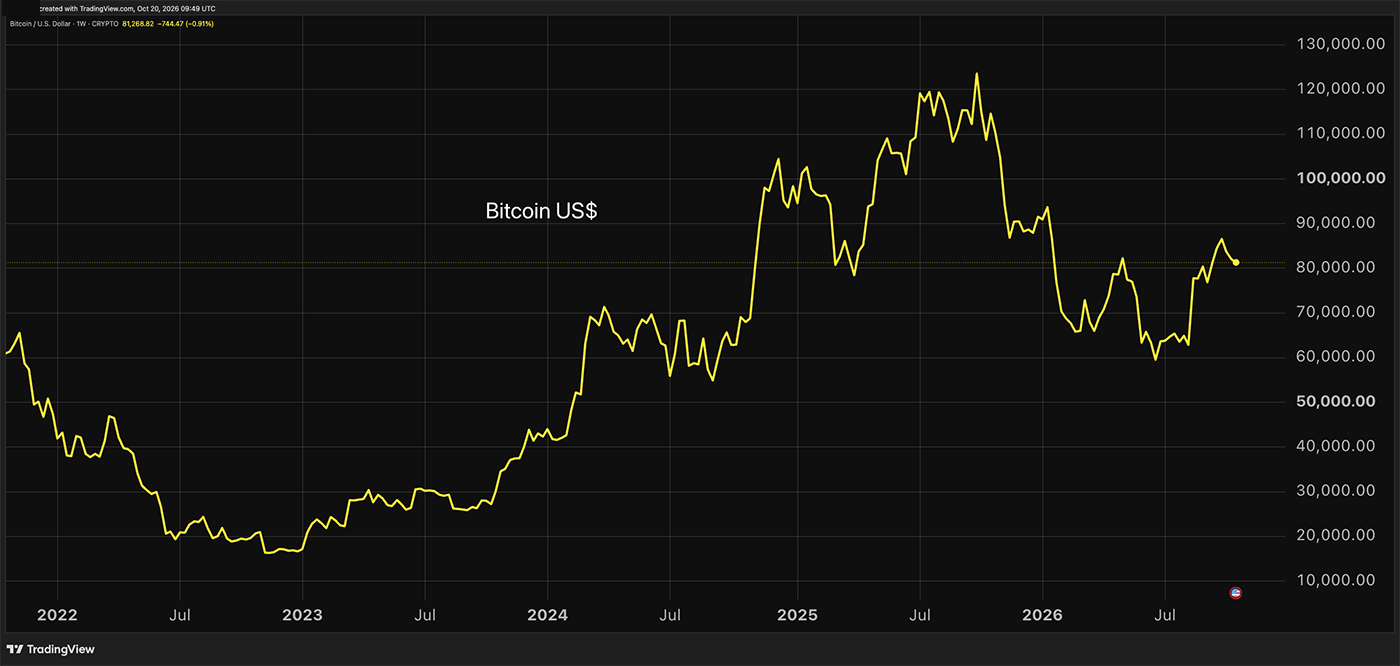
Interestingly, Bitcoin rallied 1.1% to about $62,175, hence it is pertinent to compare its chart with gold on a five-year view.
Is it replacing gold as a “debasement trade”, where investors look to protect their wealth against excess sovereign debt and fiat currency debasement?
Source: TradingView. Past performance is not a guide to future performance.
Despite looking uninspiring on a one-year view, in a five-year context gold looks to have cleared the froth of the late 2025 to March 2026 blow-off top, back to the trendline:
TradingView. Past performance is not a guide to future performance.
Bitcoin’s chart does similarly look to be in a recovery trend, albeit from the de-rating from the end of September 2025 high of $123,890 – compared to that being gold’s take-off point – with it finding support around $60,000 last July.
It is still more volatile than gold, which tends to rally more reliably during systemic market stress or geopolitical panic. Experience to date suggests buying Bitcoin during liquidity crunches, but this all gets very complex for most people.
Central banks are active buyers of gold, using it as a core safe-haven asset and reserve diversifier, whereas they have largely avoided buying Bitcoin due to higher volatility and a short history. Therefore, gold is heavily driven by central banks and is more trusted for institutional stability, whereas Bitcoin is primarily held by individuals and private companies.
I make such macro points in a company-specific piece since the big picture does [suggest] gold shares, [given] the extent of global risks seem likely supportive of gold in the medium term.
Yes, I have some bias as an equities analyst towards finding attractive shares to benefit, but the upside potential is a lot more interesting than, say, a gold exchange-traded fund (ETF) or the hassle of physical purchase.
Greatland currently in focus ahead of an activities report
Covering the third quarter of 2026, a report is due next Monday, 26 October. While likely to focus on operational specifics, the contextual question is whether gold production – guidance was raised last April – continues to improve Greatland’s cash pile, such that it can self-fund pre-production expenditure of the Havieron gold project near the mature Telfer mine in Western Australia.
If so, then there looks to be another good buying opportunity despite the chart, admittedly, being in a downward drift.
This is AIM’s biggest company, with a £3.3 billion valuation, and it is also listed on the Australian Securities Exchange. Yes, it does involve relatively high “specific risk” in the sense of only having two key assets. First, is Telfer, the cash engine producing around 330,000 ounces of gold and 15,000 tonnes of copper, with drilling campaigns expanding the resource to near eight million ounces of gold. This mine helped Greatland raise its cash reserves from £278 million to £676 million in the last financial year to 30 June.
The second asset is Havieron, located 45km east of Telfer, and aiming to become a complementary operation [following] a high-grade underground discovery the Greatland board approved in last June, aided by a £262 million debt facility.
- Insider: bosses slash stakes in AIM’s biggest company
- Revealed: the best AIM companies of 2026
- UK Budget latest
The latter aspect raised the possibility that it might not be self-funded, albeit you could say it was a prudent policy considering gold’s volatility. Havieron production is targeted, from late 2028, to add some 270,000 ounces of gold annually to Greatland’s output.
Since a joint listing in Australia means Greatland now reports in Australian dollars, I have translated these numbers for its June 2026 year into sterling for comparative context:
Greatland Resources - financial summary
Year-end 30 Jun
| 2019 | 2020 | 2021 | 2022 | 2023 | 2024 | 2025 | 2026 | |
| Operating profit (£m) | -3.3 | -5.2 | -5.7 | -8.4 | -20.8 | -14.9 | 191 | 622 |
| Net profit (£m) | -3.3 | -5.1 | -5.5 | -11.4 | -21.1 | -14.9 | 163 | 452 |
| Reported EPS (p) | -0.1 | -0.1 | -0.1 | -0.3 | -0.4 | -0.3 | 30.5 | 67.1 |
| Normalised EPS (p) | -0.1 | -0.1 | -0.1 | -0.3 | -0.4 | -0.3 | 32.0 | 67.1 |
| Operating cashflow/share (p) | -0.09 | -0.13 | -0.07 | -0.15 | -0.24 | -0.24 | 54.7 | 96.4 |
| Capital expenditure/share (p) | 0.02 | 0.00 | 0.35 | 0.46 | 0.30 | 0.24 | 15.3 | 35.3 |
| Free cashflow/share (p) | -0.12 | -0.13 | -0.42 | -0.60 | -0.54 | -0.48 | 39.4 | 61.1 |
| Dividend/share (p) | 0.0 | 0.0 | 0.0 | 0.0 | 0.0 | 0.0 | 0.0 | 0.0 |
| Return on capital (%) | -141 | -90.9 | -27.7 | -16.6 | -21.6 | -17.6 | 21.9 | 43.5 |
| Cash (£m) | 2.8 | 6.0 | 10.4 | 18.8 | 43.7 | 6.3 | 278 | 676 |
| Net debt (£m) | -2.8 | -5.6 | 2.1 | 24.6 | -1.8 | 35.5 | -263 | -664 |
| Net asset value (£m) | 2.3 | 5.3 | 4.2 | 5.7 | 52.5 | 41.0 | 648 | 1,168 |
| Net asset value/share (p) | 0.1 | 0.1 | 0.1 | 0.1 | 1.0 | 0.8 | 96.8 | 174 |
Source: company accounts.
The late August annual results reflected the first full year of Telfer ownership since acquisition in December 2024, and achieving £622 million sterling equivalent revenue from sales of 326,859 ounces of gold at an average price of $6,223/oz. This compares to $4,150/oz currently, which is a 33% decline.
This explains uninspiring forecasts if taking a near-term “growth” view. Consensus is for a 26.5% decline in earnings per share (EPS) this current financial year, from 67.1p to 49.3p equivalent implying a trailing price/earnings (PE) of 7.4x, rising to 10.1x.
Given gold’s volatility and the difficulty of predicting global events, [it is hard to know] quite how seriously to take the consensus for a further 6% EPS decline to 46.2p in 2028. The implied 12 months’ forward PE would be about 10.3x.
There is no dividend, but free cash flow of £375 million equivalent helped strengthen the balance sheet for organic investment across the Havieron and Telfer projects.
With due respect also, annual return on capital employed was 43.5%, hence it can drop substantially under lower gold prices and still be respectable versus, for example, the celebrated ARM Holdings achieving only around 10%.
Making valuation an exercise in contrasts, a market price of 495p per share is nearly three times underlying net asset value (NAV), which in principle does add to volatility. You have to rely on earnings which fluctuate in many companies, gold miners especially so.
- Stockwatch: possibly the best risk-adjusted yield in UK equities
- Sign up to our free newsletter for investment ideas, latest news and award-winning analysis
- eyeQ: household name triggers trading signal
Also, there is no dividend for any yield support to kick in. At least the balance sheet has no debt, just £11.6 million leases in the context of £1,168 million net assets.
The prospect of declining profits in the next two years hardly helps Greatland’s story, and together with weaker gold prices, explains why the shares continue to fall. Yet the global political context to me suggests that gold should be regaining support, so much does depend on central bank buying, where a spree helped gold’s bull run from August 2025.
However, if next Monday’s update is well received, it could re-focus attention on Greatland as a relatively attractive gold share within a diversified portfolio.
Despite Warren Buffett famously criticising gold as an unproductive asset that “doesn’t do anything but sit there and look at you”, Berkshire Hathaway Inc Class B (NYSE:BRK.B) spent around £420 million equivalent on Barrick Mining Corp (NYSE:B) shares in 2020.
Despite the risk of a near-term downside persisting, I retain a “buy” stance.
Edmond Jackson is a freelance contributor and not a direct employee of interactive investor.
AIM stocks tend to be volatile high-risk/high-reward investments and are intended for people with an appropriate degree of equity trading knowledge and experience.
These articles are provided for information purposes only. Occasionally, an opinion about whether to buy or sell a specific investment may be provided by third parties. The content is not intended to be a personal recommendation to buy or sell any financial instrument or product, or to adopt any investment strategy as it is not provided based on an assessment of your investing knowledge and experience, your financial situation or your investment objectives. The value of your investments, and the income derived from them, may go down as well as up. You may not get back all the money that you invest. The investments referred to in this article may not be suitable for all investors, and if in doubt, an investor should seek advice from a qualified investment adviser.
Full performance can be found on the company or index summary page on the interactive investor website. Simply click on the company's or index name highlighted in the article.
Disclosure
We use a combination of fundamental and technical analysis in forming our view as to the valuation and prospects of an investment. Where relevant we have set out those particular matters we think are important in the above article, but further detail can be found here.
Please note that our article on this investment should not be considered to be a regular publication.
Details of all recommendations issued by ii during the previous 12-month period can be found here.
ii adheres to a strict code of conduct. Contributors may hold shares or have other interests in companies included in these portfolios, which could create a conflict of interests. Contributors intending to write about any financial instruments in which they have an interest are required to disclose such interest to ii and in the article itself. ii will at all times consider whether such interest impairs the objectivity of the recommendation.
In addition, individuals involved in the production of investment articles are subject to a personal account dealing restriction, which prevents them from placing a transaction in the specified instrument(s) for a period before and for five working days after such publication. This is to avoid personal interests conflicting with the interests of the recipients of those investment articles.