Stockwatch: should you chase this 8% dividend yield?
As well as attractive dividend income, a director has bought shares in this FTSE 250 company. Analyst Edmond Jackson assesses potential for total shareholder returns.
27th October 2026 10:39
by Edmond Jackson from interactive investor

Is the first meaningful director share purchase in this high-yielding real estate investment trust (REIT) for 14 months worth paying attention to?
- Invest with ii: SIPP Account | Stocks & Shares ISA | See all Investment Accounts
On 23 October, the chief financial officer at Primary Health Properties (LSE:PHP) and his wife received 114,360 shares for nil consideration but also bought 54,659 shares for £50,000 at 91p. While hard to ascertain if this buying might relate to such a grant – as terms of a performance share plan – it is still a material purchase in the low end of an 89p to 107p range this year:
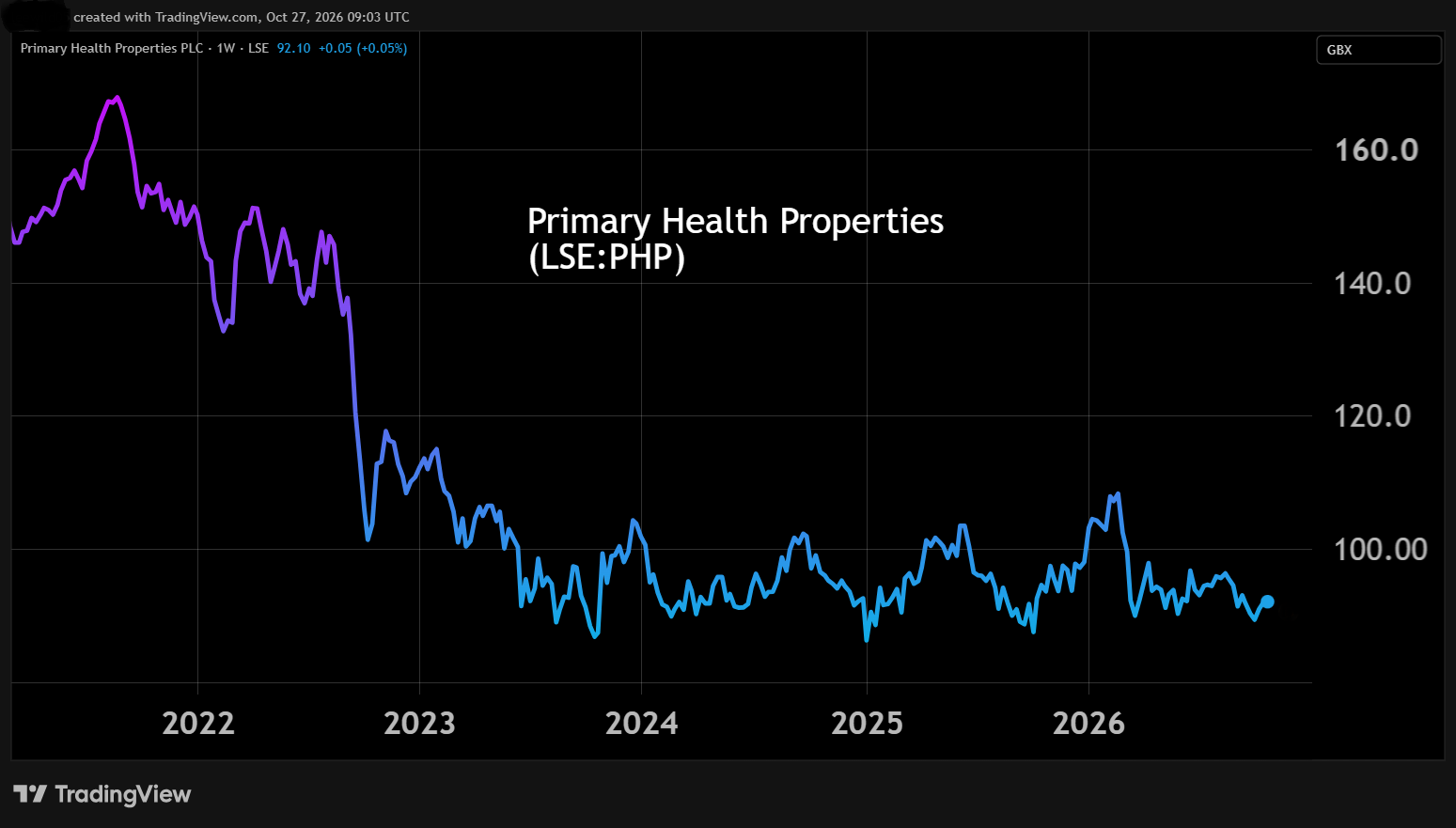
TradingView. Past performance is not a guide to future performance.
Aside from agreed regular small purchases by the founder and non-executive chair, the last material purchase was £150,000 worth at 92.1p by the senior non-executive director in August 2025.
This REIT likes to proclaim itself as having an unbroken 30-year track record of annual dividend growth, aided by upward-only rent reviews for healthcare properties that seem a lot more durable than, say, offices or shopping centres. A circa 8% dividend yield helps explain its popularity with retirees.
- Shares round-up: an 8% dividend yield and Filtronic’s rally
- Stockwatch: possibly the best risk-adjusted yield in UK equities
Yet total return in recent years has been frustrating; you could say the market prices for such yield as compensation for holding risk.
Macro conditions can significantly affect these shares
Management flaws are not necessarily implied. In particular, the 2022 derating occurred when interest rates rose to combat post-pandemic inflation, which also raised government bond (gilt) yields. Since REITS like this rely on long duration, fixed-income-like cash flows, rising (virtually) risk-free yields compress REIT valuations - what investors are willing to pay for rental income even when relatively secure.
The notorious September 2022 UK Mini-Budget also triggered a sell-off in property-related shares, yet there is currently a mild parallel by way of high gilt yields and interest rates probably having to rise to curb inflation. In the very near term perhaps the best we can say, macro-wise, is that Wednesday’s Autumn Budget possibly induces an aspect of relief rally in affected shares, if the chancellor at least is seen to be steadying the UK fiscal ship.
Since PHP is substantially reliant on government-backed NHS leases, you could say a radical left-wing government could take a tougher line – anti-private sector profits in a public service – similar to the way Prime Minister Andy Burnham is currently crusading against the water industry. It’s a bit like how the political Right threatens renewables, although I suspect in government they will have enough on their plate.
Radical response to lack of growth leads to debt dilemma
My chief concern is how PHP took the step of a major acquisition in July 2025 – to re-rate financial performance – which bumped up debt. It has also since led to the curiosity of joint ventures with financial institutions where PHS “seeds” (more accurately cedes) properties at a slight discount to net asset value (NAV) in return for cash lump sums that are then applied to reduce debt.
I confess that I am yet to figure out whether this is value-enhancing, neutral or worse, although it may explain why the shares at 92p trade at an 11.5% discount to adjusted net tangible assets per share (as of last June) on a reported basis.
I last mentioned PHP in July 2025 when they pipped private equity group Kohlberg Kravis Roberts in a takeover contest for listed rival Assura plc, creating the eighth-largest UK REIT with a portfolio of over £6 billion. At that time, 6.5% of PHP’s issued share capital was shorted, probably higher in total given disclosure related to positions over 0.5% versus 5.24% total shorting as of 19 October. That is significant in the context of a £2.4 billion company and, while I do not fear shorting (which can usefully depress market price for buying, with a baked-in rebound), we must always consider any rationale behind short positions.
- Trading Strategies: a FTSE 100 stock with recovery potential
- Sign up to our free newsletter for investment ideas, latest news and award-winning analysis
Fifteen months ago, PHP proclaimed an inflection point in its property cycle due to “improving rental growth and stabilisation in yields”, and also a 10-year health plan for England just published, with the government re-iterating its commitment to strengthen the NHS. The Assura acquisition makes this difficult to test given that it bulks up PHP’s numbers. From the 30 July interim results, it is not possible to see like-for-like performance within a 123% advance in net rental income and 109% in adjusted earnings, albeit a more modest 9% rise in adjusted interim earnings per share (EPS), with reported EPS actually down 14%.
The interim statement described the combination with Assura as contributing to a strong set of results “supported by a robust operational performance”, with the outlook conclusion citing various political initiatives as supportive.
If an operational inflection point is present, might it be the case that high gilt yields offset this by way of tempering PHP’s share price? I think that has to be considered.
See from the table below how net debt jumped 2.5x from 2024 (grinding higher to £3.4 billion as of last June), which the market understandably would have factored in dividend risk, helping explain a volatile-sideways share price. Financial risk scores are adjusted to “cautious”.
Primary Health Properties - financial summary
Year end 31 Dec
| 2019 | 2020 | 2021 | 2022 | 2023 | 2024 | 2025 | |
| Turnover (£ million) | 121 | 139 | 146 | 154 | 170 | 182 | 259 |
| Operating profit (£m) | 7.1 | 173 | 183 | 73.3 | 87.3 | 104 | 213 |
| Net profit (£m) | -71.3 | 112 | 140 | 56.3 | 27.3 | 41.4 | 119 |
| Operating margin (%) | 5.9 | 124 | 126 | 47.6 | 51.4 | 57.5 | 82.2 |
| Reported earnings/share (p) | -6.5 | 8.7 | 9.8 | 2.2 | 1.9 | 2.8 | 6.6 |
| Normalised earnings/share (p) | 2.1 | 8.4 | 13.5 | 1.8 | 1.8 | 2.8 | 9.2 |
| Operational cashflow/share (p) | 8.6 | 8.7 | 9.8 | 8.2 | 9.2 | 9.3 | 10.0 |
| Capital expenditure/share (p) | 0.0 | 0.0 | 0.0 | 0.0 | 0.0 | 0.0 | 0.0 |
| Free cashflow/share (p) | 8.6 | 8.7 | 9.8 | 8.2 | 9.2 | 9.3 | 10.0 |
| Return on total capital (%) | 0.3 | 6.6 | 6.6 | 2.6 | 3.2 | 4.1 | 3.6 |
| Cash (£m) | 143 | 104 | 33.4 | 29.1 | 3.2 | 3.5 | 20.0 |
| Net debt (£m) | 1,125 | 1,114 | 1,246 | 1,274 | 1,323 | 1,338 | 3,288 |
| Net assets (£m) | 1,229 | 1,414 | 1,500 | 1,482 | 1,424 | 1,376 | 2,554 |
| Net assets per share (p) | 101 | 108 | 113 | 111 | 107 | 103 | 98.4 |
Source: company accounts.
While there had already been two joint ventures across PHP’s portfolio, including with the Universities Superannuation Scheme (USS), the one declared last 19 October, with global institutional investor GIC, is most relevant to debt reduction. Twenty-seven private hospitals worth about £700 million will be “seeded” at a 5% discount to NAV in a 50:50 joint venture, with PHP receiving about £500 million to be applied for debt reduction. The CEO also proclaims the deal as enhancing the return on equity, which has varied from 2% to 6% but looks to be trending at over 8%.
Today, PHP has announced that its joint venture with USS will increase from £250 million to as high as £800 million, albeit PHP has just a 20% interest.
I have to say these joint ventures strike me as possible “dilution by other means” rather than a share issue, to cut debt, and it’s unclear whether the joint venture strategy was indicated for debt management when PHP bought Assura. It seems an after-case. The strategy is said to be supporting dividend security given that more earnings are freed from high-cost variable-rate debt, but that followed from bulking-up anyway, which in hindsight was not great given upward pressure now on rates.
A seemingly modest valuation
With consensus for normalised EPS around 7.5p based on roughly £200 million net profit, the forward price/earnings (PE) ratio of 12x appears proverbially modest. But I doubt it is significant to the valuation. The focus here is inflation-linked dividend growth and holding the share as part of a diversified income portfolio. The yield does, however, assume full distribution of projected earnings.
The shares rose to 108p by February then slid in March to 90p, trading volatile-sideways up to 97p. A current price of 92p is therefore at the lower end of the range albeit against attractive (near) risk-free gilt yields and prices.
Net debt should reduce to around £2.9 billion as a result of the GIC deal, where interim results showed it as £3.4 billion, with £78 million of finance costs taking 43% of operating profit. More “joint ventures” therefore look required, and I would prefer to see evidence both in terms of earnings and NAV, that they are not compromising. Like with any property assets right now, it is hard to assume upward revaluations are a certainty beyond a sense of replacement build cost inflation.
- Insider Interview: we have the most resilient dividend in the sector
- Find out the latest UK Budget news here
My conclusion therefore is that it is encouraging to see the CFO appear to reckon PHP shares rate a material “buy” at 92p. Healthcare provision plus the realities of a Labour government having to work with private sector provision constitute a reasonable tailwind. Mind a headwind of high gilt yields if they persist.
I also find PHP has got itself into a corner with a major acquisition boosting debt at the wrong time, thus effectively requiring asset disposals to manage it. To upgrade firmly to “buy”, I would like more evidence of how this works out, hence I maintain a “hold” rating.
Edmond Jackson is a freelance contributor and not a direct employee of interactive investor.
These articles are provided for information purposes only. Occasionally, an opinion about whether to buy or sell a specific investment may be provided by third parties. The content is not intended to be a personal recommendation to buy or sell any financial instrument or product, or to adopt any investment strategy as it is not provided based on an assessment of your investing knowledge and experience, your financial situation or your investment objectives. The value of your investments, and the income derived from them, may go down as well as up. You may not get back all the money that you invest. The investments referred to in this article may not be suitable for all investors, and if in doubt, an investor should seek advice from a qualified investment adviser.
Full performance can be found on the company or index summary page on the interactive investor website. Simply click on the company's or index name highlighted in the article.
Disclosure
We use a combination of fundamental and technical analysis in forming our view as to the valuation and prospects of an investment. Where relevant we have set out those particular matters we think are important in the above article, but further detail can be found here.
Please note that our article on this investment should not be considered to be a regular publication.
Details of all recommendations issued by ii during the previous 12-month period can be found here.
ii adheres to a strict code of conduct. Contributors may hold shares or have other interests in companies included in these portfolios, which could create a conflict of interests. Contributors intending to write about any financial instruments in which they have an interest are required to disclose such interest to ii and in the article itself. ii will at all times consider whether such interest impairs the objectivity of the recommendation.
In addition, individuals involved in the production of investment articles are subject to a personal account dealing restriction, which prevents them from placing a transaction in the specified instrument(s) for a period before and for five working days after such publication. This is to avoid personal interests conflicting with the interests of the recipients of those investment articles.