Stockwatch: an upgrade triggered by recovery potential
This stock might have reached an inflection point, believes analyst Edmond Jackson who also notes director share buying and investors possibly closing short positions.
28th July 2026 11:02
by Edmond Jackson from interactive investor

Last October I examined FTSE 250 marketing services group WPP (LSE:WPP) at 293p after its third-quarter results, concluding to let the situation evolve further before buying. I said “it can go either way but the news could be worse before it improves”.
- Our Services: SIPP Account | Stocks & Shares ISA | See all Investment Accounts
Here we are at 295p currently, so in terms of timing that was a fair enough call, but I have a sense not to be complacent given the appointment of Cindy Rose as CEO from last September. This ex-head of Microsoft UK with six years’ service as a WPP non-executive director, looks as if she could bring the right balance of fresh perspective yet firm understanding of a quite sprawling group assembled by acquisitions and due a streamlining.
Last November she bought £144k worth of shares at 289p, and the chairman from early 2025 Philip Jansen (the former CEO of BT) £143k at 285p. It concerned me, however, that WPP was due to drop from the FTSE 100, which happened in December, although the shares bumped along chiefly until the outbreak of the US/Iran war saw a drop to 225p by late March.
During that slide, Rose added £135k worth of WPP shares at 269p and Jansen £128k at 255p. In May, the ex-CEO of Swedish furniture retailer Ikea was appointed non-executive director and bought an initial £211k worth at 281p.
Cheap valuation and overcrowded short trade?
Such purchases by highly experienced businesspeople lend credence to the sense of a turnaround prospect, where if consensus forecasts are fair, then the December 2027 price/earnings (PE) ratio is 5.5x and the prospective dividend yield 5.6%. Either such expectations are blindly optimistic, or the shares will re-rate higher.
On the opposite trade, and above the 0.5% disclosure threshold to 13 July, were eight institutions (mainly hedge funds) short of 5.8% of WPP’s issued share capital. Since disclosure has changed such that we only now see the total percentage of shorts, it was 9.08% as of 23 July and will take a bit of time to discern any trend. There was mixed trading on the short side however up to 13 July, hence I am alert that should short sellers begin to close out positions we could see a technical re-rate, similar to quite a few other cyclical shares lately.
WPP thus looks another current example of a broadly cyclical business in need of fresh direction, actively shorted, yet well-positioned in its markets and having attracted a capable new CEO. Basic valuation criteria hint at an inflection point and, technically, the shares have been in an uptrend since late March - a dip from 285p to 245p triggered a rally. This has the feeling of a low being established unless chronic Middle East conflict pushes up inflation and interest rates:
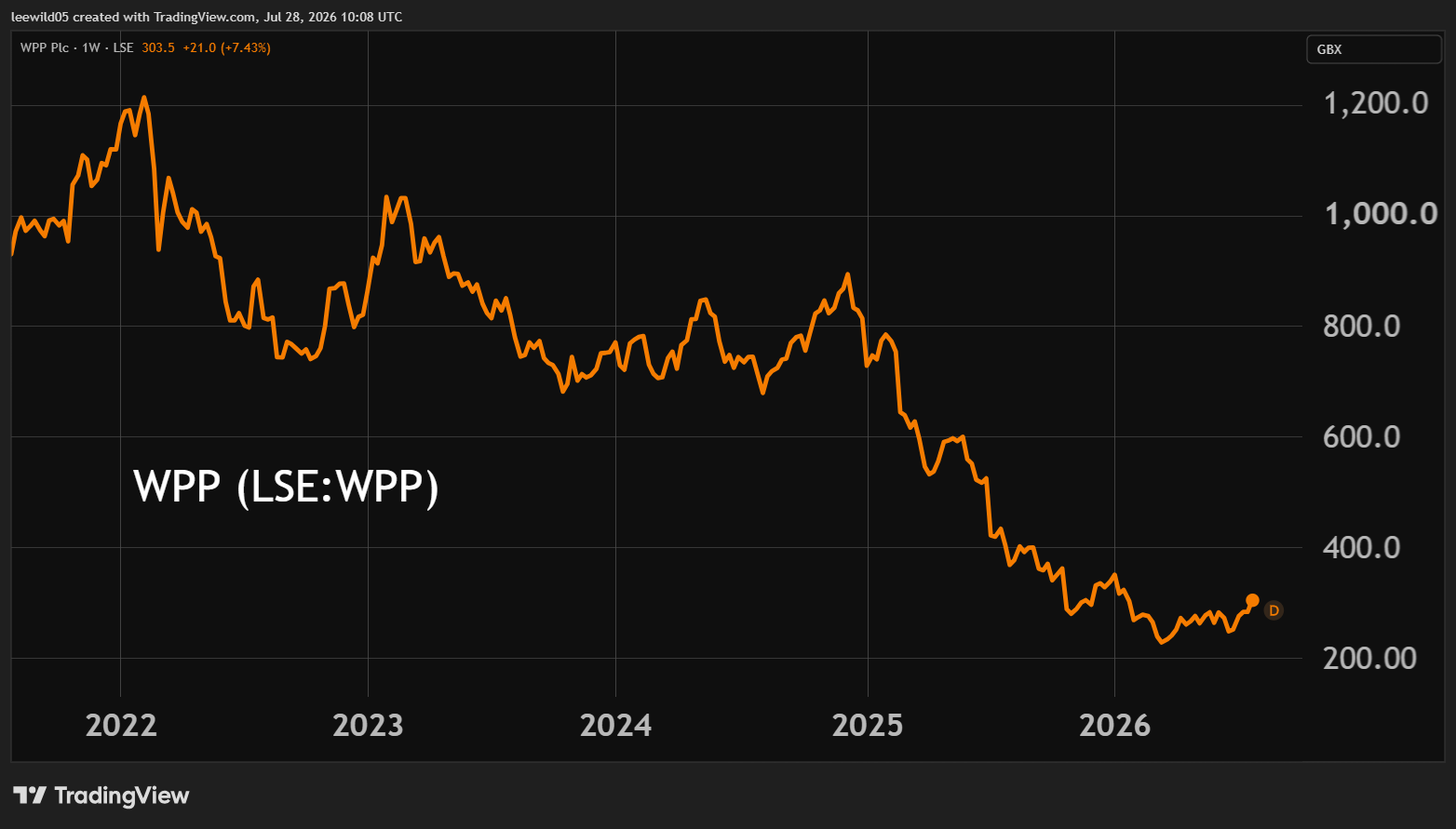
Source: TradingView. Past performance is not a guide to future performance.
Should potential buyers wait for next results?
In terms of seeking proof, yes, waiting till half-year results on 6 August might be prudent, but pragmatically we have seen a string of companies recently report progress countering the sense of an obvious short trade, triggering rallies up to 20% or more. That half the disclosed short-sellers have started to reduce their short trades since 1 July exposes the shares to upside if the CEO can reassure the market.
Key to sentiment will be insights conveyed by the CEO on progress of her “Elevate28” three-year strategic turnaround plan – aimed at transforming WPP from a diversified holding company into an integrated operating company with four key divisions of media, creative, production and enterprise solutions, unified by the AI platform WPP Open.
The bearish stance is that WPP is late to the AI party which is fundamentally undermining group revenue. Major brands can increasingly handle content creation and advertisement planning in-house thus saving on agency fees. And WPP is going with the flow, launching WPP Open Pro which enables small and mid-sized brands to independently plan and create campaigns.
So can the net effect generate overall revenue growth rather than loss from AI-creep?
Aggressive competition has manifested from digital-first platforms such as Google, Meta and Amazon, and WPP embarrassingly saw a $1.7 billion (£1.3 billion) Mars media account lost in June 2025. Client relations are potentially where a new CEO can however make a material difference.
The overall industry context looks tougher than when WPP achieved peak net profit of £1.24 billion in 2015 and £1.40 billion in 2016. But that was versus a share price well over 1,500p back then, and it intrigues me how sub-300p looks too far a fall given the new CEO.
Net debt is risk in recession
Short-sellers will be well aware of WPP’s adjusted net debt of £3.3 billion, like BlackRock Financial Management Inc, which (before the disclosure regime changed) had by far the largest short at 1.20% (raised 0.01% on 23 June). Yet the world’s largest asset manager may be doing so as part of overall risk management for different economic scenarios rather than asserting a view on the CEO’s work.
WPP had £3.3 billion average net debt during the first quarter and £3.4 billion at 31 March, implying net gearing around 120% but where goodwill (predominantly) and intangibles constituted 277% of end-2025 net assets. The 2025 income statement showed total net finance costs of £258 million, swiping 61% of operating profit after contributions from associates.
- eyeQ: Antofagasta, Medtronic, L&G, Hikma Pharma
- 20 hottest tech stocks of the week: Tesla, Alphabet, Super Micro, Microsoft
A key question therefore is whether US/Iran hostilities mitigate the situation, or a war of attrition sets in. WPP shares rose over 4% yesterday, partly amid hopes for a peace settlement but massively beat the wider market’s circa 0.5% rise, I think because investors are alert to recovery potential.
Or, if the US steps back with Trump fearing November’s mid-term elections, this leaves Iran with significant control over the Strait of Hormuz, hence upward pressure on energy/commodity prices affecting inflation and interest rates. WPP’s balance sheet is not great for such scenario.
What to make of consensus forecasts
Consensus estimates project a £215 million net loss in 2025 will become a £548 million profit this year and £588 million in 2027, which significantly mean-reverts on 2021 and 2022 (see table), helped by £500 million cost savings WPP is budgeting for. This would generate normalised earnings per share (EPS) of 51.2p and 54.1p, but mind likely exceptional costs affecting reported numbers.
WPP - financial summary
| year ended 31 Dec | 2014 | 2015 | 2016 | 2017 | 2018 | 2019 | 2020 | 2021 | 2022 | 2023 | 2024 | 2025 |
| Turnover (£ million) | 11,529 | 12,235 | 14,389 | 15,804 | 13,047 | 13,234 | 12,003 | 12,801 | 14,429 | 14,845 | 14,741 | 13,550 |
| Operating margin (%) | 13.6 | 13.2 | 14.2 | 12.1 | 9.2 | 9.4 | -20.2 | 9.1 | 8.5 | 3.8 | 9.0 | 2.8 |
| Operating profit (£m) | 1,569 | 1,610 | 2,048 | 1,909 | 1,196 | 1,248 | -2,424 | 1,167 | 1,224 | 565 | 1,321 | 382 |
| Net profit (£m) | 1,077 | 1,160 | 1,400 | 1,817 | 1,063 | 844 | -2,967 | 638 | 683 | 110 | 542 | -215 |
| Reported earnings/share (p) | 80.5 | 88.4 | 108 | 126 | 73.9 | 67.3 | -243 | 52.5 | 61.2 | 10.1 | 49.4 | -20.0 |
| Normalised earnings/share (p) | 91.6 | 92.0 | 103 | 140 | 99.0 | 81.3 | -50.5 | 69.3 | 85.3 | 35.4 | 83.6 | 33 |
| Operating cashflow/share (p) | 127 | 104 | 137 | 110 | 134 | 147 | 168 | 167 | 62.8 | 113 | 128 | 67.3 |
| Capital expenditure/share (p) | 16.0 | 18.8 | 22.0 | 25.6 | 29.7 | 31.3 | 22.3 | 24.1 | 20.0 | 19.9 | 21.5 | 17.3 |
| Free cashflow/share (p) | 111 | 84.8 | 115 | 84.8 | 105 | 116 | 146 | 143 | 42.8 | 93.3 | 107 | 50.0 |
| Dividend/share (p) | 38.2 | 44.7 | 56.6 | 60.0 | 60.0 | 22.7 | 24.0 | 31.2 | 39.4 | 39.4 | 39.4 | 15.0 |
| Cash (£m) | 2,513 | 2,382 | 2,437 | 2,391 | 2,643 | 11,306 | 12,899 | 3,883 | 2,492 | 2,218 | 2,638 | 2,694 |
| Working capital (£m) | -80.2 | -840 | -1,322 | -358 | -666 | -298 | 755 | -1,150 | -2,610 | -2,307 | -1,855 | -1,665 |
| Net debt (£m) | 2,275 | 3,211 | 4,131 | 4,483 | 4,017 | 3,789 | 2,852 | 2,943 | 4,690 | 4,658 | 3,710 | 4,138 |
| Net assets per share (p) | 569 | 590 | 728 | 747 | 744 | 630 | 386 | 313 | 344 | 314 | 322 | 235 |
Source: Historic Company REFS and company accounts
The plan is to eliminate duplication of roles in support functions, and streamline management and offices. Given the intention to invest also in analytics and AI infrastructure, it can make profit assumptions quite tricky, and also in respect of how such investment is accounted and interpreted.
Thematically, the CEO characterises WPP still currently at a “stabilisation” phase, targeting “build” in 2027 with a return to organic revenue growth, and 2028 “accelerate” as transformation into a leaner AI-enabled business completes. It’s unclear whether the balance sheet will be much shorn of debt given investment needs though.
- The FTSE 100 results you won’t want to miss this summer
- Sign up to our free newsletter for investment ideas, latest news and award-winning analysis
This looks to me as if it’s tilting positively for risk/reward on the shares unless a worse-case macro scenario compromises things.
In a muddling-through economic scenario I think WPP still justifies a starter position lest interim results reassure the market and a keen short position is exposed.
I therefore upgrade WPP shares to “buy” which has its risks before interim numbers and the narrative are disclosed, but given the technical position it could be quite easy for the shares to rise barring disappointments.
Edmond Jackson is a freelance contributor and not a direct employee of interactive investor.
These articles are provided for information purposes only. Occasionally, an opinion about whether to buy or sell a specific investment may be provided by third parties. The content is not intended to be a personal recommendation to buy or sell any financial instrument or product, or to adopt any investment strategy as it is not provided based on an assessment of your investing knowledge and experience, your financial situation or your investment objectives. The value of your investments, and the income derived from them, may go down as well as up. You may not get back all the money that you invest. The investments referred to in this article may not be suitable for all investors, and if in doubt, an investor should seek advice from a qualified investment adviser.
Full performance can be found on the company or index summary page on the interactive investor website. Simply click on the company's or index name highlighted in the article.
Disclosure
We use a combination of fundamental and technical analysis in forming our view as to the valuation and prospects of an investment. Where relevant we have set out those particular matters we think are important in the above article, but further detail can be found here.
Please note that our article on this investment should not be considered to be a regular publication.
Details of all recommendations issued by ii during the previous 12-month period can be found here.
ii adheres to a strict code of conduct. Contributors may hold shares or have other interests in companies included in these portfolios, which could create a conflict of interests. Contributors intending to write about any financial instruments in which they have an interest are required to disclose such interest to ii and in the article itself. ii will at all times consider whether such interest impairs the objectivity of the recommendation.
In addition, individuals involved in the production of investment articles are subject to a personal account dealing restriction, which prevents them from placing a transaction in the specified instrument(s) for a period before and for five working days after such publication. This is to avoid personal interests conflicting with the interests of the recipients of those investment articles.