Why Tesco and Sainsbury’s shares now offer ‘good entry point’
Both supermarkets have come off the boil recently, which has got industry analysts talking about buying in at a discount. City writer Graeme Evans explains the rationale.
9th June 2026 12:56
by Graeme Evans from interactive investor
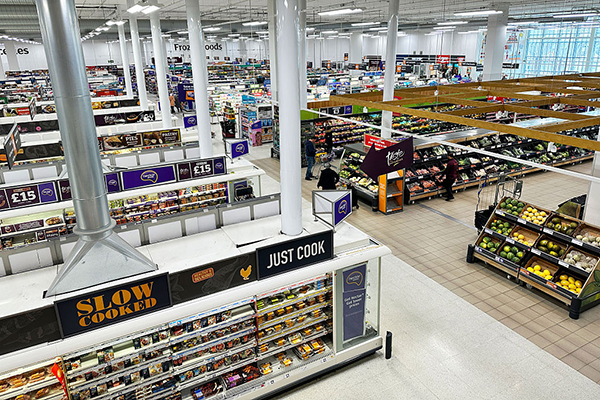
Inside a Sainsbury’s supermarket in London. Photo: Peter Dazeley/Getty Images.
Attractive entry points for the shares of Tesco (LSE:TSCO) and Sainsbury (J) (LSE:SBRY) have been flagged by a City bank after the value of the supermarkets stumbled in the wake of April’s annual results.
UBS’s Buy stance comes ahead of first-quarter updates due later this month, when it expects the grocers will reassure on their profit growth outlook despite consumer uncertainty.
- Our Services: SIPP Account | Stocks & Shares ISA | See all Investment Accounts
The bank sees a 31% upside for Sainsbury’s shares to 395p, while “high-quality, resilient compounder” Tesco is backed for a 20% rise on today’s level to reach 545p.
A separate note by Deutsche Bank this week forecast upside to 525p for Tesco as it said market conditions were “competitive but rational” and that the UK’s biggest supermarket chain was relatively well positioned to cope with inflationary pressures.
Tesco shares fell by as much as 11% in the period between its better-than-expected annual results and the end of May as industry-wide till roll figures highlighted the impact of less favourable weather conditions than a year ago.
The supermarket’s AGM trading update on 18 June also faces tough comparatives after last year’s like-for-like growth rate of 5.1% set a multi-year record outside Covid.
UBS has trimmed its UK like-for-like sales growth forecast for the quarter to 30 May to 2% from 3%, but said that signs of a greater bottom-line focus by smaller rivals Asda and Morrisons continued to point to a “rational market allowing profit growth”.
- ii view: GSK makes biggest acquisition in over a decade
- Stockwatch: this turnaround share could march higher
- Iran war 100 days: how stocks and markets have performed
- ii view: Tesco equipped to overcome Middle East threat
And despite the ongoing macroeconomic and geopolitical uncertainty, it said Tesco’s control on gross margins and structural efficiencies were reasons to remain confident that the group will deliver profit growth in 2027 and over the medium term.
The bank said the recent de-rating of shares from 16 times forecast earnings to 14 times provided a “good entry point”.
It added that continued reliable cash generation, shareholder-friendly capital allocation and optionality from AI efficiencies were among reasons why it regards the recent valuation multiple expansion of Walmart Inc (NASDAQ:WMT) as “a clear template for Tesco”.
The UK supermarket achieved its highest market share for over a decade as sales in its annual results rose 4.3% to £66.6 billion and adjusted operating profit lifted 0.6% to £3.15 billion. A 9.7p a share dividend is due on 26 June, increasing the total for the year by 5.8%.
While the war in the Middle East has forced Tesco to issue a wider range of guidance than previously planned, management still forecasts adjusted operating profit of between £3 billion and £3.3 billion for the 2026-27 financial year.
UBS said Tesco offered an attractive 13% total shareholder return compound growth rate over the next four years.
It added that a track record of about 8% compound growth in earnings over the past five years in diverse operating environments gave it confidence in the mid-term thesis.
Deutsche Bank now sees Tesco reporting first-quarter UK like-for-like sales growth of 2.2%, compared with its previous forecast of 3%.
It added: “The market is competitive but rational, in our view, with supplier costs yet to impact pricing. We view Tesco as relatively well positioned for inflation given its leading scale, defensive profile, sharpened value, private labels and incremental margin levers.”
The shares of Sainsbury’s have fallen by about 12% since its annual results, when solid figures came in short of some of the loftier estimates being attached to the group.
- Bellway update has something for bulls and bears
- Sign up to our free newsletter for investment ideas, latest news and award-winning analysis
- Money market funds the worst-selling fund sector at start of tax year
- Don’t write off UK stocks: two undervalued FTSE 100 shares
The chain is now on a multiple of 12.6 times forecast earnings, which represents a 9% discount to the long-term average.
UBS has cut its first-quarter grocery sales growth forecast to 3.5% from 4% but believes that Sainsbury’s is in good shape and is able to deliver volume outperformance versus the sector.
The bank noted slightly more crowding around “short” positions on the stock, which suggests that a soft quarterly update on 30 June is priced into expectations. It added that this pullback offered a more “attractive entry point”.
Sainsbury’s is due to pay a final dividend of 9.6p on 10 July, an award that lifted the total for the 2025-26 year by 0.7% to 13.7p a share.
These articles are provided for information purposes only. Occasionally, an opinion about whether to buy or sell a specific investment may be provided by third parties. The content is not intended to be a personal recommendation to buy or sell any financial instrument or product, or to adopt any investment strategy as it is not provided based on an assessment of your investing knowledge and experience, your financial situation or your investment objectives. The value of your investments, and the income derived from them, may go down as well as up. You may not get back all the money that you invest. The investments referred to in this article may not be suitable for all investors, and if in doubt, an investor should seek advice from a qualified investment adviser.
Full performance can be found on the company or index summary page on the interactive investor website. Simply click on the company's or index name highlighted in the article.