Why turbulence in Japan is important for all portfolios
Japan’s currency has suffered a sustained sell-off, despite a rare currency intervention from Washington and Tokyo. Analyst John Ficenec considers the historic step in detail, and the implications for US and UK equity investors.
14th August 2026 14:31
by John Ficenec from interactive investor

A sharp fall in the value of the Japanese currency may seem like nothing to worry about for investors. But as markets in Asia kick off the 24-hour trading day, they also tend to set the tone for market performance around the world. That is why the Land of the Rising Sun can offer some useful insight into the state of the market as we head into autumn at record highs around the world.
- Invest with ii: Buy International Shares | Most-traded US Stocks | Top UK Shares
Land of the falling yen
For anyone who has just returned from their summer holidays, let me bring you up to speed. At the tail end of July, Japan and the US staged a coordinated intervention to avert the slide in the yen after it hit a 40-year low against the dollar. Japan was forced to act in concert with the US in the first joint yen intervention since 2011 and the largest one-day purchase in history.
The tribulations in the yen are a headache for the US because Japan is the world’s largest holder of US debt, or Treasuries. The US economy may be the largest in the world, but it still funds itself on borrowing.
In June alone it spent $120 billion (£89 billion) more than it raised in taxes, and so far this year the gap between spending and taxes raised is $1.4 trillion, according to US Treasury data. So, it is constantly issuing more debt to keep the whole show on the road.
The levels of debt in the US are now beginning to unnerve markets, with investors starting to worry about how they are going to pay it all back. The government debt to gross domestic product ratio, which is an indication of the country’s ability to repay the debts, currently sits at around 124%.
The largest foreign holder of US debt is Japan with $1.14 trillion in US Treasuries, just ahead of the UK with $950 billion, followed by China with $660 billion.
Therein lies the problem, because if Japan wants to halt or reverse the slide in its currency, it has to sell something. It makes sense to sell some of your largest assets, which are also most liquid, to support the currency. This would all be fine if the US wasn’t also Japan’s largest export market, and provider of national defence.
Far from normal
In normal times, the sale of some US Treasuries wouldn’t really be cause for concern, but we are far from normal times. The Japanese currency is suffering a sustained sell-off. One dollar was worth around 100 yen back in 2021. Before the July intervention, $1 was worth 164 yen - its lowest level against the US dollar for 40 years.
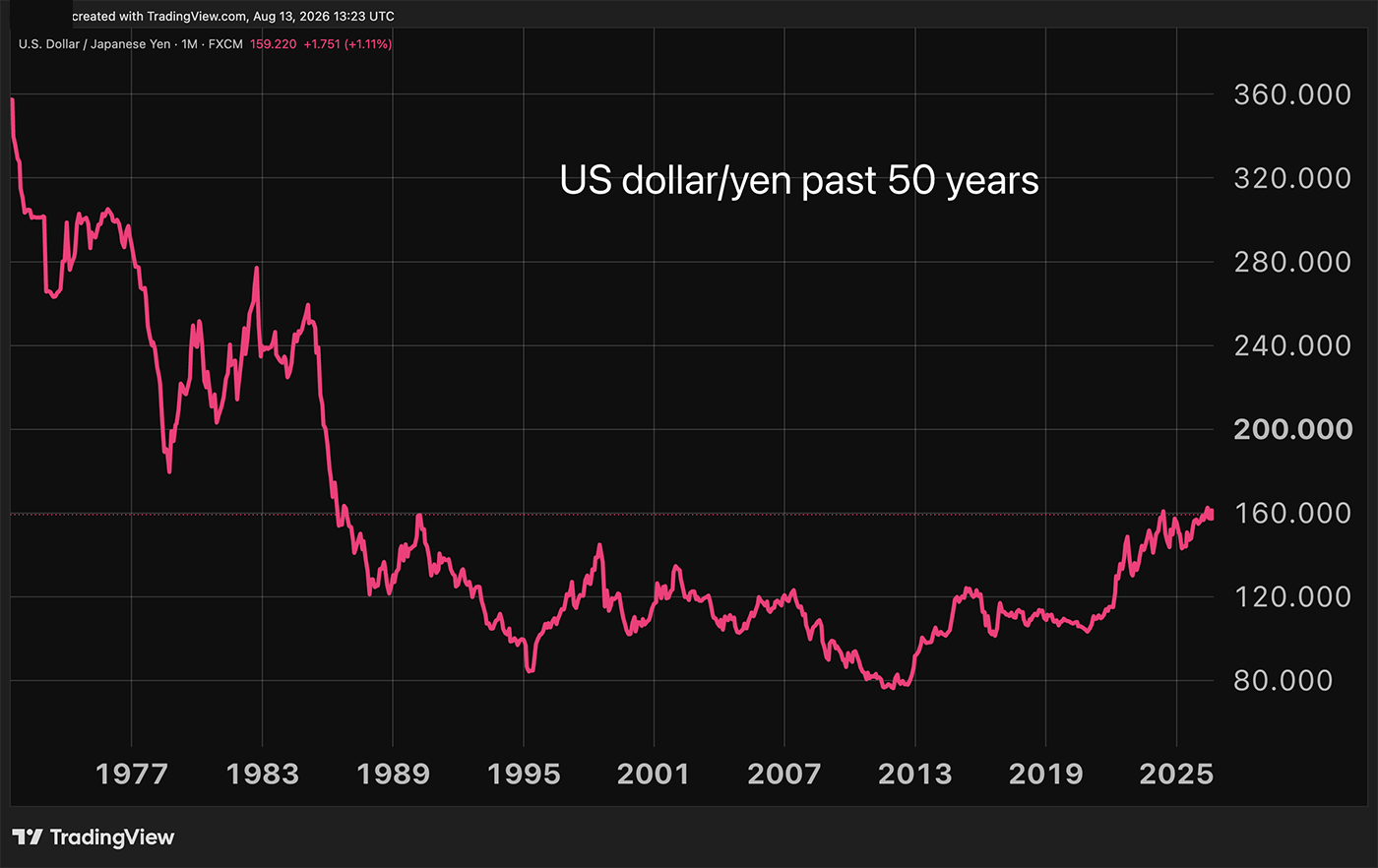
Source: TradingView. Past performance is not a guide to future performance.
In the short term that boosts the Japanese economy as it makes all the electronics, cars and other exports much cheaper for overseas buyers. But longer term, costs begin to rise sharply as Japan imports most of its raw materials, and the costs of household goods begin to rise in the shops, stoking inflation.
The question is how successful this recent intervention will be, as despite the yen strengthening from 164 to the dollar, to 157, it has since steadily sold off again and is pushing towards 160 once more.
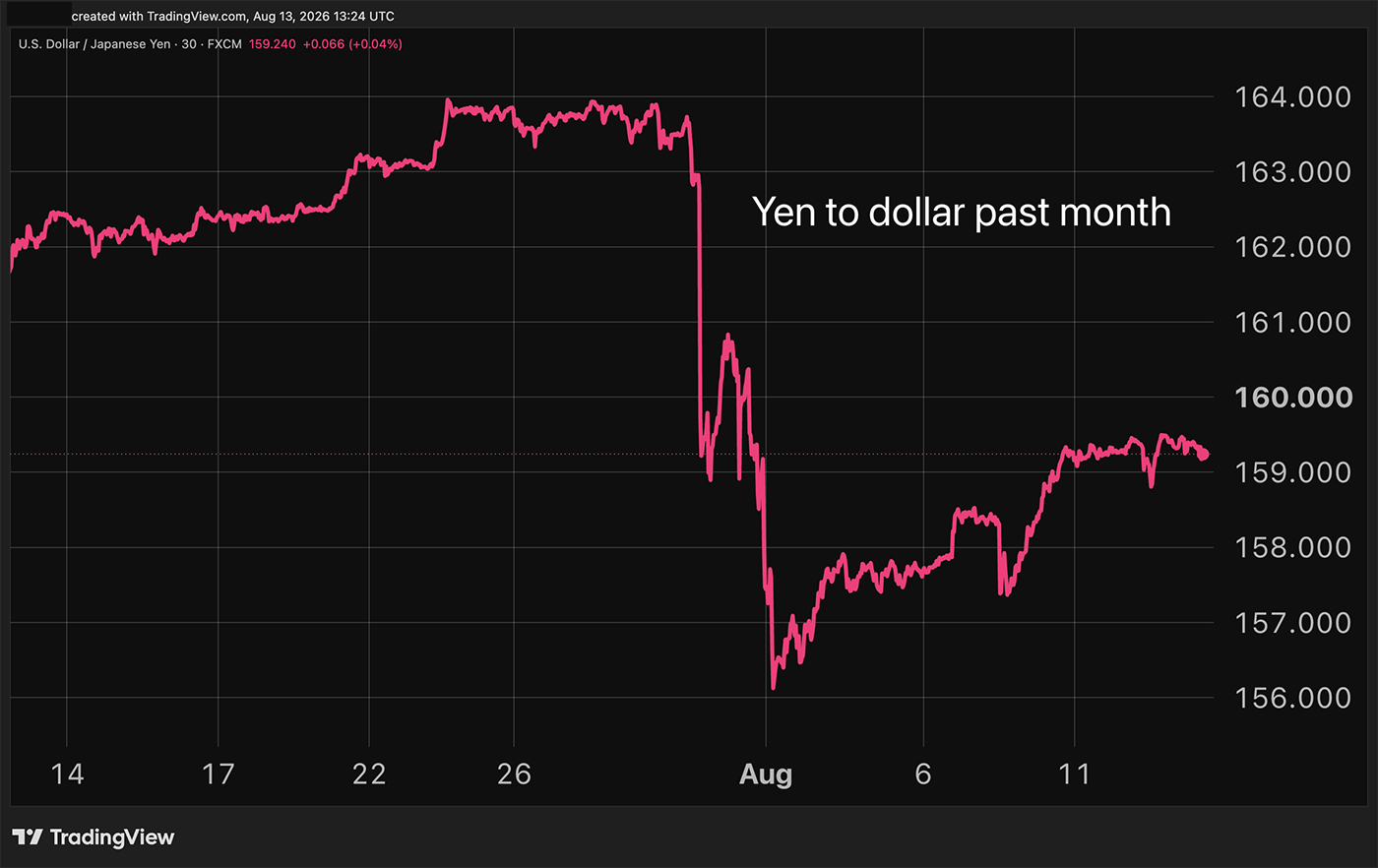
Source: TradingView. Past performance is not a guide to future performance.
The Japanese economy and yen are under pressure because it is more susceptible to higher oil prices, carries the world’s highest debt burden for an advanced economy, and with the 10-year Japanese government bond at 2.82%, it is still relatively much cheaper to borrow in yen than the US 10-year at 4.7%.
Hedge funds have been betting heavily against the Japanese currency. Before the intervention in July took place, short bets against the yen at the end of June were at their highest level since 2007. These short positions have since been greatly reduced on fears of more intervention.
The US as the largest economy in the world would usually fund the intervention by selling US Treasuries, but what was interesting in this instance is that they sold euro bonds to raise the cash to buy Japanese yen.
All this was done without so much as a courtesy call to their European trading partners, which rather suggests that the sine qua non of US economic policy is self-preservation rather than mutual benefit.
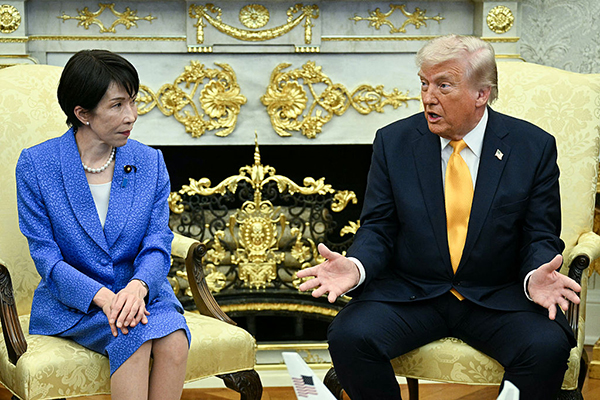
US President Donald Trump and Japan’s Prime Minister Sanae Takaichi at the White House in March 2026. Photo: Jim WATSON/AFP via Getty Images.
Under pressure
The US is having to make these extreme decisions on economic policy because of the pressure from global bond markets.
It has been said that US President Donald Trump was forced to introduce a 90-day pause on his tariff policy in April last year because of a sell-off in US Treasuries that spooked advisers. The benchmark US 10-year Treasury hit 4.44% just before the 90-day tariff pause last year.
Those levels are now a distant memory and were just the mere foothills, with the 10-year Treasury soaring to 4.71% - it’s highest level since early 2007 before the banking crisis.
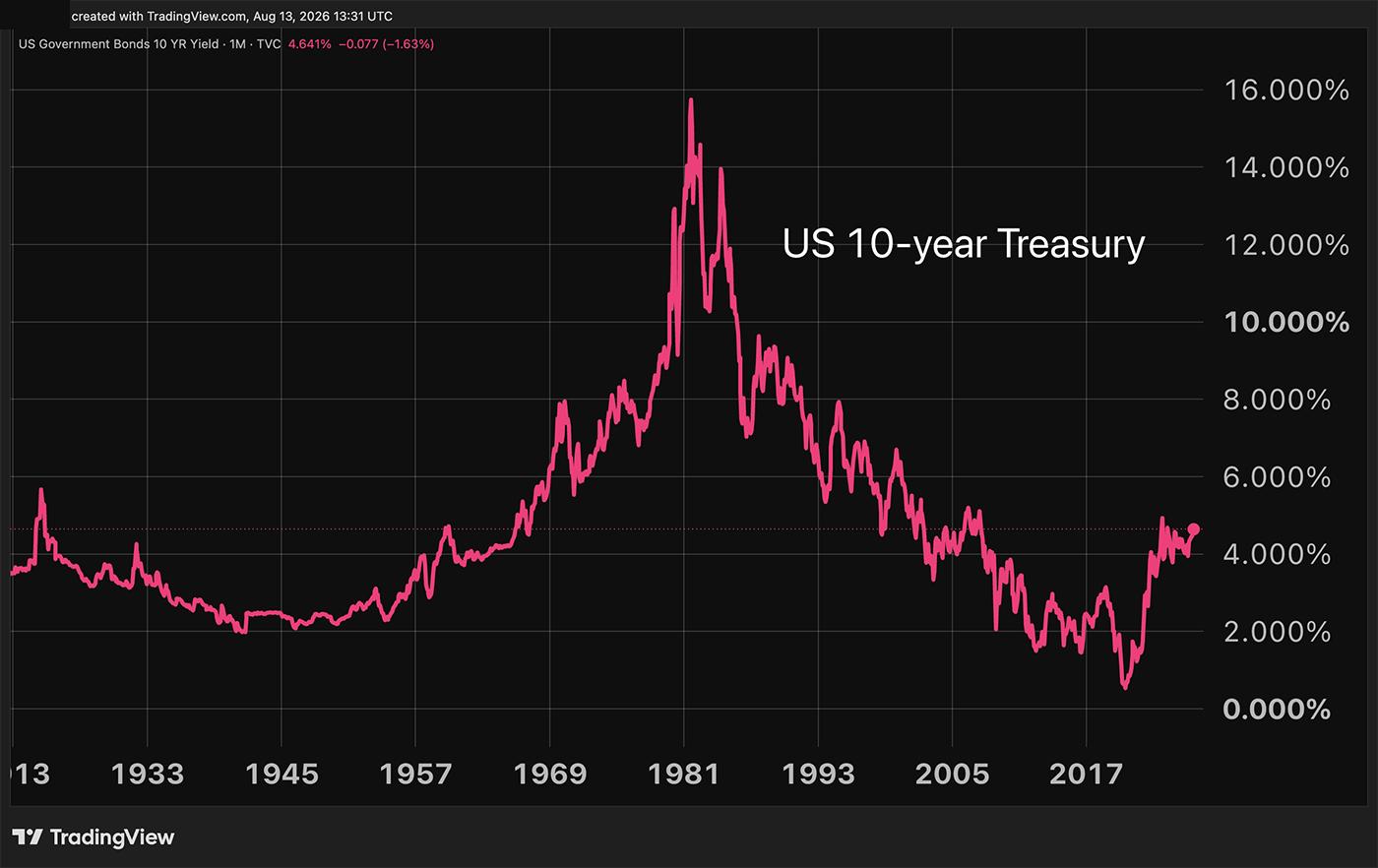
Source: TradingView. Past performance is not a guide to future performance.
The US 10-year Treasury is the benchmark used to set all mortgages, car loans, and credit card debt which increases pressure on Trump as we are now just over two months away from the midterm elections. The ongoing war in Iran has sent US petrol prices over the all-important psychological barrier of $4 per gallon as well.
Inflation has been bubbling up in the US too, hitting the highest level for three years, with the consumer price index (CPI) at 4.2% in May, although it has since fallen back to 3.4% in July, but still comfortably above the Federal Reserve target rate of 2%.
To some extent, a cap has been put on inflation through the US tapping its strategic petroleum reserve, but that is not an endless supply. The US Strategic Petroleum Reserve (SPR) started this year at 413 million barrels and is now 114 million barrels lower at 299 million barrels - the lowest level since January 1983.
Japan likewise authorised the largest drawdown in history this year from its strategic oil reserve. Alternative supplies have since been found and negotiations eased the passage of some tankers during June and July.
Needless to say, the longer the war goes on, the less capacity there is to insulate from rising oil prices as Japan has historically imported 95% of its oil from the Middle East.
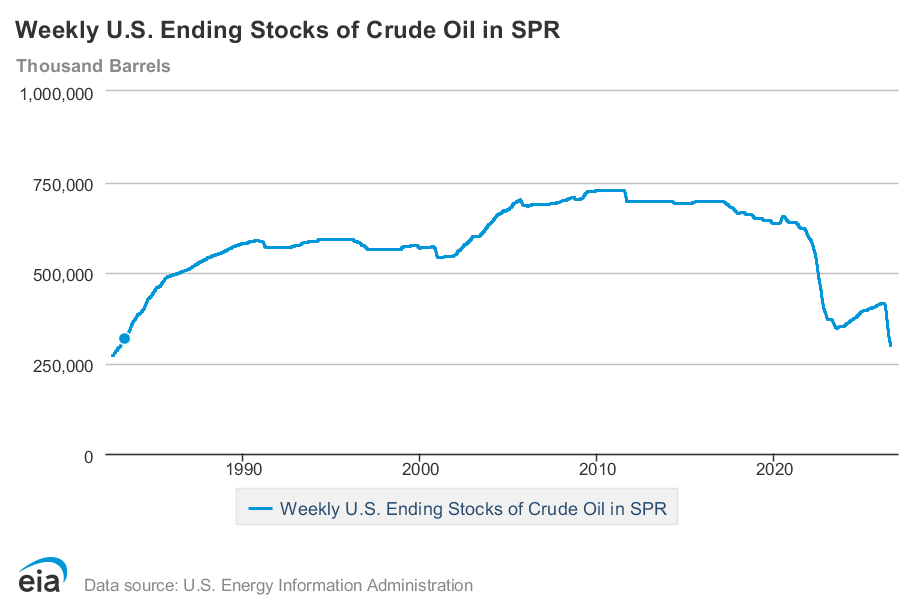
Source: US Energy Information Administration.
Punch-bowl economics
The punch bowl for markets was kept firmly in place recently as the new Federal Reserve chair Kevin Warsh held rates at between 3.5% to 3.75%. But in the bizarre world where up is down, stock markets surged higher because the US economy is doing worse than expected. Fewer jobs were created than expected in July, according to the Bureau of Labor Statistics.
A weaker outlook for labour and growth and lower inflation reduces the chance of a rate rise in September even though inflation is still well above target. Lower interest rates and a weaker dollar were also a boon for gold, which jumped almost 10% higher to $4,400 an ounce from the levels of around $4,000 where it has spent most of the summer.
Right now, there isn’t cause for alarm. Markets in the US, Japan and the UK have all hit fresh all-time highs in the face of the recent ructions. However, Henry Allen, market strategist at Deutsche Bank, warns that there is little margin for error as markets are pricing, “a goldilocks combination where growth remains strong, central banks only hike a bit, that the supply shocks will prove temporary, and oil prices fall back again”.
- 5 smart steps to navigate pre-Budget uncertainty
- Sign up to our free newsletter for investment ideas, latest news and award-winning analysis
As autumn fast approaches, and with it a return to full trading volumes after the summer doldrums, it is worth keeping an eye on some of the more esoteric corners of global finance.
The question is whether there will be any unintended consequences from the US funding two wars - fighting one while propping up its borrowing through currency intervention in global markets.
When the war in Iran first started, markets were pricing in a resolution within six weeks, but that timeline has been and gone. The global economy and markets have proved remarkably resilient, but Japan is showing that it is starting to operate under increasing pressure.
John Ficenec is a freelance contributor and not a direct employee of interactive investor.
These articles are provided for information purposes only. Occasionally, an opinion about whether to buy or sell a specific investment may be provided by third parties. The content is not intended to be a personal recommendation to buy or sell any financial instrument or product, or to adopt any investment strategy as it is not provided based on an assessment of your investing knowledge and experience, your financial situation or your investment objectives. The value of your investments, and the income derived from them, may go down as well as up. You may not get back all the money that you invest. The investments referred to in this article may not be suitable for all investors, and if in doubt, an investor should seek advice from a qualified investment adviser.
Full performance can be found on the company or index summary page on the interactive investor website. Simply click on the company's or index name highlighted in the article.
Disclosure
We use a combination of fundamental and technical analysis in forming our view as to the valuation and prospects of an investment. Where relevant we have set out those particular matters we think are important in the above article, but further detail can be found here.
Please note that our article on this investment should not be considered to be a regular publication.
Details of all recommendations issued by ii during the previous 12-month period can be found here.
ii adheres to a strict code of conduct. Contributors may hold shares or have other interests in companies included in these portfolios, which could create a conflict of interests. Contributors intending to write about any financial instruments in which they have an interest are required to disclose such interest to ii and in the article itself. ii will at all times consider whether such interest impairs the objectivity of the recommendation.
In addition, individuals involved in the production of investment articles are subject to a personal account dealing restriction, which prevents them from placing a transaction in the specified instrument(s) for a period before and for five working days after such publication. This is to avoid personal interests conflicting with the interests of the recipients of those investment articles.