Burnham’s triple lock shake-up and what it could mean for pensioners
Bold plans to introduce a triple lock lite in three and half years’ time may ultimately hinge on election success. Personal finance expert Craig Rickman looks at possible outcomes.
30th September 2026 15:34
by Craig Rickman from interactive investor
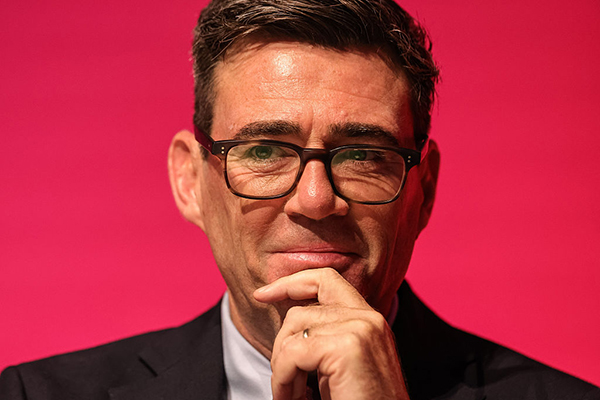
Prime Minister Andy Burnham during the Labour Party Conference 2026 in Liverpool. Photo by Mark Cosgrove/News Images/NurPhoto via Getty Images.
Andy Burnham used his first Labour Party Conference speech as prime minister to tackle one of the thorniest and most divisive issues in UK politics.
In what could turn out to be a huge political gamble, Burnham announced that the state pension triple lock will be replaced from 2030 to free up cash to create a new national care service in the UK. He believes the move will save £15 billion a year by the end of the 2030s, rising to £50 billion by 2050.
“I’m not getting rid of the triple lock completely, I’m adjusting it,” the prime minister told the BBC shortly after the speech, conceding that the sentence might easily be construed as a politician’s cop-out.
- Invest with ii: Open a Low Cost SIPP | What is a SIPP | Interactive investor Offers
The triple lock was introduced in 2011, guaranteeing that the state pension uprates annually by the highest of inflation, wage growth or 2.5%. But pressure to scrap or water down the triple lock has been mounting for almost a decade, with concerns that it’s driving the state pension towards long-term unsustainability.
In the first review of the state pension age, conducted in 2016, John Cridland recommended the policy should be replaced by an earnings link from 2020 to keep costs down and avoid intergenerational unfairness.
The matter, however, has been treated as the hottest of political hot potatoes, with successive governments and political leaders resisting calls to address its future; until now.
We’ll delve deeper into how the triple lock’s successor will work, but as a short summary the state pension will increase by the highest of inflation or 2.5% but will hold its value relative to earnings over time. So, essentially it will retain its 2.5% baseline, but the expensive “ratchet” effect when periods of high inflation are followed by wages playing catch up, will disappear.
According to Burnham, the state pension is expected to rise to a record level relative to earnings by 2030. “What I’m proposing sustains it at that level but doesn’t carry on the same rate of growth,” he explained to the BBC. A triple lock lite, if you like.
- Two-thirds of investors predict UK interest rate hike in November
- How much do you need to secure a comfortable retirement?
Reports that the prime minister might address the triple lock’s future had ramped up before he took to the stage. Despite facing increasing calls since the start of his premiership to tackle the policy, Labour’s election manifesto pledge to leave it alone for this parliament relieved him of acting now.
He could’ve easily anchored himself to this promise and let the matter drift for a few more years – potentially leaving it for someone else to address. Burnham has instead grasped the nettle and avoided punting this key aspect of the state pension’s future down the road for someone else to make the first move on.
How will the new policy work?
It’s not crystal clear at this stage and will be more complicated than the triple lock, but we have a broad idea. The proposal is more favourable to state pension recipients than straightforward, like the one temporarily introduced in 2022 when the government claimed its furlough scheme skewed the wage data.
As the Institute for Fiscal Studies (IFS) noted, a pivotal aspect of the fresh proposal is the removal of the ratchet effect which has made the policy increasingly expensive.
Since 2011, the state pension has increased 89% under the triple lock, bumping it up to a much higher level relative to average earnings – precisely what the policy was set out to achieve. Under either earnings increases or inflation, the state pension would’ve risen 66% or 60%, respectively, over this period. The IFS estimates that if the new uprating system had been implemented from 2011, annual expenditure would be £9 billion lower than it is today, but the state pension still would’ve risen around 75%, a “real terms” rise of 6%.
It said: “This illustrates a broader point: the new triple lock still leads to increases in the real value of the state pension over time, just not quite as fast as it would have under the old triple lock.”
- When will you get your state pension?
- Sign up to our free newsletter for investment ideas, latest news and award-winning analysis
Burnham’s proposed change still contains three elements, but it will operate in a different way. “In any given year it will go up by at least inflation or 2.5% – and anything more that is needed to retain that value. This means that over time the state pension is set to rise in line with average earnings,” the government said yesterday in an update on its website.
What do voters think?
A central talking point since the plans were announced, is whether the politically sensitive nature of the triple lock - notably the reliance on the “grey vote” - has kiboshed Burnham’s chances of winning the next election.
The risk of losing voters is one possible reason to explain why successive governments have staunchly stuck with the triple lock, despite urges from various quarters to review its long-term sustainability.
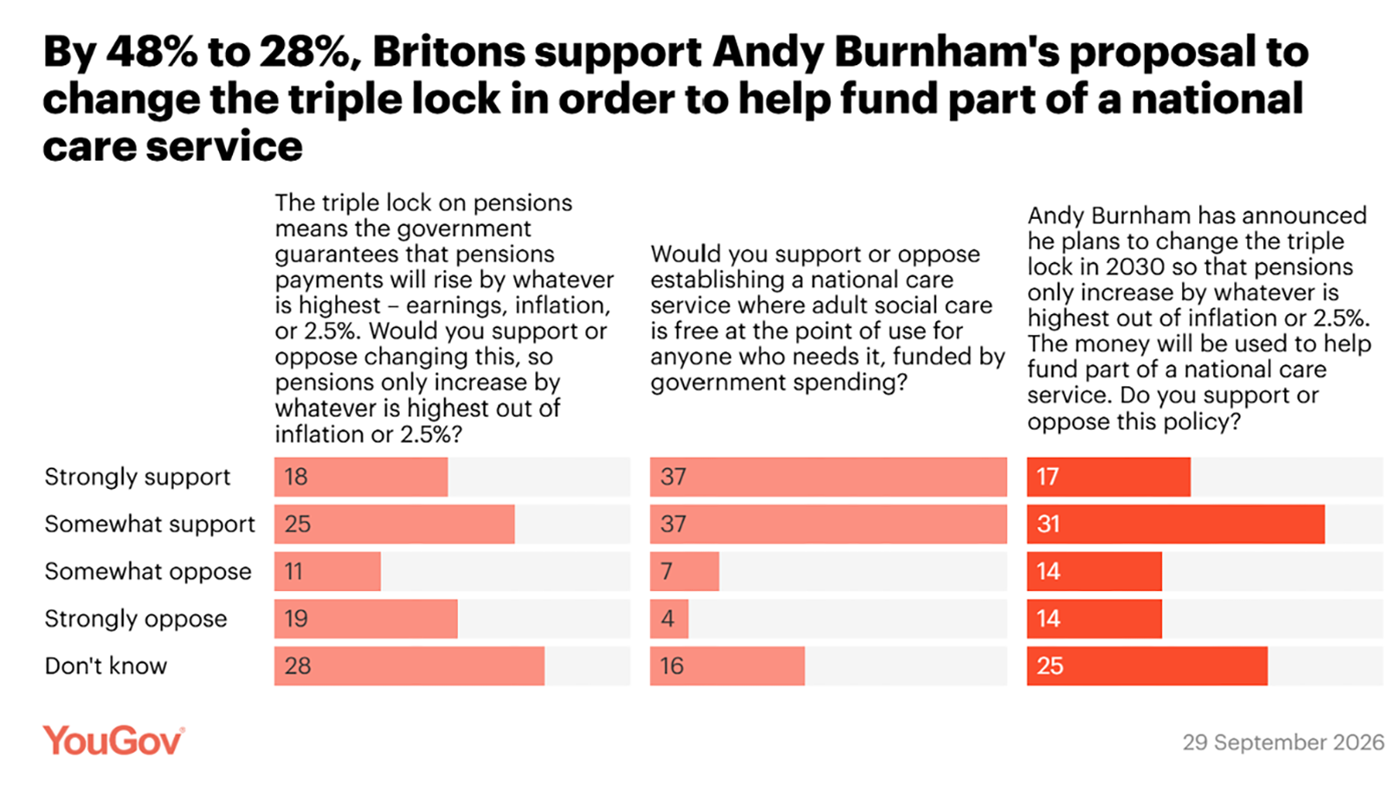
However, YouGov put Burnham’s proposal to water down the triple lock and direct the savings towards social care to around 4,500 voters. The results suggest that many are onside.
As the image below shows, almost half (48%) of voters either strongly or somewhat support the idea, compared to just 28% who are against it.
Will triple lock’s future now be put to bed?
While it will take the pressure off Burnham to nail his colours to the mast, the matter is set to rage on. As expected, others – including rival political parties – have waded into the debate, with the triple lock potentially forming a key policy battleground ahead of the next general election, which must take place by August 2029. There is no guarantee Burnham’s plan will see the light of day.
As you might expect, political leanings had a bearing on which way people voted in the YouGov survey. It found Burnham’s proposals are backed by 66% of Labour voters, 67% of Lib Dems and 58% of Greens, compared to 37% of Tories and 27% of Reform UK voters.
Conservative chair Kevin Hollinrake condemned the prime minister’s plans as “robbing Peter to pay Paul” and suggested the triple lock will form part of his party’s manifesto whenever an election is called.
Before Burnham delivered his speech, Sharon Graham, general secretary at Unite the Union, warned that scrapping the triple lock was “morally wrong”, urging the prime minister to explore wealth taxes before trying to “pick the pocket of pensioners”.
Another big question is whether the reform will generate sufficient funds to support the government’s social care plans. Given the unknown trajectory of inflation and wage rises, future state pension costs are tricky to predict. The new uprating system might not reduce spending by the numbers the government forecasts. Jonathan Cribb, deputy director at the IFS, is sceptical, saying: “We should not expect this reform to save enough that it could fund universal social care in the next parliament.”
In other words, Burnham will almost certainly need to find extra money from elsewhere, especially as Cribb notes, the savings to the state pension generated by triple lock mark 2 are likely to be smaller in the early years, before beefing up as time goes on.
These articles are provided for information purposes only. Occasionally, an opinion about whether to buy or sell a specific investment may be provided by third parties. The content is not intended to be a personal recommendation to buy or sell any financial instrument or product, or to adopt any investment strategy as it is not provided based on an assessment of your investing knowledge and experience, your financial situation or your investment objectives. The value of your investments, and the income derived from them, may go down as well as up. You may not get back all the money that you invest. The investments referred to in this article may not be suitable for all investors, and if in doubt, an investor should seek advice from a qualified investment adviser.
Full performance can be found on the company or index summary page on the interactive investor website. Simply click on the company's or index name highlighted in the article.