Is India about to move back into the fast lane?
The country’s stock market enjoyed a rapid growth spurt before lagging most Asian peers for the past few years. A Kepler analyst assesses the likelihood of a turnaround and investment trusts to gain exposure.
24th July 2026 14:15

This content is provided by Kepler Trust Intelligence, an investment trust focused website for private and professional investors. Kepler Trust Intelligence is a third-party supplier and not part of interactive investor. It is provided for information only and does not constitute a personal recommendation.
Material produced by Kepler Trust Intelligence should be considered a marketing communication, and is not independent research.
Just two years ago India appeared unstoppable. The economy was booming, with GDP growth of over 8%, transformative PM Narendra Modi had just been sworn in for a historic third term, and even the men’s cricket team had won their first T20 World Cup since 2007.
However, in hindsight, the third quarter of 2024 proved a high-water mark for the country’s equity markets, which peaked in September, and have now lagged most Asian peers for the past couple of years. In this piece, we look at the factors that have impacted the Indian success story and assess whether a turnaround is due any time soon.
Two years of troubles
There have been several factors that have contributed to the India pullback. Initially, nervousness grew as several key stocks reported lower-than-forecast earnings growth in September 2024, such as Infosys Ltd ADR (NYSE:INFY) in the IT sector, Hindustan Unilever in consumer staples and HDFC Bank Ltd ADR (NYSE:HDB) in the financials sector. This led to many investors reassessing equity valuations, which had risen significantly as the economy, and corporate earnings, had grown. However, with signs of this growth slowing, investors sold and the market fell.
Coincidentally, around the same time China announced a series of measures designed to improve its own domestic economy. This led to a sharp rally in the country’s equity market, with some indications that international investors were taking profits made in India in the past few years, and reallocating to an improving China. While the China recovery has since petered out, India has yet to benefit from a reversal in this trade due to a number of other factors.
THREE-YEAR PERFORMANCE
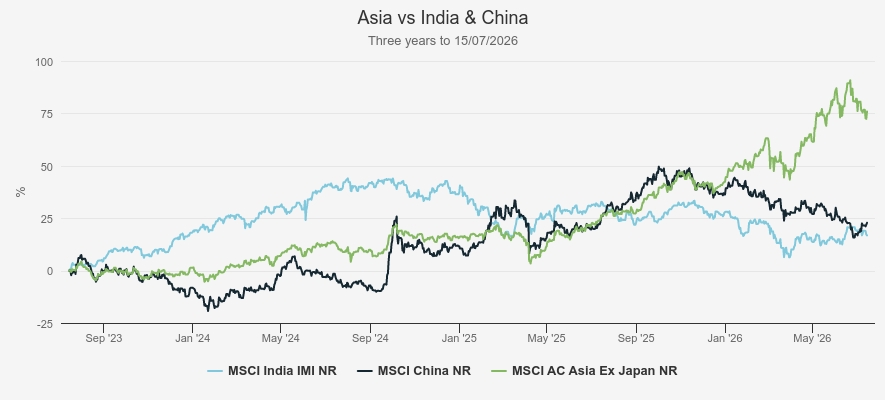
Source: Morningstar. Past performance is not a reliable indicator of future results
The India pullback initially lasted around six months, at which point Indian markets began to level out. However, before a sustained recovery could take hold, the next challenge arose – the tariff regime of Liberation Day. India was hit with a 25% rate, which, while suboptimal, was only slightly above the unweighted average of 20%. However, the real impact came later in the year when President Trump announced an additional 25% in July as a penalty for the country’s purchase of Russian oil. The timing of this was particularly challenging, as many countries had begun negotiations with the US so were on a falling trajectory, whilst India’s rate had doubled, making the country look comparatively unattractive. Furthermore, to resolve this, India, which is heavily dependent on oil imports and had been enjoying the benefits of discounted Russian oil, had to source supplies from elsewhere at higher costs, which will have fed through to firms in the country and impacted earnings. The impact of oil has again been a challenge in 2026 as prices spiked after the US-led war in Iran caused global supply issues, further weighing on India.
The tariff issue persisted throughout 2025, with the two countries eventually coming to an interim deal in February 2026, which included the removal of the additional 25%, and a fall in the initial reciprocal rate to 18%. However, before the benefits of this could feed into markets, India was already facing its third major headwind – AI.
As a country, India is arguably one of the most exposed to the prevalence of AI. The IT servicing industry is one of the country’s most well-known and important sectors, and is perceived as being at risk to the broad scale adoption of AI. In early 2026, these so-called ‘AI losers’ were hit across global markets, including several software companies and the IT servicing names, further impacting Indian markets and their outlook.
The turnaround?
These factors have clearly made for a challenging couple of years for India; however, importantly they are arguably temporary, and in many cases already subsiding. The tariff issue, for example, has been settled with the 18% negotiated rate leading to some certainty. Furthermore, the oil price had returned to pre-war levels by the midpoint of 2026, although the latest escalation in tensions has clouded the near-term picture. As such, both headwinds are unlikely to be an ongoing obstacle in the medium term.
The potential impact of AI is the one factor that has more persistence, however this could present an opportunity for contrarian investors. Firstly, there is much debate about whether the AI trade is entering bubble territory and whilst that is a discussion in its own right, India could present a hedging opportunity for those concerned over AI, as the IT services sector will likely enjoy a relief rally from waning AI breakthroughs. Similarly, several managers, including Gabriel Sacks of Aberdeen Asia Focus PLC (LSE:AAS), have begun analysing the range of India’s IT servicing companies to see if any could become AI beneficiaries by helping businesses implement systems in their existing product offering.
On top of the recent headwinds fading, the managers of Ashoka India Equity Investment Ord (LSE:AIE)highlight that India’s macroeconomic outlook looks resilient. They note that earnings growth is forecast to return to long-term averages in the upcoming financial year, which in India runs to March, shrugging off the latest difficulties. The Nifty 50 Index, India’s flagship market index, is forecast to deliver earnings growth of 13% to March 2027, considerably up on the 6% of 2025 and 8% of 2026 figures that contributed to the market pullback.
The 2027 figure is also back in line with the long-term average of 12%. Furthermore, the managers highlight that whilst inflation has risen from the likes of oil, it is only to 3.9%, approximately in line with long-term averages, meaning the country’s central bank has not had to raise interest rates, and in fact, has maintained them throughout 2026 having gone through a cutting cycle in 2025. All of this has culminated in a real GDP growth figure of 7.7% for 2026, with forecasts of 6.5% and 7% for the next two years, not only above the country’s own long-term average of 6%, but with figures that most large economies could only dream about. This points to a macro picture that has absorbed the challenges of the past two years and may now be supportive of a market recovery.
An early indication this recovery may have started has been the performance in the second quarter of 2026. The MSCI India IMI Index rose strongly in the three months to the end of June 2026, up 12.7%. Despite this rally, the challenges in Q1 have led to a year-to-date fall of 6.4%. However, AIE has demonstrated excellent stock selection in both periods, managing to outperform both in the falling market of Q1 and in the rally of Q2, leading to a first half outperformance of nearly four percentage points. We believe this is a good example as to why an active management approach may be the best way to capture any turnaround in the market, due to the ability to outperform through good stock selection.
A question of cost
As mentioned earlier, one of the main factors that contributed to the scale of the pullback was high market valuations, following years of strong performance and investor inflows. On metrics such as the price to earnings (P/E) ratio, the market was very highly valued, both versus its own history and relative to other emerging markets. With two years of more subdued performance, aggregate valuations have retreated slightly in absolute terms although have fallen considerably when compared to broader Asian markets, meaning the Indian valuation premium is now back in line with long-term averages. In fact, according to Morningstar data, India’s P/E ratio has traded at an average premium of 57% over the past three years, and a high of 81% in early 2024. This compares to the current premium of just 21%. However, much of this is to do with the strength of Taiwan and Korea, which have risen significantly in the past few months on a P/E basis, as we show in the chart below. Here, we can see that India’s P/E ratio is currently 23.5×, slightly below the three-year average of 24.5× meaning that the retracement in the market is approximately in line with the pullback in earnings.
THREE-YEAR PERFORMANCE
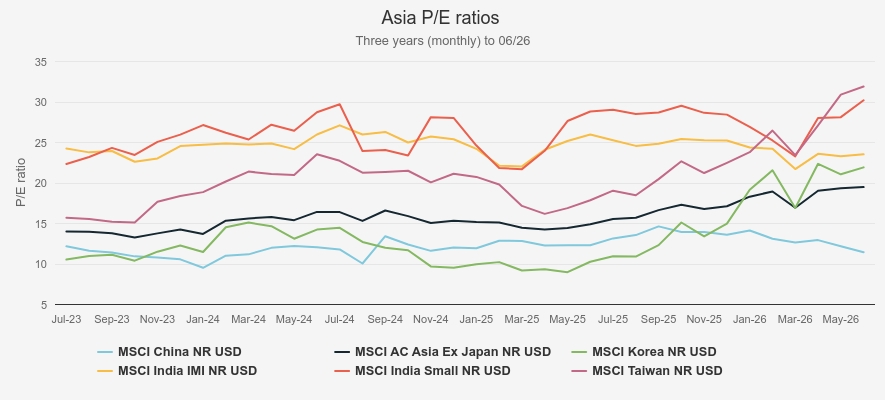
Source: Morningstar. Past performance is not a reliable indicator of future results.
In the chart above, we have included the valuations for India’s small- and mid-cap index, to show the valuation premium that still exists in this portion of the market. This is reflective of several comments that, whilst valuations in some parts of India have come back, there still remain pockets of elevated valuations in the country. We believe this further adds to the case for an active manager as the best way of capitalising on any valuation opportunity in India, as they are best able to navigate this mixed picture.
The managers of Aberdeen New India Investment Trust (LSE:ANII), Rita Tahilramani and James Thom acknowledge the picture is quite nuanced and fast moving, and have therefore been active in managing their exposures this year, looking at a mixture of different ideas. They have been adding to financials holdings, as they believe they offer some of the best value in the market, as well as delivering good operational performance, demonstrating good loan growth and higher asset quality as evidenced by record low non-performing loans, arguably showing the Indian consumer remains in good shape.
Elsewhere, they have added to more defensive areas such as healthcare, as this offers more protection from some of the macroeconomic sensitivities that have impacted the country whilst still offering long-term growth potential as the country continues to get wealthier. Rita and James are underweight the industrials sector though, as they note valuations are still quite challenging here.
One potential sign of India becoming more attractive is additions from managers with a broad Asia mandate. One example is Richard Sennitt of Schroder Oriental Income Ord (LSE:SOI), with two holdings from the country in the portfolio, which have met preferred quality characteristics that can provide an attractive and growing income over time. Indian stocks are not known for their income characteristics, and in fact, do not even feature in the trust’s benchmark, therefore for Richard to have added two off-benchmark positions in the past couple of years not only demonstrates the pockets of value on offer in India, but shows how active managers are able to identify them and capitalise accordingly.
Stepping back
While the past two years have been challenging for India, it is worth putting this into context. The country’s equity market has had a remarkable run over the longer term, with annualised returns comfortably in the double digits over the past 10 years, even accounting for a more mediocre performance more recently.
The primary factor supporting this has been the country’s strong economic growth, which is in turn supported by the numerous structural drivers in place such as excellent demographics, a government focused on reforms, and the increasing wealth of the population as a result. These factors are long term and will therefore outlast the impact of near-term issues such as tariffs and oil price spikes, meaning they will remain in place to support any future recovery.
The country is still growing at a remarkable rate and is on track to become the world’s third-largest economy within the next few years. While the recent picture has become a little clouded, the country continues to offer very strong potential. In addition, the fact this potential is driven by domestic factors, rather than global macro events, means the country can continue to be a portfolio diversifier for investors as part of a wider portfolio.
As such, while it is difficult to call this a turning point for India, we think the country continues to offer a very compelling investment case for the long term.
Kepler Partners is a third-party supplier and not part of interactive investor. Neither Kepler Partners or interactive investor will be responsible for any losses that may be incurred as a result of a trading idea.
These articles are provided for information purposes only. Occasionally, an opinion about whether to buy or sell a specific investment may be provided by third parties. The content is not intended to be a personal recommendation to buy or sell any financial instrument or product, or to adopt any investment strategy as it is not provided based on an assessment of your investing knowledge and experience, your financial situation or your investment objectives. The value of your investments, and the income derived from them, may go down as well as up. You may not get back all the money that you invest. The investments referred to in this article may not be suitable for all investors, and if in doubt, an investor should seek advice from a qualified investment adviser.
Full performance can be found on the company or index summary page on the interactive investor website. Simply click on the company's or index name highlighted in the article.
Important Information
Kepler Partners is not authorised to make recommendations to Retail Clients. This report is based on factual information only, and is solely for information purposes only and any views contained in it must not be construed as investment or tax advice or a recommendation to buy, sell or take any action in relation to any investment.
This report has been issued by Kepler Partners LLP solely for information purposes only and the views contained in it must not be construed as investment or tax advice or a recommendation to buy, sell or take any action in relation to any investment. If you are unclear about any of the information on this website or its suitability for you, please contact your financial or tax adviser, or an independent financial or tax adviser before making any investment or financial decisions.
The information provided on this website is not intended for distribution to, or use by, any person or entity in any jurisdiction or country where such distribution or use would be contrary to law or regulation or which would subject Kepler Partners LLP to any registration requirement within such jurisdiction or country. Persons who access this information are required to inform themselves and to comply with any such restrictions. In particular, this website is exclusively for non-US Persons. The information in this website is not for distribution to and does not constitute an offer to sell or the solicitation of any offer to buy any securities in the United States of America to or for the benefit of US Persons.
This is a marketing document, should be considered non-independent research and is subject to the rules in COBS 12.3 relating to such research. It has not been prepared in accordance with legal requirements designed to promote the independence of investment research.
No representation or warranty, express or implied, is given by any person as to the accuracy or completeness of the information and no responsibility or liability is accepted for the accuracy or sufficiency of any of the information, for any errors, omissions or misstatements, negligent or otherwise. Any views and opinions, whilst given in good faith, are subject to change without notice.
This is not an official confirmation of terms and is not to be taken as advice to take any action in relation to any investment mentioned herein. Any prices or quotations contained herein are indicative only.
Kepler Partners LLP (including its partners, employees and representatives) or a connected person may have positions in or options on the securities detailed in this report, and may buy, sell or offer to purchase or sell such securities from time to time, but will at all times be subject to restrictions imposed by the firm's internal rules. A copy of the firm's conflict of interest policy is available on request.
Past performance is not necessarily a guide to the future. The value of investments can fall as well as rise and you may get back less than you invested when you decide to sell your investments. It is strongly recommended that Independent financial advice should be taken before entering into any financial transaction.
PLEASE SEE ALSO OUR TERMS AND CONDITIONS
Kepler Partners LLP is a limited liability partnership registered in England and Wales at 9/10 Savile Row, London W1S 3PF with registered number OC334771.
Kepler Partners LLP is authorised and regulated by the Financial Conduct Authority.