Stockwatch: Burnham government forces me to upgrade this sector
Having successfully backed this sector in the past, analyst Edmond Jackson explains why he thinks these two companies are worth buying now.
24th July 2026 12:51
by Edmond Jackson from interactive investor

Andy Burnham outside No 10 Downing Street this week. Photo: Dan Kitwood/Getty Images.
It is interesting to note already firm underlying progress at FTSE 250 infrastructure/construction shares Galliford Try Holdings (LSE:GFRD) and Kier Group (LSE:KIE) despite a challenging macro context. Such companies should indeed offer defensive growth, with successive governments touting infrastructure spend as a means to boost the economy and also appease voters with action to tackle a “crumbling Britain”.
This was why, last September, I compared these shares, concluding that both merited a “hold” rating as a hedge against UK economic uncertainty. I had previously rated both a “buy” for recovery. I’d backed Galliford Try at 97p equivalent (adjusting for a share consolidation) in May 2018 after a three-year bear market linked to project overruns and exceptional costs on construction projects. I tipped Kier at 90p in July 2023 when contract wins were manifesting in highways, rail, infrastructure and nuclear.
- Our Services: SIPP Account | Stocks & Shares ISA | See all Investment Accounts
An Andy Burnham government seems ostensibly good news. His track record as regional mayor for Greater Manchester saw him frequently try to stimulate infrastructure such as improving regional transport connectivity. Last year, he proposed an underground rail network for the city region. Only last June he said he would reinstate the northern leg of HS2 if he became prime minister. He has also been forthright in seeking greater public control over energy, framing it alongside water and transport as part of making life more affordable.
Given the costs and complexities of nationalisation, the private sector will continue to be relied on. Shaking up the planning system will be an important first step to help unlock development, attract private capital and accelerate projects that aid economic growth.
I therefore regard his accession as mildly bullish for related shares, notwithstanding the need for companies to contain costs especially if inflation worsens in relation to Middle East war. Helped by the recent dip in fuel and certain food prices, UK inflation has eased to 2.6% but with oil prices soaring again, there looks little respite for interest rates.
Re-rates around year-end updates
The corporate context has already seen a pattern of upgrades in the last six months or so, but in the last fortnight alone, Galliford has risen 15% to 621p and Kier 12% to 240p, such that Galliford has surpassed February’s 577p record high (before outbreak of the US/Iran war) and Kier is close to its 250p high achieved around the same time:
These were driven by guidance towards the top end of expectations for the latest financial year and robust order books going forward.
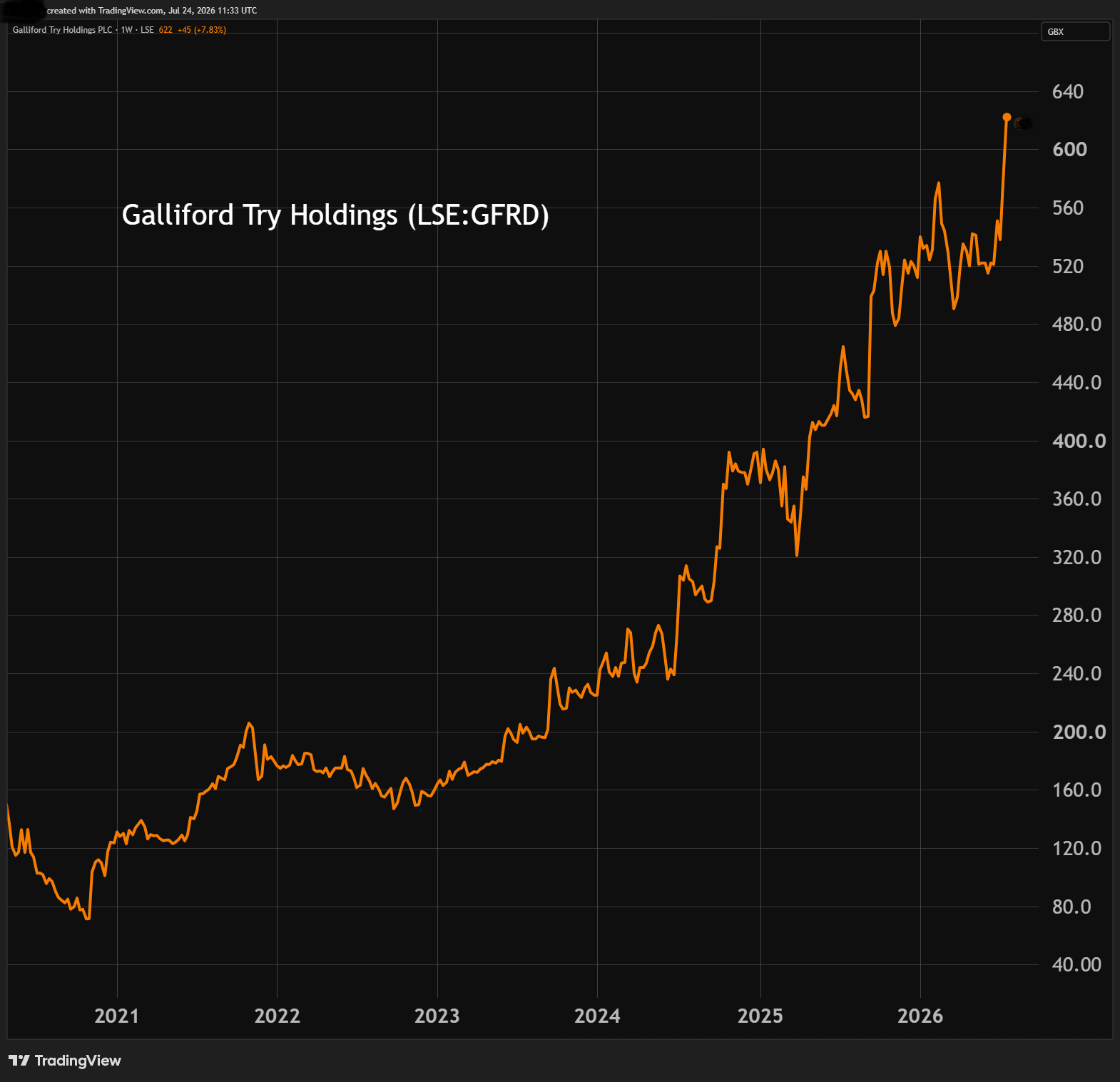
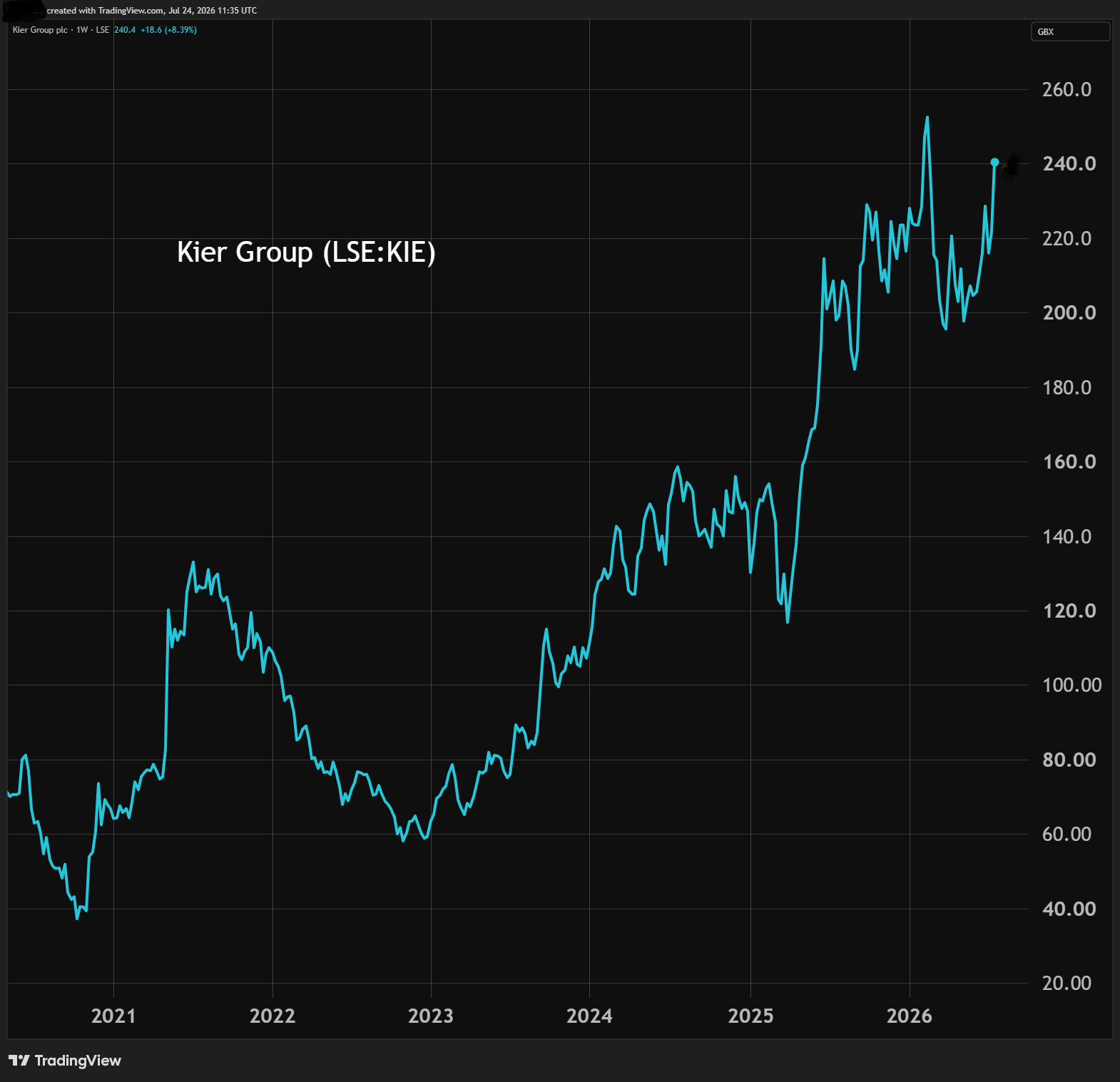
Source: TradingView. Past performance is not a guide to future performance.
Galliford has greater underlying momentum
While revenue growth has only been a modest 3%, adjusted pre-tax profit should be at the top end of an expected £51.4 million to £53.4 million range. Moreover, average month-end cash increased 21% to £216.2 million last year, culminating in £258.8 million at 30 June.
It is another profit upgrade following a mild one last January that raised earnings per share (EPS) growth expectations by 4% and 9% (according to which broker), which is a good habit to see and affirms Galliford being strategically aligned with government spending plans.
- Stockwatch: an oversold FTSE 100 share to average into
- The FTSE 100 results you won’t want to miss this summer
Momentum from the half-year thus continued throughout the second six months such that the group should report a sixth consecutive year of financial growth. Given the macro context this comes across as cyclically resistant if not offering defensive growth. While contractor shares are never going to sustain classic growth ratings, it is comforting for holders how, according to consensus forecasts, at 621p Galliford trades on a price/earnings (PE) ratio of 13.6x, with the expectation of 17.2% EPS growth this latest year easing to 15.4%.
Mind, the order book is up barely 5% to £4.3 billion albeit with around 90% of revenue secured in the current financial year.
An improved cash position also supports strong dividend growth, with 17.2% expected in respect of this latest year easing to 15.0% based on a dividend per share (DPS) of 25.6p to June 2027. On this basis, the 12-month forward yield would be 4.1% with 1.8x earnings cover.
Galliford Try Holdings - financial summary
year-end 30 Jun
| 2018 | 2019 | 2020 | 2021 | 2022 | 2023 | 2024 | 2025 | |
| Turnover (£ million) | 2,932 | 1,403 | 1,090 | 1,125 | 1,237 | 1,394 | 1,764 | 1,875 |
| Operating margin (%) | 5.2 | -4.7 | -3.6 | 0.8 | 0.2 | 0.4 | 1.4 | 2.1 |
| Operating profit (£m) | 151 | -66.5 | -39.4 | 8.5 | 2.5 | 5.6 | 13.0 | 39.7 |
| Net profit (£m) | 118 | 86.9 | 320 | 7.7 | 6.3 | 9.1 | 27.4 | 34 |
| Reported EPS (p) | 121 | -46.5 | -29.4 | 9.1 | 5.5 | 8.1 | 26.2 | 32.2 |
| Normalised EPS (p) | 175 | 4.9 | -56.4 | 15.8 | 19.5 | 18.6 | 34.4 | 26.6 |
| Operating cashflow/share (p) | 31.0 | -53.8 | -137 | 55.9 | 19.7 | 31.6 | 52.7 | 52.2 |
| Capex/share (p) | 4.7 | 3.3 | 1.3 | 1.9 | 4.3 | 2.0 | 1.0 | 5.2 |
| Free cashflow/share (p) | 26.3 | -57.1 | -139 | 54.0 | 15.4 | 29.6 | 51.7 | 47.0 |
| Ordinary dividend per share (p) | 74.2 | 58.0 | 0.0 | 4.7 | 8.0 | 10.5 | 15.5 | 19.0 |
| Covered by earnings (x) | 1.6 | -0.8 | 0.0 | 1.9 | 0.7 | 0.8 | 2.2 | 1.7 |
| Return on total capital (%) | 15.1 | -7.5 | -27.5 | 5.8 | 1.7 | 3.9 | 8.1 | 9.3 |
| Cash (£m) | 912 | 591 | 197 | 216 | 219 | 220 | 227 | 238 |
| Net debt (£m) | -98.2 | 56.6 | -175 | -197 | -194 | -181 | -223 | -233 |
| Net assets/share (p) | 614 | 612 | 109 | 121 | 119 | 113 | 118 | 119 |
Source: historic company REFS and company accounts.
Kier Group joins upgrade party
Last Tuesday, Kier updated similarly, with annual revenue and profit guided to the top end of expectations for its latest year to 30 June.
The second half saw £1.5 billion of new infrastructure business and £1.5 billion of new construction work with various significant projects. Both were weighted towards major public sector contracts such as Sizewell C, South West Water, prisons and hospitals.
The order book rose 8% to £11.9 billion – a greater dynamic than Galliford – and similarly 90% of revenue is secured for the current financial year.
Likewise, also, the trend in average month-end cash rose to around £11 million, with 30 June net cash up 14% to around £232 million. While prudently necessary for implanting major contracts, this also mitigates financial risk.
- Where to invest in Q3 2026? Four experts have their say
- Sign up to our free newsletter for investment ideas, latest news and award-winning analysis
Qualitative progress like this ought to benefit the shares’ rating given Kier’s improved financial consistency versus an historic fear of contract disruption. Kier has adopted a more focused approach away from riskier low-margin ventures to marry with government priorities, and the Burnham government’s initial words on water and defence affirm this strategy.
At 240p, the 12-month forward PE is 10.0x relative to the expectation for 13% EPS growth easing to 7% to June 2027, although it’s unclear whether management’s guidance to brokers has conservatively left scope for further upgrades given the strength of order book.
Dividend growth is also more modest than at Galliford, with Kier expected to see 8% growth this latest year, easing to 4.6% in June 2027 with DPS of 8.1p implying a 3.4% yield with 2.9x cover.
Kier Group - financial summary
year end 30 Jun
| 2014 | 2015 | 2016 | 2017 | 2018 | 2019 | 2020 | 2021 | 2022 | 2023 | 2024 | 2025 | |
| Turnover (£ million) | 2,907 | 3,276 | 3,998 | 4,112 | 4,220 | 3,966 | 3,423 | 3,261 | 3,144 | 3,381 | 3,905 | 4,077 |
| Operating margin (%) | 1.0 | 1.7 | -0.3 | 1.1 | 3.1 | -5.2 | -5.9 | 1.3 | 1.4 | 2.4 | 2.6 | 2.7 |
| Operating profit (£m) | 29.0 | 57.3 | -10.2 | 45.3 | 129 | -205 | -201 | 43.7 | 45.1 | 81.5 | 103 | 112 |
| Net profit (£m) | 10.0 | 4.4 | -17.6 | 10.7 | 87.3 | -210 | -273 | -0.3 | 12.7 | 41.1 | 42.7 | 56.4 |
| Reported EPS (p) | 15.8 | 39.3 | -25.3 | 12.8 | 75.5 | -126 | -90.9 | 11.6 | 2.8 | 9.3 | 11.3 | 12.1 |
| Normalised EPS (p) | 56.1 | 58.0 | 72.9 | 65.3 | 81.7 | 98.7 | 80.8 | 51.7 | 17.8 | 18.3 | 11.8 | 19.3 |
| Earnings per share growth (%) | -10.5 | 3.4 | 25.7 | 4.7 | 25.1 | 20.9 | -18.2 | -35.9 | -65.6 | 3.1 | -35.6 | 63.2 |
| Operating cashflow/share (p) | -8.5 | 168 | 172 | 130 | 111 | -53.5 | -37.9 | 22.8 | 16.3 | 41.6 | 50.9 | 50.4 |
| Capex/share (p) | 78.0 | 58.7 | 53.9 | 52.1 | 54.1 | 20.3 | 4.1 | 3.0 | 1.5 | 1.5 | 3.7 | 3.5 |
| Free cashflow/share (p) | -86.5 | 109 | 118 | 77.6 | 57.3 | -73.8 | -42.0 | 19.8 | 14.8 | 40.1 | 47.2 | 46.9 |
| Dividend per share (p) | 56.5 | 54.2 | 63.4 | 56.7 | 58.0 | 4.2 | 0.0 | 0.0 | 0.0 | 0.0 | 5.2 | 7.2 |
| Covered by earnings (x) | 0.3 | 0.7 | -0.4 | 0.2 | 1.3 | -30.0 | 0.0 | 0.0 | 0.0 | 0.0 | 2.2 | 1.7 |
| Net debt (£m) | 210 | 181 | 143 | 146 | 213 | 195 | 510 | 171 | 163 | 124 | 5.1 | -53.0 |
| Net assets/share (p) | 545 | 603 | 587 | 439 | 517 | 274 | 127 | 97.8 | 124 | 115 | 115 | 114 |
Source: historic company REFS and company accounts.
Possibly favour Kier over Galliford Try
Galliford is the relatively conservative choice given its stronger financial record and near-term earnings/dividend growth prospects, but are the fruits of Kier’s turnaround initiatives now coming through such that its relative discount in the sector make it a more favourable pick?
Both companies look set to benefit from a new government seeking to make its mark delivering improvement, and Kier’s risk management continues to strengthen. Its latest CEO was appointed last November, moving up from a role as commercial director, with the previous CEO since 2019 retiring.
There looks to be a case to own both shares given this favourable tailwind, although if forced to choose I sense Kier has greater medium-term potential upside from here. Mind, that a festering Middle East war and new inflation threat could temper progress, although less than with, say, private house-building sector.
On a two to three-year view, I therefore upgrade both to “buy” but select your entry with care after the latest re-rates and possibility of summer volatility.
Edmond Jackson is a freelance contributor and not a direct employee of interactive investor.
These articles are provided for information purposes only. Occasionally, an opinion about whether to buy or sell a specific investment may be provided by third parties. The content is not intended to be a personal recommendation to buy or sell any financial instrument or product, or to adopt any investment strategy as it is not provided based on an assessment of your investing knowledge and experience, your financial situation or your investment objectives. The value of your investments, and the income derived from them, may go down as well as up. You may not get back all the money that you invest. The investments referred to in this article may not be suitable for all investors, and if in doubt, an investor should seek advice from a qualified investment adviser.
Full performance can be found on the company or index summary page on the interactive investor website. Simply click on the company's or index name highlighted in the article.
Disclosure
We use a combination of fundamental and technical analysis in forming our view as to the valuation and prospects of an investment. Where relevant we have set out those particular matters we think are important in the above article, but further detail can be found here.
Please note that our article on this investment should not be considered to be a regular publication.
Details of all recommendations issued by ii during the previous 12-month period can be found here.
ii adheres to a strict code of conduct. Contributors may hold shares or have other interests in companies included in these portfolios, which could create a conflict of interests. Contributors intending to write about any financial instruments in which they have an interest are required to disclose such interest to ii and in the article itself. ii will at all times consider whether such interest impairs the objectivity of the recommendation.
In addition, individuals involved in the production of investment articles are subject to a personal account dealing restriction, which prevents them from placing a transaction in the specified instrument(s) for a period before and for five working days after such publication. This is to avoid personal interests conflicting with the interests of the recipients of those investment articles.