Stockwatch: an oversold FTSE 100 share to average into
After a terrible nine months, analyst Edmond Jackson believes this blue-chip share has fallen far enough. Here’s the thinking behind his ‘buy’ rating.
21st July 2026 09:39
by Edmond Jackson from interactive investor

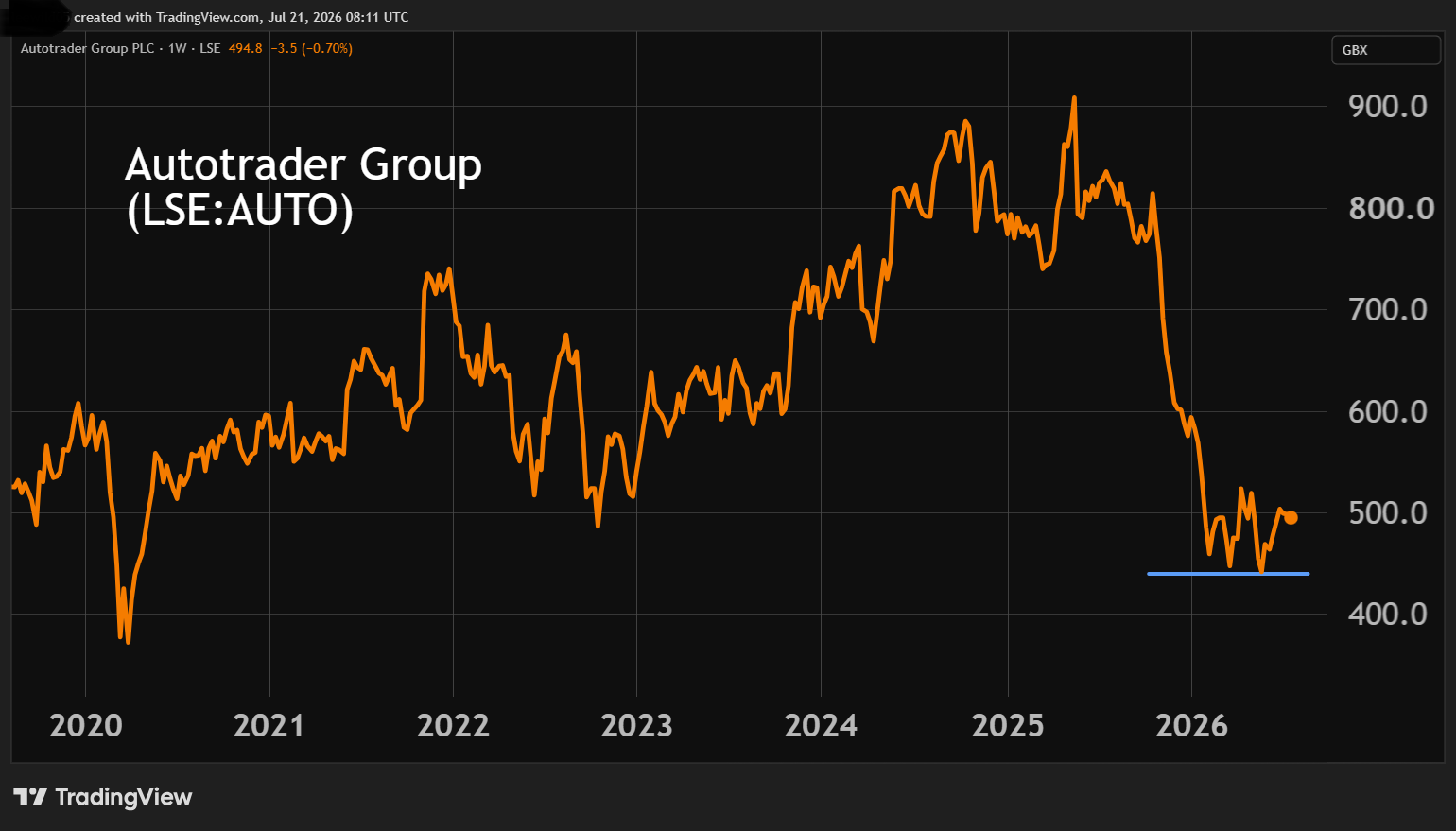
Last April I drew attention to FTSE 100-listed Autotrader Group (LSE:AUTO), the UK’s largest automotive sales platform, where a de-rating from around 900p in May 2025 to 496p looked overextended. While the business has had some issues, this extent of fall has probably related to a crowded 10.1% short trade (those over the recent 0.5% disclosure threshold) that soared from zero last December, making it the fourth most-shorted share on the London exchange.
- Our Services: SIPP Account | Stocks & Shares ISA | See all Investment Accounts
It offered scope as a contrarian “buy” given Autotrader is not a business likely to fail, is over-indebted or manifests aggressive accounting (classic reasons to short a share), and there being lots of shares for short-sellers to buy back makes a rebound chiefly a matter of timing.
Yet the price fell further to 427p by late May after the 21 May annual results cited revenue and operating profit both up 4%, which missed forecasts but maintained a 63% margin. Earnings per share (EPS) rose 8% to 34p, hence a modest 12.5x trailing price/earnings (PE) ratio, although the UK used car market remains challenging. A prospective yield below 3% means the shares are quite exposed to volatility.
Showing how a keenly-shorted share need not do anything special operationally to rise, Autotrader rallied pretty consistently to 515p (currently around 500p) after Middle East hostilities resumed – despite softer operating profit guidance for the 31 March 2027 year. This coincided with the short position halving to 5.2% and affirms why I watch it partly for investment timing.
The chart now looks as if March and May established a “double-bottom” reversal pattern:
Source: TradingView. Past performance is not a guide to future performance.
Underlying momentum versus market volatility
Medium-term investors need to feel the business offers commercial mileage rather than just an oversold share correcting briefly.
The bear case is Autotrader’s exposure to AI disruption and, having missed forecasts, also lowered guidance. Annual results to 31 March 2026 suggested its underlying trend has been slightly falling - within 4% annual revenue growth, the second half-year was 3% “and lower in the fourth quarter”. Partly this was due to difficult trading conditions, but management has characterised it as a temporary issue rated to introducing the Deal Builder digital retail tool from last July and comprehensively last November.
It enables vehicle buyers to complete various stages online – from valuation for part-exchange, to reservation, applying for finance and handover by delivery or click-and-collect.
- Don't miss these key summer investing events
- Insider: boss buys Vistry plus £500k deal at UK tech stock
But dealers key to Autotrader’s revenue – contributing on average nearly £3k a month versus consumers using the platform for free – protested at a mandatory £99 online reservation system taking vehicles off-market without their consent. It also resulted in a loss of control from their own dealership processes.
Autotrader conceded the rollout was pushed too fast and made amendments, such that dealerships involved with Autotrader have slipped 1% to 13,942 over the fiscal year. Yet Deal Builder is said to have doubled conversion of customer enquiries into sales, and resolving issues led to a gradual increase in Key Performance Indicators through April and May. At the final results, bosses said growth was anticipated in the second half.
I am therefore inclined to give management the benefit of the doubt here, and regard the disruption and revenue decline as temporary, obviously with the caveat how the UK economy will also influence Autrotrader’s underlying trend.
AI risk
Specifically, it involves “disintermediation” where AI agents bypass classified portals – searching, comparing and negotiating directly across various automotive sources. Concerns are thus similar as for marketing services group WPP (LSE:WPP) and business analytics group RELX (LSE:REL) whose shares have similarly de-rated due to fears of services being supplanted by AI.
However, all three companies have pitched how they are keenly embedding AI into their own platforms, with Autotrader contending that integration within ChatGPT better matches buyers to inventory. Given it controls over 80% of consumer minutes spent on UK car sites, it has a huge proprietary database and buyer intent that challenger AI models cannot easily replicate.
There still seems a risk that generative AI could commoditise core classified listings and reduce the premium that dealerships pay for top ad placements. That justifies a de-rating in the PE from growth multiples above 24x from 2019 to 2022 (over 40x in 2021 when there was pandemic-driven demand and investor optimism), but is 13x consensus forecasts to March 2027, easing to 11.4x justified?
Despite rivals such as Facebook Marketplace emerging in 2016, they have not made great inroads. Autotrader’s relation with car buyers has strengthened very slightly with 11x more time spent on the site (2025: 10x) than the nearest competitor and 6x (likewise 2025) all main competitors combined. Over 80% of buyers on Autotrader come to the site directly rather than from referral sites.
I therefore see this continuing strong competitive position as coinciding with what could be a chart double-bottom reversal.
Gearing up for aggressive buyback programme
Autotrader has variously had net cash rather than debt (see table) but in the last financial year assumed a £165 million revolving credit facility to assist with buybacks, which looks like it will need to rise to achieve the current programme.
Some £483 million was returned to shareholders last year via dividends and accelerated buybacks in the second half, partly debt funded. The cash flow statement showed £358 million spent on buybacks (6.6% of the issued share capital), up from £177 million, and in the 2027 year around £500 million will be bought back, with authority approved at the recent AGM.
Autotrader - financial summary
| Year end 31 Mar | 2020 | 2021 | 2022 | 2023 | 2024 | 2025 |
| Turnover (£ million) | 369 | 263 | 433 | 500 | 571 | 601 |
| Operating margin (%) | 70.2 | 61.3 | 70.2 | 59.3 | 61.1 | 62.7 |
| Operating profit (£m) | 259 | 161 | 304 | 297 | 349 | 377 |
| Net profit (£m) | 205 | 128 | 245 | 234 | 257 | 283 |
| EPS - reported (p) | 22.1 | 13.2 | 25.6 | 24.8 | 28.1 | 31.6 |
| EPS - normalised (p) | 22.0 | 13.2 | 25.6 | 23.3 | 28.1 | 31.6 |
| Operating cashflow/share (p) | 21.1 | 12.9 | 28.4 | 28.3 | 31.4 | 34.0 |
| Capital expenditure/share (p) | 0.2 | 0.1 | 0.3 | 0.4 | 0.4 | 0.4 |
| Free cashflow/share (p) | 20.9 | 12.8 | 28.1 | 27.9 | 31.0 | 33.6 |
| Dividend/share (p) | 2.4 | 5.0 | 8.2 | 8.4 | 9.6 | 10.6 |
| Covered by earnings (x) | 9.2 | 2.6 | 3.1 | 3.0 | 2.9 | 3.0 |
| Return on total capital (%) | 54.7 | 31.6 | 62.1 | 49.1 | 58.6 | 65.1 |
| Cash (£m) | 37.6 | 45.7 | 51.3 | 16.6 | 18.7 | 15.3 |
| Net debt (£m) | 282 | -10.6 | -41.8 | 52.1 | 15.9 | -11.8 |
| Net assets (£m) | 142 | 459 | 473 | 527 | 552 | 569 |
| Net assets per share (p) | 15.4 | 47.5 | 50.1 | 57.4 | 61.2 | 64.7 |
Source: company accounts
Implicitly, the board is confident this will be value-enhancing despite raising financial risk with debt; another example how Autotrader shares look to have de-rated further than strengths of the business justify.
Possibly to underline this to investors, after the late May annual results eight directors bought a total £294k worth of shares at prices from 443p to 462p, two of which were around £50k each. This was followed by another £25k purchase on 29 June. While having the flavour of a “show of strength”, it has more substance than £10k buys all-round.
From a technical market perspective, such extent of buybacks turns the screw on short-sellers – requiring the business to deteriorate further given the balance of trading could tilt to the buy side.
- Shares for the future: a FTSE 100 company to fear and respect
- Sign up to our free newsletter for investment ideas, latest news and award-winning analysis
Admittedly, institutional trading has been mixed, with selling not confined to hedge funds. In late May and early June (implicitly in response to results) BlackRock, Baillie Gifford and Fidelity trimmed their stakes by low single-digit percentages. However, Norges Bank (Norway’s sovereign wealth find) raised its holding by 28% and Vanguard by almost 2%.
Autotrader is relatively conservative with its updates, sticking simply to interim and final announcements rather than regular trading statements – unless obviously, the business was to change significantly relative to market expectations. Buyers therefore may have to wait until the early November half-year results.
I continue to believe an averaging-in approach is justified and retain a “buy” stance.
Edmond Jackson is a freelance contributor and not a direct employee of interactive investor.
These articles are provided for information purposes only. Occasionally, an opinion about whether to buy or sell a specific investment may be provided by third parties. The content is not intended to be a personal recommendation to buy or sell any financial instrument or product, or to adopt any investment strategy as it is not provided based on an assessment of your investing knowledge and experience, your financial situation or your investment objectives. The value of your investments, and the income derived from them, may go down as well as up. You may not get back all the money that you invest. The investments referred to in this article may not be suitable for all investors, and if in doubt, an investor should seek advice from a qualified investment adviser.
Full performance can be found on the company or index summary page on the interactive investor website. Simply click on the company's or index name highlighted in the article.
Disclosure
We use a combination of fundamental and technical analysis in forming our view as to the valuation and prospects of an investment. Where relevant we have set out those particular matters we think are important in the above article, but further detail can be found here.
Please note that our article on this investment should not be considered to be a regular publication.
Details of all recommendations issued by ii during the previous 12-month period can be found here.
ii adheres to a strict code of conduct. Contributors may hold shares or have other interests in companies included in these portfolios, which could create a conflict of interests. Contributors intending to write about any financial instruments in which they have an interest are required to disclose such interest to ii and in the article itself. ii will at all times consider whether such interest impairs the objectivity of the recommendation.
In addition, individuals involved in the production of investment articles are subject to a personal account dealing restriction, which prevents them from placing a transaction in the specified instrument(s) for a period before and for five working days after such publication. This is to avoid personal interests conflicting with the interests of the recipients of those investment articles.