Where to invest in Q3 2026? Four experts have their say
Our asset allocation panel share their views on the areas where they are bullish and bearish.
22nd July 2026 09:11
by Jim Levi from interactive investor

Artificial intelligence (AI) is the fastest-adopted technology in history. Worth a mere $95 billion (£70 billion) just five years ago, it is projected to be worth $1800 billion by the end of the decade and perhaps $4800 billion by 2033. No wonder then that AI - and the investment opportunities and pitfalls it may create - is much on the minds of our panel of four fund managers.
- Our Services: SIPP Account | Stocks & Shares ISA | See all Investment Accounts
The so-called Magnificent Seven stocks - Apple Inc (NASDAQ:AAPL), Amazon.com Inc (NASDAQ:AMZN), Alphabet Inc Class A (NASDAQ:GOOGL) (Google), Microsoft Corp (NASDAQ:MSFT), Meta Platforms Inc Class A (NASDAQ:META), NVIDIA Corp (NASDAQ:NVDA) and Tesla Inc (NASDAQ:TSLA) - are all heavily involved and they make up about one-third of the total value of Wall Street’s S&P 500 Index.
But the impact of AI is global and in relative terms it is making an even bigger impact on equities in emerging markets - particularly Taiwan and South Korea. This has led to the creation of a new list of seven leading stocks called the Semiconductor Seven - all of them quoted in Far East markets - and led by Taiwan Semiconductor Manufacturing Co Ltd ADR (NYSE:TSM), Samsung Electronics Co Ltd DR (LSE:SMSN), and SK hynix Inc ADR (NASDAQ:SKHY). These companies whose customers include the Magnificent Seven in the US are already making large profits out of supplying chips for AI.
Has Big Tech overspent on AI?
But there are question marks over the huge costs of building the data centres for AI and how profitable the business might be for the likes of Apple, Alphabet and Microsoft.
According to Rob Burdett at Nedgroup Investments, AI “has created a huge cloud of uncertainty and the market is reacting accordingly”. The stock market ratings for the likes of Amazon, Microsoft and Nvidia are now cheaper than those of low tech stocks such as Coca-Cola HBC AG (LSE:CCH) and McDonald's Corp (NYSE:MCD). He points out that the cash flows of the Magnificent Seven at the end of last year was $300 billion and is now nearer $50 billion because of the heavy investment in data centres.
“The amount of money being spent on data centres for AI has overtaken all the money being spent on commercial property in the US,” Burdett claims.
Where does that leave the stance of our panel of four fund managers on Wall Street? As usual, our scorecard shows a mixed reaction. Burdett himself has lowered his score for US equities from seven to five. “Back in April I raised my US equities score from four to seven and that worked well,” he says. “But at this point I don’t want to be overweight Wall Street.”
- Top stocks to insulate your portfolio from AI volatility
- Have delayed mega-IPOs intensified pressure on AI funding?
- DIY Investor Diary: shifting from 25 holdings to 50
At Schroders Dorian Carrell supports Burdett’s caution taking his score down from six to four. “We think there is better value elsewhere,” he says.
David Coombs at Rathbones takes the opposite route in raising his score for US equities from six to eight. “I think we will start to see the market begin to anticipate a cut in American interest rates early next year,” he says. “Meanwhile, there is a widening of interest in smaller US companies and in stocks outside the Magnificent Seven.”
But even he admits he cannot dodge the central question: “Is AI going to make money for those leading companies or is it going to prove too costly?”
Emerging market enthusiasm wanes
The overall mood of caution among the panel members is reflected in rising cash scores. Burdett was already scoring eight but both Coombs and Carrell have boosted their cash score to five. “We all remember that the autumn is a favourite time for big stock market corrections,” Burdett warns.
Craig Hoyda, investment director at Aberdeen standing in again for Max Macmillan, makes only one change in his equities scores by going from an overweight seven to a neutral five on emerging markets. “We have seen incredible volatility in Asian markets - particularly Taiwan and South Korea, which now dominate the emerging markets space,” he says.
“This volatility and concentration on just a few dominant AI-related stocks makes us cautious.”
Coombs is even more cautious, lowering his emerging markets score from seven to four and even Carrell who scored a nine for the sector back in April has edged his score slightly lower to eight. Overall, the average score for emerging market equities is down from 7.5 to 6. Carrell himself is suggesting a recovering Chinese economy may take up some of the running in the sector in the coming weeks. “Overall, we think emerging markets will continue to do well,” he says.
Views on UK, Europe and Japan
There is a two-way pull going on in UK equities. On the one hand, there is a steady stream of foreign bids for leading UK companies - Tate & Lyle (LSE:TATE), Schroders (LSE:SDR), easyJet (LSE:EZJ) and a big chunk of ITV (LSE:ITV) among them - which indicate that in the eyes of overseas investors at least our domestic equity market looks cheap.
On the other hand is the reality of a sluggish economy and continued uncertainty about the plans of the new Andy Burnham government. Three of the four panel members score a neutral five. Carrell says: “The noises we have heard so far from the Burnham camp do not indicate plans that are constructed for long-term growth. And that is what the country needs.”
- ii Top 50 Fund Index: most-bought funds, trusts and ETFs in Q2 2026
- How to smoothly transition your investment portfolio into retirement
- Valuable lessons learned from my 2026 share tip performance
Only Coombs is underweight in European equities - lowering his score from four to three with his concerns that Chinese competition is damaging German car manufacturing, but Burdett keeps his score at eight. “Our positive view is about the revival of the German economy through extra defence spending and European equities are certainly not expensive compared with US shares,” he says.
Again Coombs is the odd man out in Japanese shares leaving his score an underweight four. Burdett, a long-term bull of Japan lowers his score from eight to seven, while both Aberdeen’s Hoyda and Carrell at Schroders keep their scores at seven. The one blot on the Japanese equities landscape is the continued weakness of the yen against the dollar. “Our score would be higher if the Bank of Japan took some action and the weakness of the currency ended,” says Carrell.
Hoyda makes an intriguing prediction that UK interest rates will be reduced by the end of the year and in anticipation he has raised his UK bonds score from five to seven. Other panel members are less confident that inflation will be more under control by then but there are no other changes in scores for either UK or global government bonds.
- Ian Cowie: the investment trusts doing a roaring trade
- Sign up to our free newsletter for investment ideas, latest news and award-winning analysis
- How the experts would invest a SIPP at every life stage
However, Hoyda has some indirect support for his belief that lower inflation and lower interest rates may soon be on the way from Burdett, who tops up his score for gold to eight. “Central banks are still buying gold and lower interest rates would be good news for the yellow metal,” he says.
Corporate bonds remain the lowest-scoring sector although Coombs has decided to double his score from one to two. “We recently bought one AAA-rated corporate bond,” he says.
One final positive note is that although the battle between the US and Iran over the Strait of Hormuz rumbles on, all the panel members agree that the impact it has so far had on energy supplies and inflation has not been as bad so far this summer as had been feared. That has kept markets upbeat, with overweight positions in both equities and government bonds for the most part being maintained. Overall, the mood seems to be one of subdued optimism.
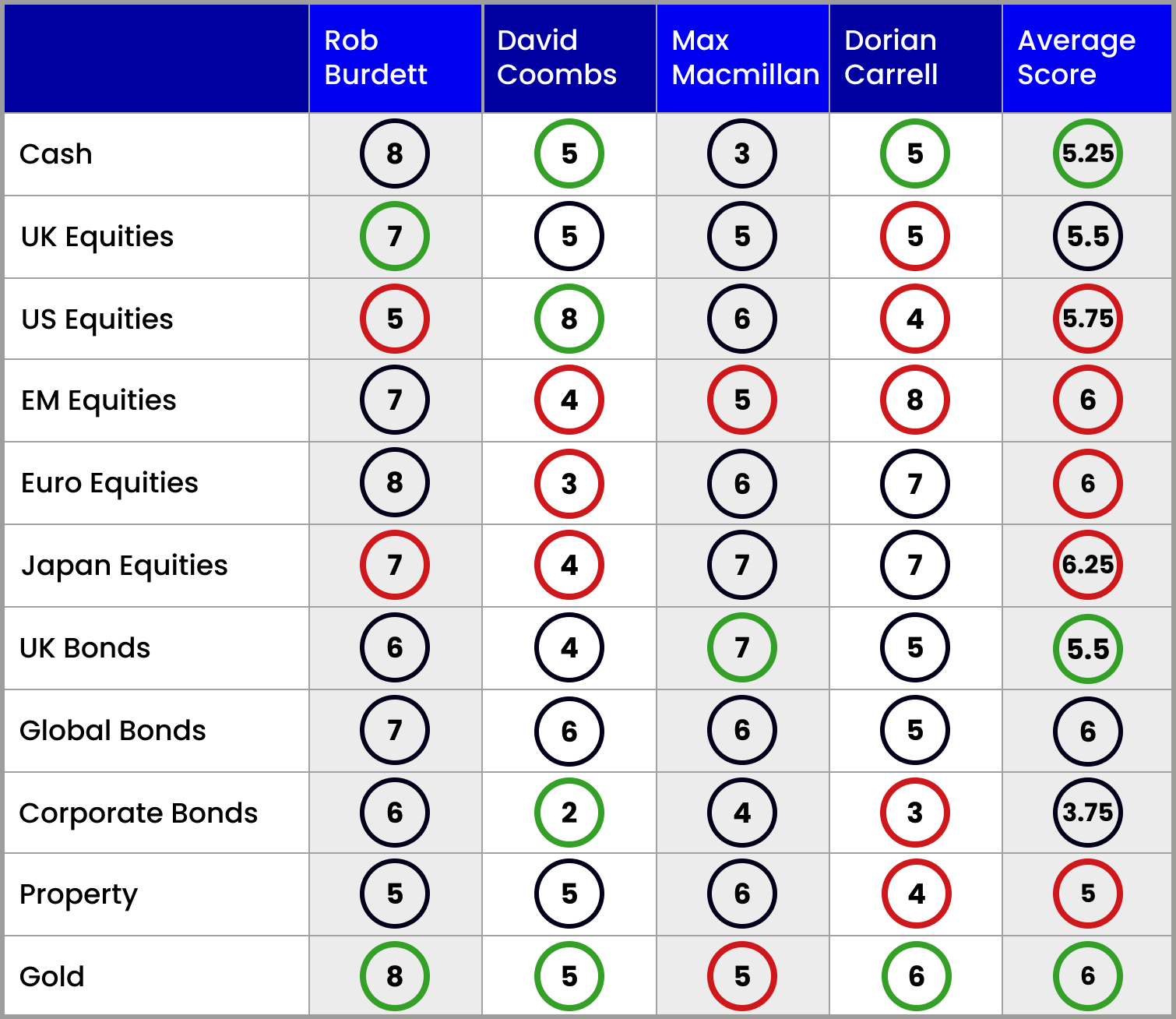
Note: the scorecard is a snapshot of views for the third quarter of 2026. How the panellists’ views have changed since the second quarter of 2026: red circle = less positive, green circle = more positive. Key to scorecard: EM equities = emerging market equities. 1 = poor, 5 = neutral and 9 = excellent.
Panellist profiles
Rob Burdett is head of multi-manager with Nedgroup Investments.
Dorian Carrell is head of multi-asset income at Schroders.
David Coombs is head of multi-asset investments at Rathbones.
Max Macmillan is head of strategic asset allocation at Aberdeen.
These articles are provided for information purposes only. Occasionally, an opinion about whether to buy or sell a specific investment may be provided by third parties. The content is not intended to be a personal recommendation to buy or sell any financial instrument or product, or to adopt any investment strategy as it is not provided based on an assessment of your investing knowledge and experience, your financial situation or your investment objectives. The value of your investments, and the income derived from them, may go down as well as up. You may not get back all the money that you invest. The investments referred to in this article may not be suitable for all investors, and if in doubt, an investor should seek advice from a qualified investment adviser.
Full performance can be found on the company or index summary page on the interactive investor website. Simply click on the company's or index name highlighted in the article.