Stockwatch: a defensive share with value and takeover appeal
A couple of successful high-profile investors have taken big stakes in this FTSE 250 company. Analyst Edmond Jackson thinks it’s worth following their lead.
8th September 2026 10:44
by Edmond Jackson from interactive investor

Grainger (LSE:GRI) is a £1.25 billion FTSE 250 real estate investment trust (REIT), developing, owning and operating more than 11,000 rental homes across the UK. This can come across as rather dull, with its chart in overall decline over the last five years.
Yet there looks to be an interesting gap between this semblance and underlying prospects.
- Our Services: SIPP Account | Stocks & Shares ISA | See all Investment Accounts
The CEO of the last 10 years has repositioned operations towards build-to-rent (BTR), which admittedly can sound like troubled builder Vistry Group (LSE:VTY), but it is a fundamentally lower-risk set-up. Grainger is the UK’s only listed pure-play BTR platform of scale in the structurally undersupplied rental market.
I’m a bit sceptical of the company’s claim that rising rents are linked to wage inflation as that may temper anyway. I would note that overall cost-of-living pressures could make it harder to keep exacting higher rents, and that rising government bond yields can pressure a share like this given that it is a quasi-proxy for a bond, appealing for reliable 5% income.
Furthermore, net gearing is high at 80%, which in the first half to 31 March meant the net interest charge took 39% of operating profit – perhaps because debt is also (somewhat oddly) chiefly short term. Management speaks of £300-350 million worth of disposals by the 2029 financial year to reduce debt, but it seems modest.
With these key caveats I’m still intrigued over how the shares are rising from a 150p low last June, such that at 170p they could now be mean-reverting upwards despite the chart yet to affirm an uptrend:
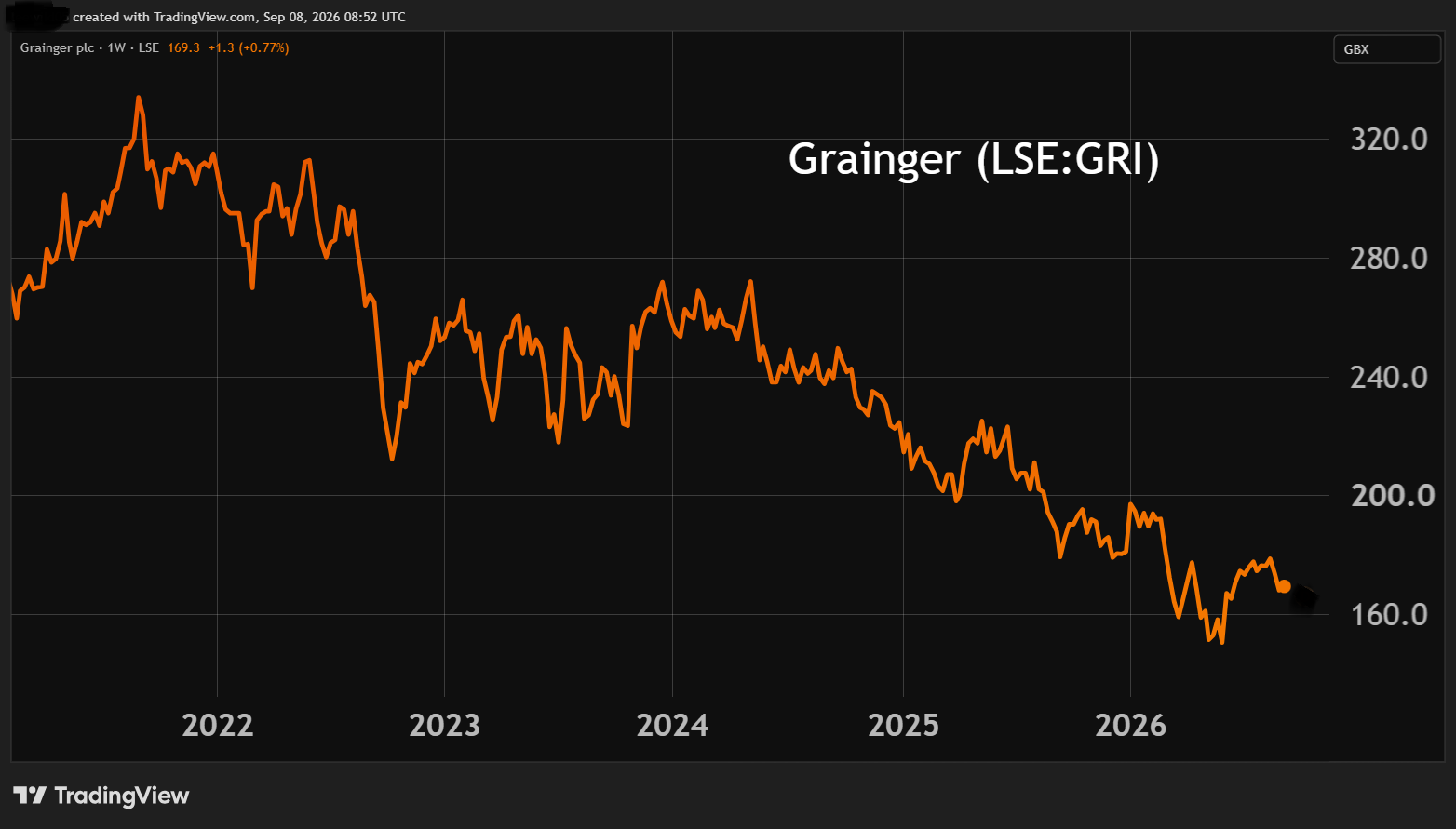
Source: TradingView. Past performance is not a guide to future performance.
Going back to 2012, the shares had a fine run from under 100p to over 300p before Covid struck. The trend then went volatile-sideways before a more consistent downtrend manifested over the last two years.
Corporate raiders close in on hefty discount to net assets
I think a recent upturn is explained partly by classic “raiders” such as US investor Boaz Weinstein and the UK’s Mike Ashley appearing on the register with meaningful stakes. Ashley I have come to associate with maverick buying into troubled companies, but Weinstein has an ace record over nearly 30 years in finance and has quite recently taken action against several UK investment trusts. While Grainger has said that it has met constructively with Ashley’s team, Weinstein’s Sabre Capital Management has kept schtum, which could imply that they are a smoking gun.
- Fund Focus: get ready for more activist tussles
- Insider: bosses slash stakes in AIM’s biggest company
- eyeQ: Barclays, Intel, Capita, Pearson
Both these investors likely recognise shares at a big discount to underlying net assets (NAV) in a fundamentally sound business. It was 48% from a NAV of 290p per share, as defined by European Public Real Estate Association (EPRA) methodology, when the shares were 150p, which has narrowed to 41% at 170p.
Various other factors tilt Grainger’s shares to upside
Perhaps the price hit a 13-year low last June due to the market pricing in slower rental growth. In Grainger’s first-half to 31 March, like-for-like rental growth eased to 3.1% from 3.6%.
More positively, this may have helped set up an inflection point for the market to recognise better news including the stake-building.
Reaction to the Renters’ Rights Act introduced last May has involved smaller landlords exiting the market and a growing perception that it will favour larger operators. The bill’s provisions are extensive and while many seem entirely reasonable, they add to hurdles – especially financial – and explain why private landlords are withdrawing. For example, there are now £7,000 fines for minor or initial non-compliance by landlords. Grainger is much better positioned to absorb this if it arises.
It therefore should improve demand for major operators and possibly give a slight upward squeeze on rents in the medium term, until more supply is generated. Already yesterday, an update in respect of Grainger’s 11 months to the end of August cited demand averaging 1,400 customer enquiries a week.
On 26 July, housing secretary Angela Rayner confirmed that the government is ruling out rent controls and freezes in England after the new prime minister’s team reportedly investigated limits on rent increases.
This came after Saba Capital Management declared a 6.3% stake in Grainger early last July, made more interesting in August when UK-listed REIT, warehouse landlord Segro (LSE:SGRO), fell to a £14.3 billion offer from peer US group Prologis Inc (NYSE:PLD).
On 26 June, I had drawn a parallel between a possible 925p per share offer from Prologis as being a similar “valuation arbitrage” as when FirstCash Holdings Inc (NASDAQ:FCFS) bought H&T Group, the UK’s largest pawnbroker. American operators seem to be carving up UK Plc.
Grainger - financial summary
year-end 30 Sep
| 2020 | 2021 | 2022 | 2023 | 2024 | 2025 | |
| Turnover (£m) | 222 | 258 | 287 | 201 | 205 | 215 |
| Operating margin (%) | 61.6 | 74.0 | 116 | 29.6 | 42.2 | 73.4 |
| Operating profit (£m) | 137 | 191 | 332 | 59.6 | 86.6 | 158 |
| Net profit (£m) | 82.8 | 110 | 229 | 25.6 | 31.2 | 203 |
| Reported earnings/share (p) | 12.7 | 16.1 | 30.9 | 3.5 | 4.2 | 27.3 |
| Normalised earnings/share (p) | 12.8 | 16.1 | 30.7 | 3.6 | 4.2 | 27.2 |
| Operating cashflow/share (p) | 12.4 | 21.8 | 13.7 | 24.9 | 18.4 | 16.5 |
| Capital expenditure/share (p) | 30.0 | 53.3 | 39.4 | 41.5 | 35.8 | 20.2 |
| Free cashflow/share (p) | -17.6 | -31.5 | -25.7 | -16.6 | -17.4 | -3.7 |
| Dividend/share (p) | 5.5 | 5.2 | 6.0 | 6.7 | 7.6 | 8.3 |
| Return on capital (%) | 4.8 | 6.0 | 9.7 | 1.7 | 2.4 | 4.4 |
| Cash (£m) | 369 | 318 | 95.9 | 121.0 | 93.2 | 85.8 |
| Net debt (£m) | 1,025 | 1,031 | 1,265 | 1,420 | 1,507 | 1,511 |
| Net assets/share (p) | 214 | 234 | 265 | 260 | 255 | 275 |
Source: company accounts.
Further positive clicks in the risk/reward ratchet
Yesterday’s update cited “another strong year of operational performance” that I would personally describe as “sound”, but still respect when the shares are at a 41% discount to NAV.
Occupancy was cited at 96% - it was 98% a year ago – and like-for-like BTR rental growth of 3% has turned out in line with guidance.
The shares added 1.4% to 170p, and it is still hard to assert in a new uptrend, but unless the market breaks this autumn then – all-considered – it looks likely.
While the forward price/earnings (PE) ratio seems pricey at 17x consensus for normalised earnings per share (EPS) of 10p in the September 2027, an expected dividend of 9.0p implies a 5.3% prospective yield. While earnings cover is quite tight, earnings should be relatively reliable, hence a high payout ratio is rational. The yield looks supportive in the sense that Grainger is likely significantly owned by income investors. The presence of Weinstein and Ashley points to capital upside also.
Grainger’s assets are mainly London and South East-oriented but it has rebalanced towards regional cities such as Manchester, Birmingham, Bristol and Leeds. At the May interims, the CEO had expected London to return to strong growth, and for growth to improve generally in the second-half fiscal year, amid increased tenant demand as smaller landlords quit.
- Shares for the future: still my third-highest-scoring stock
- Sign up to our free newsletter for investment ideas, latest news and award-winning analysis
- The Income Investor: a FTSE 100 share with dividend potential
Management iterates being on track to grow earnings 35% from the 30 September 2025 financial year to September 2029, helped by BTR developments in the pipeline. It would obviously be more encouraging in terms of bringing down the PE if “per share” were included.
There is an accelerated disposals programme for around £850 million of non-core assets, to reduce net debt by £300-350 million by September 2029 and apparently offset higher interest rates. I would prefer to see lower debt and do not initially agree that this extent of disposals will reliably align with higher interest costs, but it is not a deal-breaker.
It suggests to me the stance here is a moderate “buy”, maybe not a strong one.
£2.4 million of central costs are to be removed at the start of the September 2027 year, with a further £2 million savings also to be delivered; in all 12% of the cost base. Surplus capital will be applied between investment opportunities and buybacks although my conservative priority would be debt reduction.
Last May, the director of land, development and acquisition, bought nearly £20,000 worth of shares at 150p after the chair designate bought £32,000 worth at 160p (although that could be seen as a somewhat obligatory purchase). Institutional shareholder trading has been mixed but the two high-profile stakebuilders suggest a fresh-headed approach this year favours “buy”.
Edmond Jackson is a freelance contributor and not a direct employee of interactive investor.
These articles are provided for information purposes only. Occasionally, an opinion about whether to buy or sell a specific investment may be provided by third parties. The content is not intended to be a personal recommendation to buy or sell any financial instrument or product, or to adopt any investment strategy as it is not provided based on an assessment of your investing knowledge and experience, your financial situation or your investment objectives. The value of your investments, and the income derived from them, may go down as well as up. You may not get back all the money that you invest. The investments referred to in this article may not be suitable for all investors, and if in doubt, an investor should seek advice from a qualified investment adviser.
Full performance can be found on the company or index summary page on the interactive investor website. Simply click on the company's or index name highlighted in the article.
Disclosure
We use a combination of fundamental and technical analysis in forming our view as to the valuation and prospects of an investment. Where relevant we have set out those particular matters we think are important in the above article, but further detail can be found here.
Please note that our article on this investment should not be considered to be a regular publication.
Details of all recommendations issued by ii during the previous 12-month period can be found here.
ii adheres to a strict code of conduct. Contributors may hold shares or have other interests in companies included in these portfolios, which could create a conflict of interests. Contributors intending to write about any financial instruments in which they have an interest are required to disclose such interest to ii and in the article itself. ii will at all times consider whether such interest impairs the objectivity of the recommendation.
In addition, individuals involved in the production of investment articles are subject to a personal account dealing restriction, which prevents them from placing a transaction in the specified instrument(s) for a period before and for five working days after such publication. This is to avoid personal interests conflicting with the interests of the recipients of those investment articles.