Stockwatch: this share has crashed - should you buy the dip?
After correctly predicting a sharp decline at this once-celebrated growth share, analyst Edmond Jackson explains what he’d do following the latest sell-off.
15th September 2026 10:52
by Edmond Jackson from interactive investor

While there have been multiple share price spikes recently even as companies deliver maybe only slightly better-than-expected updates, it is interesting to consider if a profit warning from software billing group Cerillion (LSE:CER) chiefly reflects timing of orders or a wider malaise linked to inflation.
- Invest with ii: Share Dealing with ii | Open a Stocks & Shares ISA | Our Investment Accounts
The stock market faces suddenly higher oil and gas prices amid no resolution over the Strait of Hormuz, while Iran-backed rebels attack Saudi oil facilities and seize strategic islands in the Red Sea. Is the energy crisis feared last March finally about to manifest?
Cerillion had been one of the market’s celebrated growth shares, but its warning shows that one can never be complacent about “growth” ratings. All businesses potentially face vicissitudes.
After a superb run from around 150p in 2019 to 1,938p in August 2024, the shares turned volatile, then rebounded 46% from near 1,300p in March 2025 and enjoyed another 42% rally in early 2025. It’s unclear whether technical analysis might have pulled in buyers only for them to get burnt fingers:
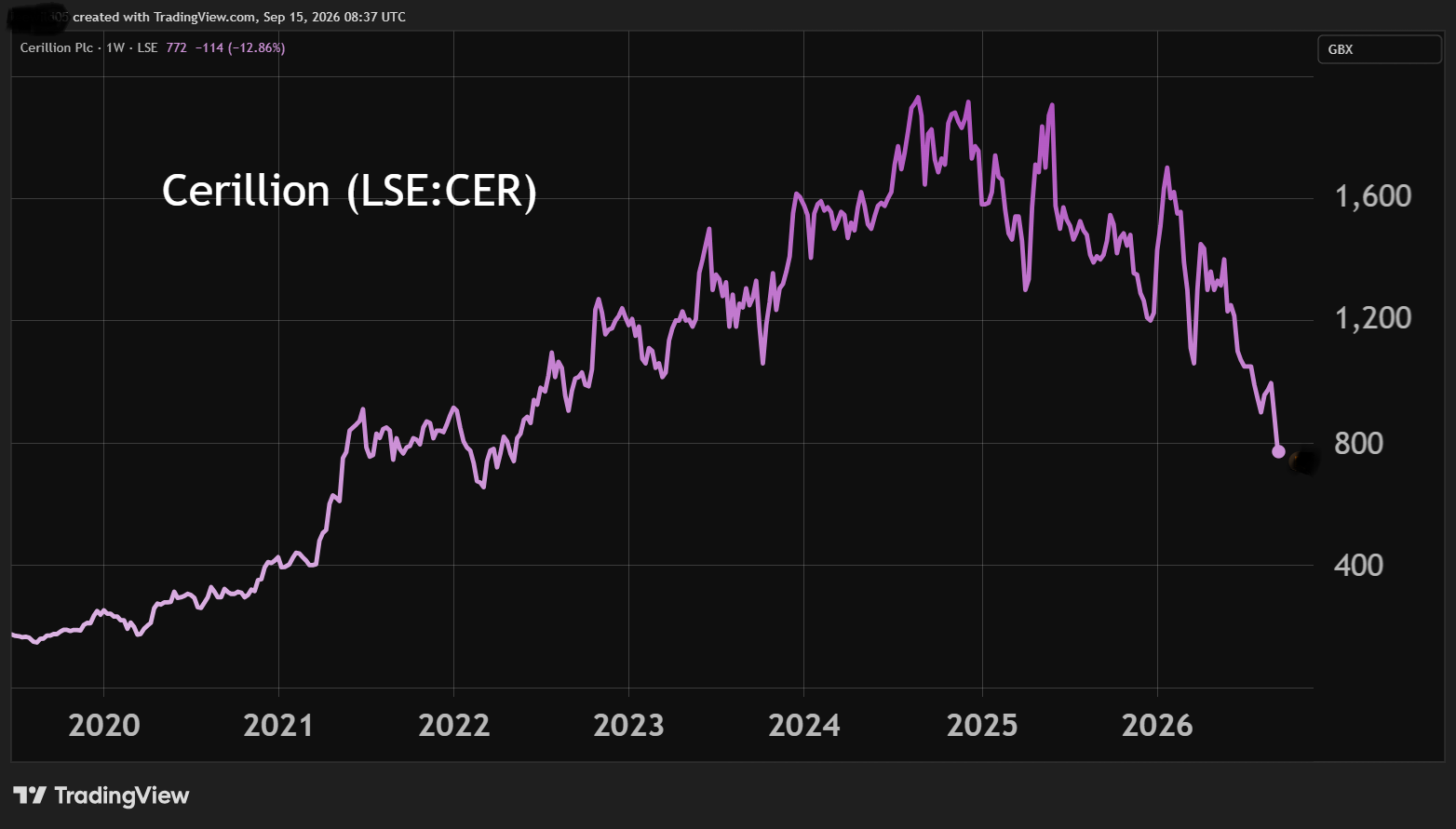
Source: TradingView. Past performance is not a guide to future performance.
PE rating around 30x became unsustainable
I drew attention to Cerillion as a “buy” at 820p in April 2022 when investors salivated over mid-20% revenue growth plus operational gearing (where the rate of profits growth is magnified relative to revenue). Come May 2025 at around 1,700p, I opined that the shares were overpriced on a forward price/earnings (PE) 30x consensus forecasts versus interim results showing new orders 3% lower. I tilted towards an overall “sell” stance, reckoning that Cerillion might trade sideways-volatile at best.
Yesterday, shares closed down 12.5% at 774p after Cerillion said its second half to 30 September would be ahead of the first, but that delayed customer orders imply a 6.4% downgrade to expectations for the closing financial year’s revenue. This percentage I derive using the points of guidance range - there would still be annual revenue growth albeit just 3.5%.
Showing how operational gearing works both ways, Cerillion’s two brokers have cut earnings per share (EPS) forecasts by 17% given the EBITDA (underlying profit) margin is expected in the region of 43% to 45% versus 50.9% in the September 2025 year. This cut is obviously greater than yesterday’s 12.5% fall, although the shares fell from around 1,000p to 885p this month, even before the downgrades.
- Insider: bargain hunters swoop on two struggling FTSE 250 stocks
- AIM’s big winners: 28 shares up 100%+ in 2026
The situation also highlights a risk when companies say their financial year is likely to be second-half weighted, as did Cerillion with its 1 June interims. The main reason for the revenue shortfall is “some anticipated new and existing customer orders delayed or deferred”, and multiples suggests to me that decision-making is stalling in the current environment – also in respect of inflation. There is no explanation of the margin shortfall, hence I default to perennial operational gearing.
The company’s two brokers now project adjusted EPS of 48.7p in this latest year, for a trailing PE near 16x, easing to 14.5x if the September 2027 expectation for 53.3p EPS is met.
With the prospective yield only near 2.3% - albeit with strong 3.6x earnings cover and decent cash flow - there is not exactly material yield support. This kind of share is between two stools in the sense that confidence is eroding to support the growth case, while yield is insufficient to attract income-seekers. Sentiment can therefore continue to erode unless the narrative picks up, which does look possible given “major implementations are progressing...the back-order book remains strong, the new customer pipeline healthy and the balance sheet very robust”.
It offers hope for holders who perhaps wish they had sold, but I suspect the shares will take their cue from what guidance is vouched at the end of November annual results.
Does this reflect tougher competition?
I suspect it might well do, hence I would currently avoid resuming a “buy” stance, the real question being whether to remain with “sell” or adjust to “hold” in respect of the de-rating to a mid-teens PE.
The long-term table does show excellent growth in operating margins from 5.2% to 45.4% - as if the modern Cerillion should be a high-quality business able to withstand an extent of margin loss:
Cerillion - financial summary
Year-end 30 Sep
| 2016 | 2017 | 2018 | 2019 | 2020 | 2021 | 2022 | 2023 | 2024 | 2025 | |
| Turnover (£ million) | 8.4 | 16.0 | 17.4 | 18.8 | 20.8 | 26.1 | 32.7 | 39.2 | 43.8 | 45.4 |
| Operating margin (%) | 5.2 | 13.1 | 10.9 | 13.4 | 13.5 | 28.9 | 32.7 | 39.0 | 42.1 | 45.4 |
| Operating profit (£m) | 0.4 | 2.1 | 1.9 | 2.5 | 2.8 | 7.5 | 10.7 | 15.3 | 18.4 | 20.6 |
| Net profit (£m) | 0.3 | 2.0 | 1.9 | 2.3 | 2.6 | 6.4 | 9.3 | 12.9 | 15.3 | 16.6 |
| EPS - reported (p) | 1.3 | 6.9 | 6.5 | 7.8 | 8.8 | 21.7 | 31.6 | 43.7 | 51.5 | 56.3 |
| EPS - normalised (p) | 3.4 | 6.9 | 6.8 | 7.8 | 8.8 | 21.7 | 36.7 | 44.3 | 52.4 | 56.4 |
| Operating cashflow/share (p) | -3.5 | 11.7 | 12.5 | 17.1 | 22.2 | 33.1 | 41.7 | 32.9 | 37.8 | 44.8 |
| Capital expenditure/share (p) | 3.2 | 3.6 | 5.6 | 4.1 | 4.8 | 4.3 | 5.4 | 4.8 | 5.1 | 7.7 |
| Free cashflow/share (p) | -6.7 | 8.1 | 6.9 | 13.0 | 17.4 | 28.8 | 36.3 | 28.1 | 32.7 | 37.1 |
| Dividends per share (p) | 3.9 | 4.2 | 4.5 | 4.9 | 5.5 | 7.1 | 9.1 | 8.0 | 13.2 | 15.4 |
| Covered by earnings (x) | 0.3 | 1.6 | 1.4 | 1.6 | 3.1 | 3.5 | 3.5 | 5.5 | 3.9 | 3.7 |
| Return on total capital (%) | 2.4 | 12.0 | 11.1 | 14.8 | 13.0 | 29.7 | 34.1 | 37.3 | 35.7 | 32.5 |
| Cash (£m) | 5.0 | 5.3 | 5.3 | 6.8 | 8.3 | 13.2 | 20.2 | 24.7 | 29.9 | 34.4 |
| Net debt (£m) | -0.4 | -1.7 | -2.5 | -5.0 | -2.1 | -8.4 | -16.2 | -21.6 | -27.1 | -31.1 |
| Net assets (£m) | 13.0 | 13.8 | 14.4 | 15.5 | 16.0 | 20.2 | 26.7 | 36.9 | 48.5 | 59.6 |
| Net assets per share (p) | 43.9 | 46.6 | 48.9 | 52.7 | 54.5 | 68.8 | 90.9 | 125 | 164 | 202 |
Source: historic company REFS and company accounts.
But while Cerillion has carved out a highly profitable niche among mid-market telecom operators, digital brands and mobile service providers, it nowadays operates in a crowded sector. There is strong competition for large-scale telecom contracts from big companies and cloud-driven ones. In emerging markets or smaller deployments, agile specialist providers have manifested.
It has become a tricky area to decipher where not even specialist industry analysts issued “sell” stances. They remained positive through a near 60% de-rating but cut price targets – for example from around 2,000p to 1,400p in response to the latest downgrade.
It appears to reflect a general principle about how high margins attract competition and growth share ratings cannot be taken for granted. There’s also awareness that this can be more objective than being close to the show and interacting with management.
An example of the latter is some investors criticising how the 1 June interim results affirmed annual guidance, citing material software licence revenue due in the second half. A more detached view might respect caution about how even with relatively sticky revenues in billing software, four months can be a long time in corporate life.
Take order book comment with pinch of salt
Another interesting upshot is how much attention one should pay to companies boasting a strong order book.
At 31 March, Cerillion’s back-order book was a record £81.2 million and the new customer pipeline was up 4% to a new high of £271 million. You could quite easily assume that underwrote medium-term revenues. Also, the board appeared to underline this by raising the interim dividend 15% to 5.5p.
- Watch our webinar: Q4 Global Market Outlook
- Sign up to our free newsletter for investment ideas, latest news and award-winning analysis
Perhaps a balanced view is that this strong orders context implies a near-term timing issue which does periodically bedevil software companies. Do not over-react. But here it is currently tricky to decipher what should be the appropriate PE going forward, respecting a necessary de-rating linked to competition.
It is a stretched comparison I don’t make directly with Cerillion, but oilfield services provider Petrofac used to serially boast a strong order book but ended up in administration due to its debts and a failed restructuring.
Finding a floor at 775p?
The shares rose 2% to 790p in early dealings on Tuesday morning despite markets down on renewed Middle East conflict and implications for energy prices and inflation. A balanced view would respect what the balance of buyers and sellers suggests, as if selling has now been absorbed.
In the near term, a “hold” stance can therefore be justified given the prospect of supportive delayed news on contracts which eases fear. Cerillion’s rating seems about right for this scenario but what if the macro/market context now deteriorates?
Altogether I retain a “sell” stance chiefly due to apparent loss of uniqueness in this commercial space which could be a long-term factor, while there is negligible yield to compensate for the risk of owning the shares.
The appropriate time to upgrade would be in sight of the annual results and guidance and when the Middle East situation settles.
Edmond Jackson is a freelance contributor and not a direct employee of interactive investor.
AIM stocks tend to be volatile high-risk/high-reward investments and are intended for people with an appropriate degree of equity trading knowledge and experience.
These articles are provided for information purposes only. Occasionally, an opinion about whether to buy or sell a specific investment may be provided by third parties. The content is not intended to be a personal recommendation to buy or sell any financial instrument or product, or to adopt any investment strategy as it is not provided based on an assessment of your investing knowledge and experience, your financial situation or your investment objectives. The value of your investments, and the income derived from them, may go down as well as up. You may not get back all the money that you invest. The investments referred to in this article may not be suitable for all investors, and if in doubt, an investor should seek advice from a qualified investment adviser.
Full performance can be found on the company or index summary page on the interactive investor website. Simply click on the company's or index name highlighted in the article.
Disclosure
We use a combination of fundamental and technical analysis in forming our view as to the valuation and prospects of an investment. Where relevant we have set out those particular matters we think are important in the above article, but further detail can be found here.
Please note that our article on this investment should not be considered to be a regular publication.
Details of all recommendations issued by ii during the previous 12-month period can be found here.
ii adheres to a strict code of conduct. Contributors may hold shares or have other interests in companies included in these portfolios, which could create a conflict of interests. Contributors intending to write about any financial instruments in which they have an interest are required to disclose such interest to ii and in the article itself. ii will at all times consider whether such interest impairs the objectivity of the recommendation.
In addition, individuals involved in the production of investment articles are subject to a personal account dealing restriction, which prevents them from placing a transaction in the specified instrument(s) for a period before and for five working days after such publication. This is to avoid personal interests conflicting with the interests of the recipients of those investment articles.