Stockwatch: short sellers getting beat by this FTSE 250 share
It’s one of the most shorted stocks on the London stock market, but the shares are rising and analyst Edmond Jackson believes they may continue to do so. Here’s why.
31st July 2026 11:12
by Edmond Jackson from interactive investor

A 20% spike in the unloved mid-cap shares of “food to go” retailer Greggs (LSE:GRG) - FTG is the acronym peppered through its interim results - has surprised even experienced investors after a year of near flatlining.
Yet to me it’s another example of how the hottest area of the London market currently is over-shorted turnaround and cyclical shares, which need only affirm “in line” trading with a moderately upbeat narrative to squeeze a crowded trade.
- Invest with ii: Top UK Shares | Share Tips & Ideas | Cashback Offers
This also happened on Wednesday 29 July amid renewed hostilities between Iran and the US, plus the Federal Reserve disappointing on interest rate policy. It showed how this investment/trading approach can work well irrespective of a difficult macro context.
The Financial Conduct Authority’s (FCA) list of “current aggregate net short positions”, which has replaced individual institutions disclosed over 0.5% of issued share capital, showed Greggs at 13.94% as of 27 July, falling to 13.78% on 29 July when interim results were published. While guidance for the full year was in line with expectations, the half-year numbers were robust, countering any sense of a stalling business.
From a chart perspective, the jump is hard to categorise. No classic “double bottom” turning point is involved, but even if this spike settles back, then the chart from February 2025 could pan out as something of a bullish “bowl”:
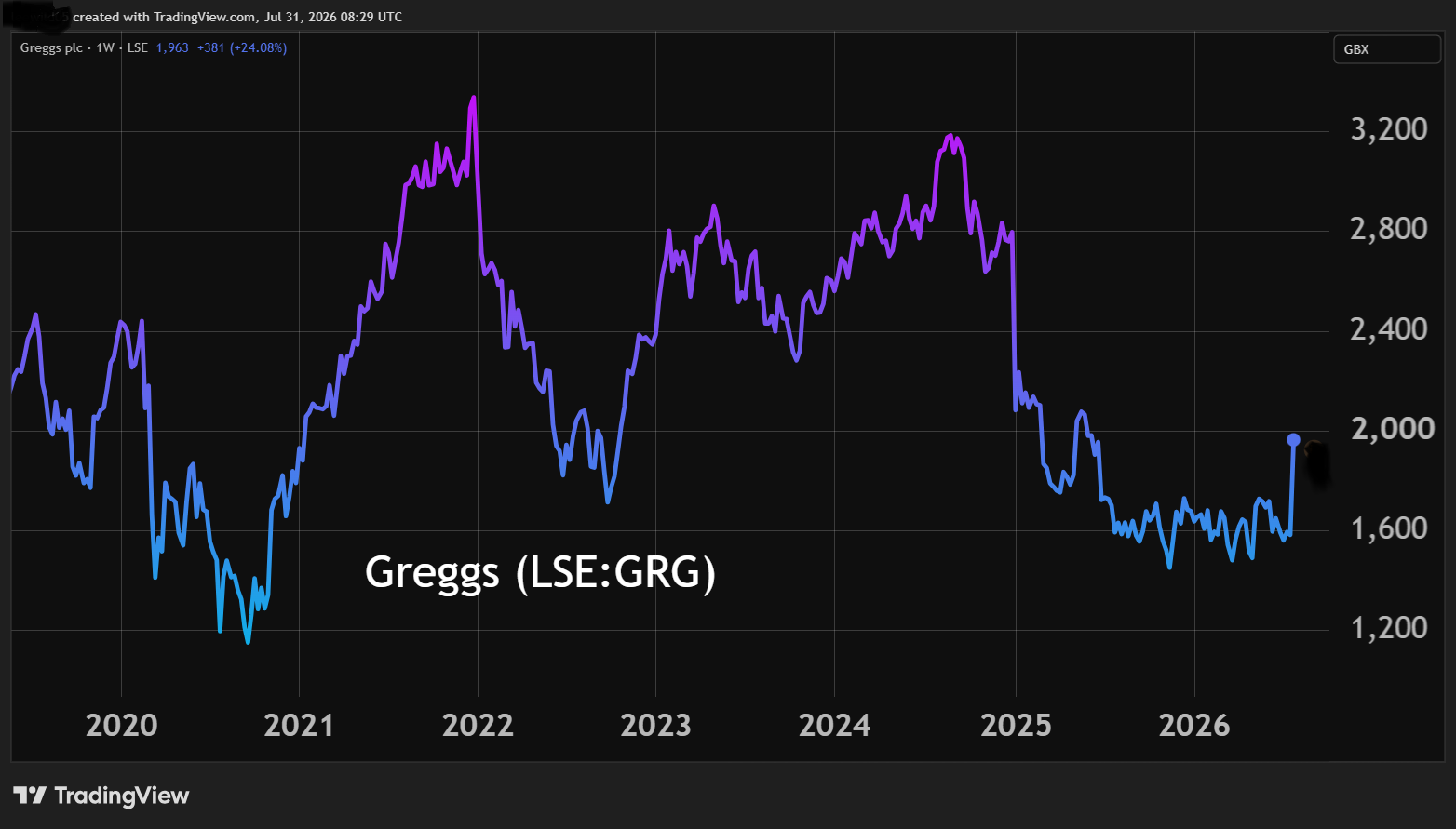
Source: TradingView. Past performance is not a guide to future performance.
Those remaining with short positions obviously can opine how from late 2022 the stock manifested two determined rallies, looking as if a chart low was in, only to cede this in dramatic fashion. Yet from 2018 there have been three broad roller coasters, and possibly a support level is currently being built.
Solid numbers and narrative defy short selling
Half-year pre-tax profit is up 19.7% to £76 million on revenue up 7.2% to £1,102 million, reflected in earnings per share (EPS) also up 21.2% to 54.9p. The interim dividend is unchanged at 19.0p. Furthermore, the accounts are “clean” without a lot of adjustments resulting in normalised versus reported numbers.
This is respectable profitability and the first-half margin rose to 7.9% from 6.9% like-for-like, where the full year 2025 achieved was 8.5%. Management speaks of restoring 20% return on capital employed – previously up to 22.5% over 2021 to 2024 – implying good cost control despite effects of the US/Iran war on food and transport prices. Downside risk obviously lurks should this war fester on, while food prices could rise in the second half-year due to drought.
While it can seem that roll-out of the classic Greggs outlets has approached maturity, management contends that new adept smaller formats can raise the total number of shops from 2,773 as of end-June to “at least 3,500 UK shops over the longer term, growing market share further (from 8.7%) and making Greggs more accessible”.
This potentially sustains top-line growth and defies the firm being one of London’s most-shorted shares. There were 65 net shop openings in the first half, with 100 to 110 expected for 2026 as a whole. A “bitesize Greggs” format (four opened so far) is creating additional opportunities to open in locations with insufficient space for a full-service shop. Three new “Greggs Express” installations are also being trialled with a franchise partner within retail sites where there is no existing Greggs presence.
- Where I’m finding opportunities beyond AI
- Sign up to our free newsletter for investment ideas, latest news and award-winning analysis
- How to prepare for tax grab on cash returns
They speak of “generating strong returns in catchments such as retail parks, railway stations, airports, roadsides and supermarkets where Greggs is currently under-represented and there remains significant headroom for further growth. These openings are delivering strong investment returns and further broadening the reach of the estate.”
More generally, when I have been in Ambleside and Keswick in recent months for fell running, and Greggs outlets have been busy, probably because elsewhere a sausage roll costs £5 and a small cake £4. Not to disparage artisan retailer efforts but the reality is that a cost-of-living crisis means Greggs is the “go-to” for many people, especially if a town has no supermarkets close to hand.
It hardly seems a complex business, simply the launch of a new chicken roll last April has been “a standout success” and it has also strengthened its “hot food and pizza offer with introductions such as the tandoori chicken pizza slice, expanding choice with bolder, contemporary flavours” and, in May, healthier lunchtime choices were introduced such as chicken caesar salad and prawn-layered pasta salad. There have also been innovations across the drinks range including the launch of matcha green tea. All this helps sustain customer interest.
Bluntly, unless enough people radically change their habits to be up early for breakfast or carry around sandwiches, “FTG” demand is likely to remain solid despite higher prices, with Greggs still relatively more appealing for cost.
Is robust performance baked in?
From an investment perspective, care is needed not to overreact to this share price spike, although from a medium-term trading perspective I would say it was always baked in (forgive the pun) after a sound business had its shares aggressively short-sold.
In May 2025 at 1,780p I suggested a possible “buy” case, although a speculative one. The 2024 annual cash flow statement had shown nearly 80% of £311 million net cash flow from operations going on investment in new store openings relative to £107 million on dividends. I suggested that if the strategy was to change with business maturity – returning more cash – then potentially the dividend could at least double, hence buyers at current prices might possibly lock in a 125p a share dividend equating to a 7% yield.
I was wrong in the sense that new store openings remain a priority, although they are just another angle to deliver total return.
Greggs - financial summary
Year-end 31 Dec
| 2020 | 2021 | 2022 | 2023 | 2024 | 2025 | |
| Turnover (£ million) | 811 | 1,230 | 1,513 | 1,810 | 2,014 | 2,151 |
| Operating margin (%) | -0.9 | 12.5 | 10.2 | 10.6 | 10.4 | 8.5 |
| Operating profit (£m) | -7.0 | 153 | 154 | 192 | 209 | 183 |
| Net profit (£m) | -13.0 | 118 | 120 | 143 | 153 | 122 |
| EPS - reported (p) | -12.9 | 114 | 118 | 139 | 150 | 119 |
| EPS - normalised (p) | -1.5 | 116 | 119 | 143 | 144 | 133 |
| Operating cashflow/share (p) | 43.2 | 278 | 246 | 304 | 303 | 329 |
| Capital expenditure/share (p) | 61.0 | 52.8 | 101 | 194 | 235 | 278 |
| Free cashflow/share (p) | -17.8 | 225 | 145 | 110 | 68.3 | 50.3 |
| Dividends per share (p) | 0.0 | 57.0 | 59.0 | 62.0 | 69.0 | 50.0 |
| Covered by earnings (x) | 0.0 | 2.0 | 2.0 | 2.3 | 2.2 | 2.4 |
| Return on total capital (%) | -1.2 | 22.5 | 21.1 | 22.4 | 20.7 | 16.1 |
| Cash (£m) | 36.8 | 199 | 192 | 195 | 125 | 70.8 |
| Net debt (£m) | 255 | 84.6 | 110 | 124 | 290 | 404 |
| Net assets (£m) | 322 | 429 | 446 | 531 | 571 | 625 |
| Net assets per share (p) | 317 | 421 | 437 | 519 | 558 | 611 |
Source: company accounts.
A low-risk balance sheet continues, the only financial debt a year later being £15 million long-term borrowings down from £35 million in June 2025, although store growth has pushed up total lease liabilities to £454 million from £4.6 million. The interim interest charge was £10.5 million, taking 12% of operating profit versus £6.9 million and 9.8% respectively in the first half of 2025.
Debt is not needed for further expansion given the interim cash flow statement shows £144 million net cash from operations - up 16% - versus £77 million total investment, with £51 million going out as dividends.
- Dividend record: the sectors responsible for income boom
- 20 hottest tech stocks: semiconductors, Corning, Microsoft, SpaceX
- Why we’ve bought 10 new stocks this year
But if Greggs achieves £134 million net profit as per consensus for 2027, around 1,970p currently normalised EPS of 129p implies a forward price/earnings (PE) ratio of 15.3x and dividend per share (DPS) of 70.4p, giving a prospective 3.6% yield covered 1.8x. The price/sales ratio is around 1.0x and price/tangible book value 3.5x, with the regular price/book value not much cheaper at around 3.3x. As a snapshot valuation this looks about right.
A ‘hold’ on fundamentals, ‘buy’ on crowded short trade
This is my essential reading of Greggs shares. Yes, cost pressures will increase if food and oil prices do, and the best momentum for UK roll-out is probably passed. Yet the business occupies a strong and valuable market position in FTG, difficult to replicate even by “Express”-size grocery outlets which cannot muster a similar range of food and drink. That food and drink is not habitually prepared and carried around by people is unlikely to change.
These results defy Greggs being a crowded short trade, therefore unless markets tank on inflation and interest rate worries I anticipate signs of short-closing (buying back shares) to continue – those traders will be hoping they can do so steadily in the months ahead.
However, the price is consolidating – down 3% this morning to 1,970p after this spike – hence care is needed with an entry point. Yet Greggs’ medium-term technical position looks to favour upside, with pressure on the shorts, hence I conclude “buy”.
Edmond Jackson is a freelance contributor and not a direct employee of interactive investor.
These articles are provided for information purposes only. Occasionally, an opinion about whether to buy or sell a specific investment may be provided by third parties. The content is not intended to be a personal recommendation to buy or sell any financial instrument or product, or to adopt any investment strategy as it is not provided based on an assessment of your investing knowledge and experience, your financial situation or your investment objectives. The value of your investments, and the income derived from them, may go down as well as up. You may not get back all the money that you invest. The investments referred to in this article may not be suitable for all investors, and if in doubt, an investor should seek advice from a qualified investment adviser.
Full performance can be found on the company or index summary page on the interactive investor website. Simply click on the company's or index name highlighted in the article.
Disclosure
We use a combination of fundamental and technical analysis in forming our view as to the valuation and prospects of an investment. Where relevant we have set out those particular matters we think are important in the above article, but further detail can be found here.
Please note that our article on this investment should not be considered to be a regular publication.
Details of all recommendations issued by ii during the previous 12-month period can be found here.
ii adheres to a strict code of conduct. Contributors may hold shares or have other interests in companies included in these portfolios, which could create a conflict of interests. Contributors intending to write about any financial instruments in which they have an interest are required to disclose such interest to ii and in the article itself. ii will at all times consider whether such interest impairs the objectivity of the recommendation.
In addition, individuals involved in the production of investment articles are subject to a personal account dealing restriction, which prevents them from placing a transaction in the specified instrument(s) for a period before and for five working days after such publication. This is to avoid personal interests conflicting with the interests of the recipients of those investment articles.