Stockwatch: is there still value in these winning shares?
Having made a substantial profit on both these stocks in just two months, analyst Edmond Jackson explains what he’d do with them now.
22nd September 2026 10:12
by Edmond Jackson from interactive investor

In July I made the case that an Andy Burnham government implied further upgrades for the infrastructure sector, with FTSE 250 shares Galliford Try Holdings (LSE:GFRD) and Kier Group (LSE:KIE) already reporting firm progress despite a challenging macro context.
- Our Services: SIPP Account | Stocks & Shares ISA | See all Investment Accounts
Taking a two- to three-year view I upgraded both to “buy” at 621p and 240p respectively. I’d done that for Galliford before at 97p equivalent in May 2018 and Kier at 90p in July 2023, then adjusted to “hold” after recovery manifested and the question became, what extent of growth can be achieved?
I suggested possibly favouring Kier given its shares’ relative discount in the sector, with Galliford the conservative choice without debt, yet both companies being set to benefit from a new government seeking to make its mark.
Burnham is barely two months into being Prime Minster – so policy benefits are yet to flow – but both companies continue to surprise ahead of expectations. Over the last seven trading days, Galliford has re-rated 24% to 703p and Kier 27% to 312p - the latter asserting double-digit adjusted earnings per share (EPS) growth prospects when it reported annual results to 30 June last Tuesday.
Kier had otherwise not recently quantified EPS guidance, but doing so underlines its confidence amid “good momentum into the new financial year, with recent significant contract and framework awards, strong order book growth and expanding pipeline”. Mind, this does benefit from over 95% of the June 2027 year revenue and over 70% of 2028 revenue already secured, in a context where the order book is up 8% to £11.9 billion.
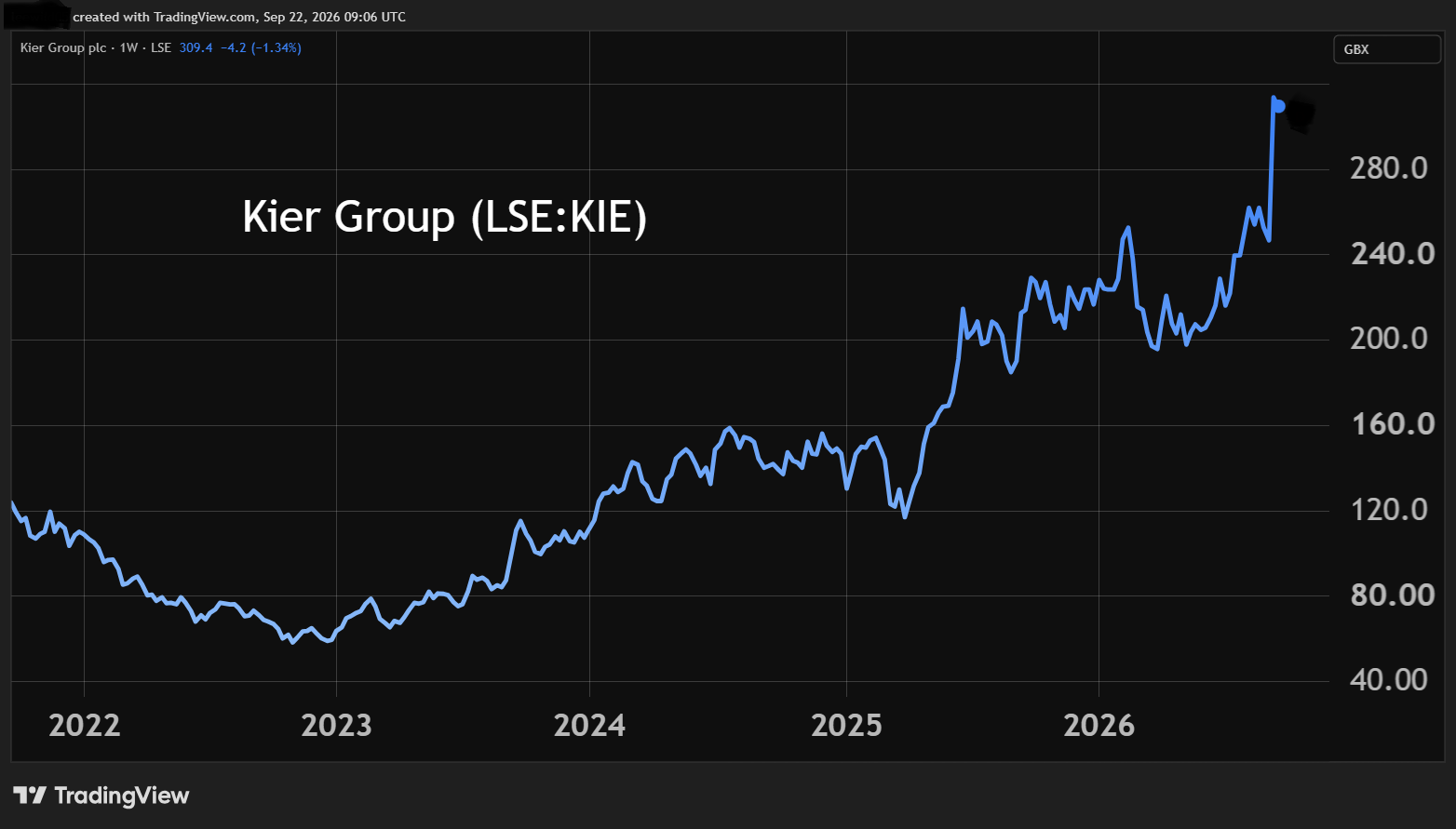
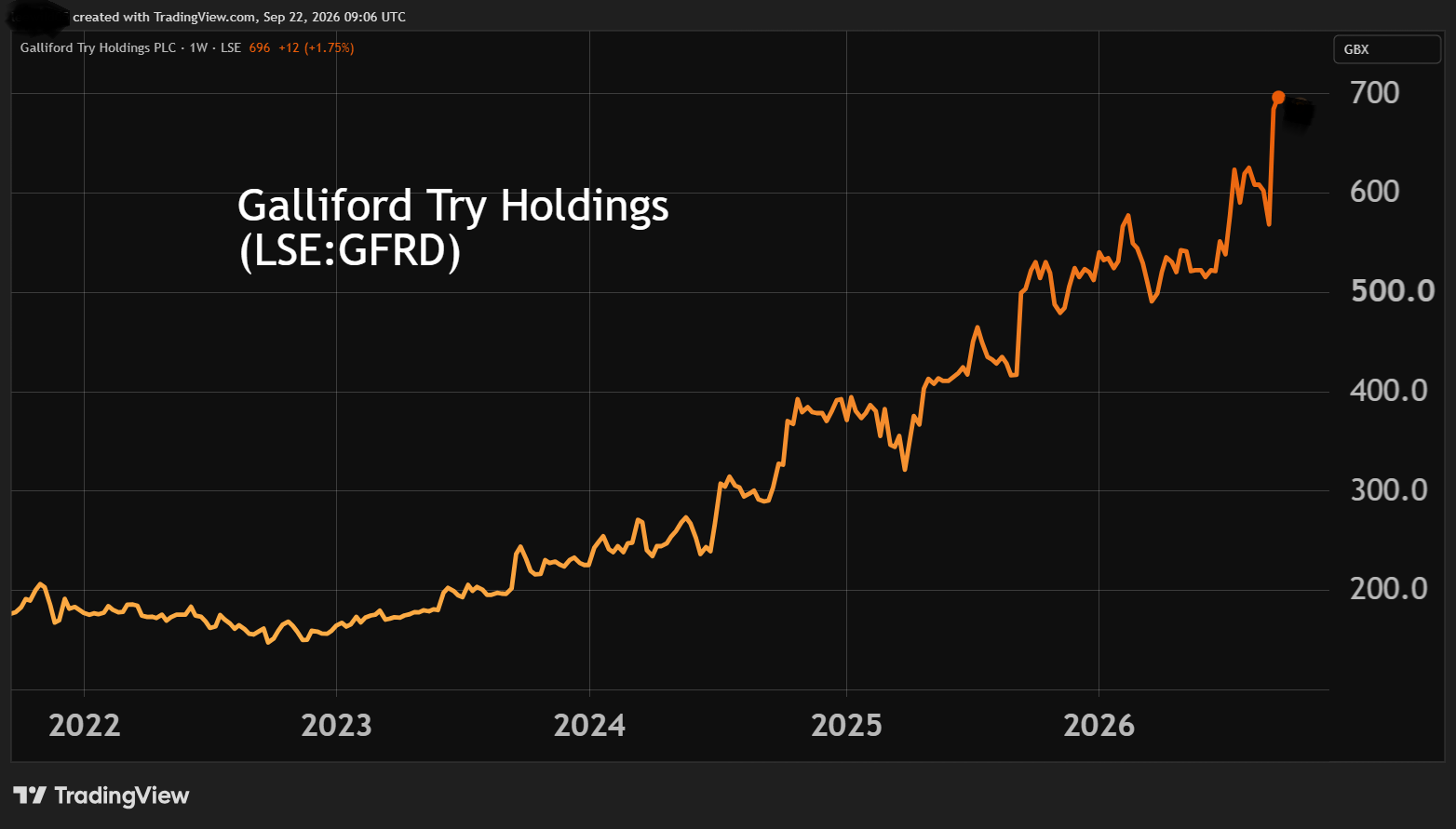
Source: TradingView. Past performance is not a guide to future performance.
Also, there is a frequent and material differential between Kier’s reported and adjusted EPS – 13.5p versus 23.1p in the latest financial year – because of £32 million compliance costs for fire and cladding, plus amortisation of intangible assets which relates to strict accounting rules and does need adjusting for to discern true profit. Galliford has a similar history albeit only with a circa 2% differential between reported versus adjusted earnings in its last full year.
A sense of dependability driving “status change”
“Status change” used to be one of Jim Slater’s core concepts well before he followed a laser approach focusing on underappreciated earnings growth – his “Zulu principle”. Both remain relevant, selectively.
Contractor-type shares have previously suffered discounts due to the risk that low-margin work need only be disrupted by one or two projects incurring problems, to turn group profit into losses. Galliford is also benefiting from regulatory demands on the water industry, the key driver of its “environment” side that generates 35% of group revenue.
- Two housebuilder stocks, one warning from macro
- eyeQ: AstraZeneca, Deutsche Boerse, Taylor Wimpey, Barclays
Consensus forecast annual EPS growth to June 2027 for Kier was previously 5.2%, hence double digits suddenly appears very significant. It could be that normalised EPS is getting near 30p on a 12-month view, in which case with the shares around 312p the PE would be 10.4x, hence the re-rate. Obviously this is quite a snapshot view in earnings progression context.
As for yield, Kier resumed dividends in respect of its June 2024 year and dividend per share has previously been targeted at 8.2p in respect of June 2027, with 3.0x earnings cover. If similar cover was applied to the possible EPS scenario now, a circa 10p DPS implies a 3.2% yield.
Kier Group - financial summary
Year-end 30 June
| 2014 | 2015 | 2016 | 2017 | 2018 | 2019 | 2020 | 2021 | 2022 | 2023 | 2024 | 2025 | 2026 | |
| Turnover (£ million) | 2,907 | 3,276 | 3,998 | 4,112 | 4,220 | 3,966 | 3,423 | 3,261 | 3,144 | 3,381 | 3,905 | 4,077 | 4,353 |
| Operating margin (%) | 1.0 | 1.7 | -0.3 | 1.1 | 3.1 | -5.2 | -5.9 | 1.3 | 1.4 | 2.4 | 2.6 | 2.7 | 2.7 |
| Operating profit (£m) | 29.0 | 57.3 | -10.2 | 45.3 | 129 | -205 | -201 | 43.7 | 45.1 | 81.5 | 103 | 112 | 119 |
| Net profit (£m) | 10.0 | 4.4 | -17.6 | 10.7 | 87.3 | -210 | -273 | -0.3 | 12.7 | 41.1 | 42.7 | 56.4 | 61.7 |
| Reported EPS (p) | 15.8 | 39.3 | -25.3 | 12.8 | 75.5 | -126 | -90.9 | 11.6 | 2.8 | 9.3 | 11.3 | 12.1 | 13.5 |
| Normalised EPS (p) | 56.1 | 58.0 | 72.9 | 65.3 | 81.7 | 98.7 | 80.8 | 51.7 | 17.8 | 18.3 | 11.8 | 19.7 | 23.1 |
| Earnings per share growth (%) | -10.5 | 3.4 | 25.7 | 4.7 | 25.1 | 20.9 | -18.2 | -35.9 | -65.6 | 3.1 | -35.6 | 66.8 | 17.4 |
| Operating cashflow/share (p) | -8.5 | 168 | 172 | 130 | 111 | -53.5 | -37.9 | 22.8 | 16.3 | 41.6 | 50.9 | 50.4 | 50.1 |
| Capex/share (p) | 78.0 | 58.7 | 53.9 | 52.1 | 54.1 | 20.3 | 4.1 | 3.0 | 1.5 | 1.5 | 3.7 | 3.5 | 2.3 |
| Free cashflow/share (p) | -86.5 | 109 | 118 | 77.6 | 57.3 | -73.8 | -42.0 | 19.8 | 14.8 | 40.1 | 47.2 | 46.9 | 47.8 |
| Dividend per share (p) | 56.5 | 54.2 | 63.4 | 56.7 | 58.0 | 4.2 | 0.0 | 0.0 | 0.0 | 0.0 | 5.2 | 7.2 | 7.8 |
| Covered by earnings (x) | 0.3 | 0.7 | -0.4 | 0.2 | 1.3 | -30.0 | 0.0 | 0.0 | 0.0 | 0.0 | 2.2 | 1.7 | 1.7 |
| Net debt (£m) | 210 | 181 | 143 | 146 | 213 | 195 | 510 | 171 | 163 | 124 | 5.1 | -53.0 | -54.4 |
| Net assets/share (p) | 545 | 603 | 587 | 439 | 517 | 274 | 127 | 97.8 | 124 | 115 | 115 | 115 | 117 |
Source: historic company REFS and company accounts.
Rising financial constraints to Burnham’s mouthing
Kier has simultaneously said it is withdrawing from property development given market volatility, instead focusing on infrastructure and construction where there is growth. It is following what Galliford did in 2019.
In principle, this should improve the share’s rating given infrastructure/construction are substantially public sector-driven whereas development is more prone to private sector cyclicality.
Public sector investment is still not immune to higher interest rates, especially if bond yields track higher. Water, roads, school, prisons, affordable housing and defence facilities all have to be paid for. Around 90% of Kier’s revenue derives from the public sector and regulated industries, and the percentage rises to near 95% for Galliford.
Today comes news of faster-than-expected growth in government borrowing in August. The chancellor is already under pressure ahead of the 28 October budget and tax rises pose a risk to growth. Defence spending must rise, yet Burnham has opined that “national security can’t come at the expense of social security”. Meanwhile, Iceland’s boss has publicly reprimanded Burnham for “acting like Father Christmas”.
- Insider: massive buying at FTSE 100 giant and a recovery play
- 10 hottest ISA shares, funds and trusts
- Sign up to our free newsletter for investment ideas, latest news and award-winning analysis
Supposedly, with UK public sector net debt currently around 95% of GDP and debt service costs 3.5% of GDP, fiscal rules require debt-to GDP ratios to fall.
Such macro doubts beg the question whether one should take some profit out of these latest re-rates. It is a tricky call but also relevant given capital gains tax looks set to rise (for those owning shares outside a SIPP or ISA).
Kier and Galliford contrast for financial liabilities and costs
This is relevant also if UK interest rates have to grind higher to mitigate inflation from higher energy prices as the Middle East war drags on. A combination of this plus higher taxes also risks UK stagflation.
Kier’s 30 June balance sheet had £1,900 million cash versus £1,667 million bank debt and £178 million leases. The £34.9 million net finance charge still took a material 29.4% of operating profit. Yet Galliford has no debt beyond £47.8 million leases, otherwise £259 million cash, hence a 13.2% net finance income benefit to operating profit.
It is why I have characterised Galliford with lower financial risk and shows why Kier’s recent attractiveness on relative value criteria needs continually weighing.
Galliford Try results beat forecasts but no upgrade
On 17 September, Galliford Try reported a modest 3.0% increase in revenue to £1,931 million for its year to 30 June, supported by highways and water, albeit a 24.2% increase in adjusted pre-tax profit to £55.9 million, with the adjusted operating margin up from 3.0% to 3.5%. All divisions contributed to this.
While this beat market expectations, “a continued confident outlook” was expressed for the 2027 year backed by a £4.3 billion order book – up 5% relative to Kier’s 8%. Galliford also lags Kier slightly for visibility: 90% of projected revenue secured for the June 2027 year and 62% for 2028.
Galliford Try Holdings - financial summary
Year-end 30 June
| 2018 | 2019 | 2020 | 2021 | 2022 | 2023 | 2024 | 2025 | 2026 | |
| Turnover (£ million) | 2,932 | 1,403 | 1,090 | 1,125 | 1,237 | 1,394 | 1,764 | 1,875 | 1,931 |
| Operating margin (%) | 5.2 | -4.7 | -3.6 | 0.8 | 0.2 | 0.4 | 1.4 | 2.1 | 2.5 |
| Operating profit (£m) | 151 | -66.5 | -39.4 | 8.5 | 2.5 | 5.6 | 13.0 | 39.7 | 48.6 |
| Net profit (£m) | 118 | 86.9 | 320 | 7.7 | 6.3 | 9.1 | 27.4 | 33.6 | 41.2 |
| Reported EPS (p) | 121 | -46.5 | -29.4 | 9.1 | 5.5 | 8.1 | 26.2 | 32.2 | 39.2 |
| Normalised EPS (p) | 175 | 4.9 | -56.4 | 15.8 | 19.5 | 18.6 | 34.4 | 34.4 | 42.4 |
| Operating cashflow/share (p) | 31.0 | -53.8 | -137 | 55.9 | 19.7 | 31.6 | 52.7 | 52.2 | 73.8 |
| Capex/share (p) | 4.7 | 3.3 | 1.3 | 1.9 | 4.3 | 2.0 | 1.0 | 5.2 | 3.4 |
| Free cashflow/share (p) | 26.3 | -57.1 | -139 | 54.0 | 15.4 | 29.6 | 51.7 | 47.0 | 70.4 |
| Ordinary dividend per share (p) | 74.2 | 58.0 | 0.0 | 4.7 | 8.0 | 10.5 | 15.5 | 19.0 | 23.5 |
| Covered by earnings (x) | 1.6 | -0.8 | 0.0 | 1.9 | 0.7 | 0.8 | 2.2 | 1.7 | 1.7 |
| Return on total capital (%) | 15.1 | -7.5 | -27.5 | 5.8 | 1.7 | 3.9 | 8.1 | 9.3 | 9.8 |
| Cash (£m) | 912 | 591 | 197 | 216 | 219 | 220 | 227 | 238 | 259 |
| Net debt (£m) | -98.2 | 56.6 | -175 | -197 | -194 | -181 | -223 | -233 | -259 |
| Net assets/share (p) | 614 | 612 | 109 | 121 | 119 | 113 | 118 | 119 | 131 |
Source: historic company REFS and company accounts.
Strong cash conversion helped year-end cash up 9% to £259 million and the total dividend rise 23.7% to 23.5p per share. A new £15 million buyback programme has been announced relative to a £690 million capitalisation.
Consensus anticipates June 2027 adjusted EPS of 47.4p, representing around 12% growth and implying a near 15x PE with the shares at 703p. The yield would be 3.4% covered 1.75x.
Tempering to “hold” stances in near term
This can appear a volte-face barely two months after asserting “buy”, but ahead of the Budget I see reason to be cautious of gilt market concerns over government debt. Can we be sure the various infrastructure projects are sufficiently ring-fenced?
Edmond Jackson is a freelance contributor and not a direct employee of interactive investor.
These articles are provided for information purposes only. Occasionally, an opinion about whether to buy or sell a specific investment may be provided by third parties. The content is not intended to be a personal recommendation to buy or sell any financial instrument or product, or to adopt any investment strategy as it is not provided based on an assessment of your investing knowledge and experience, your financial situation or your investment objectives. The value of your investments, and the income derived from them, may go down as well as up. You may not get back all the money that you invest. The investments referred to in this article may not be suitable for all investors, and if in doubt, an investor should seek advice from a qualified investment adviser.
Full performance can be found on the company or index summary page on the interactive investor website. Simply click on the company's or index name highlighted in the article.
Disclosure
We use a combination of fundamental and technical analysis in forming our view as to the valuation and prospects of an investment. Where relevant we have set out those particular matters we think are important in the above article, but further detail can be found here.
Please note that our article on this investment should not be considered to be a regular publication.
Details of all recommendations issued by ii during the previous 12-month period can be found here.
ii adheres to a strict code of conduct. Contributors may hold shares or have other interests in companies included in these portfolios, which could create a conflict of interests. Contributors intending to write about any financial instruments in which they have an interest are required to disclose such interest to ii and in the article itself. ii will at all times consider whether such interest impairs the objectivity of the recommendation.
In addition, individuals involved in the production of investment articles are subject to a personal account dealing restriction, which prevents them from placing a transaction in the specified instrument(s) for a period before and for five working days after such publication. This is to avoid personal interests conflicting with the interests of the recipients of those investment articles.