US midterms 2026: what election could mean for your portfolio
Americans are preparing to vote in elections that could set the tone for the next two years, not just in Washington but on Wall Street and in the Square Mile. Analyst John Ficenec explains why.
21st October 2026 08:39
by John Ficenec from interactive investor
The US midterm elections in early November could change the political landscape that has helped lift share prices to record highs. At the same time, global markets have been on shaky ground recently with soaring borrowing costs and fears over AI investment unnerving investors. As the prospect of a divided house in the world’s largest economy hurtles into view, it’s important for investors to consider what it could mean for their savings.
- Invest with ii: Buy US Stocks from UK | Most-traded US Stocks | Cashback Offers
Markets abhor uncertainty
Just as nature abhors a vacuum, markets hate uncertainty. The latest polling and prediction market figures make grim reading for the Donald Trump presidency and Republican supporters. According to The Economist’s tracker of YouGov polling, Trump’s approval rating is at -27, a new low and significantly worse than both Joe Biden and the first Trump presidency at the midterm point. Prediction markets are skewed towards Democrats taking control of both the House of Representatives and the Senate. Polymarket, where people bet on real world events, is currently showing a 91% chance of the Democrats taking the House, and a 65% chance of them controlling the Senate.
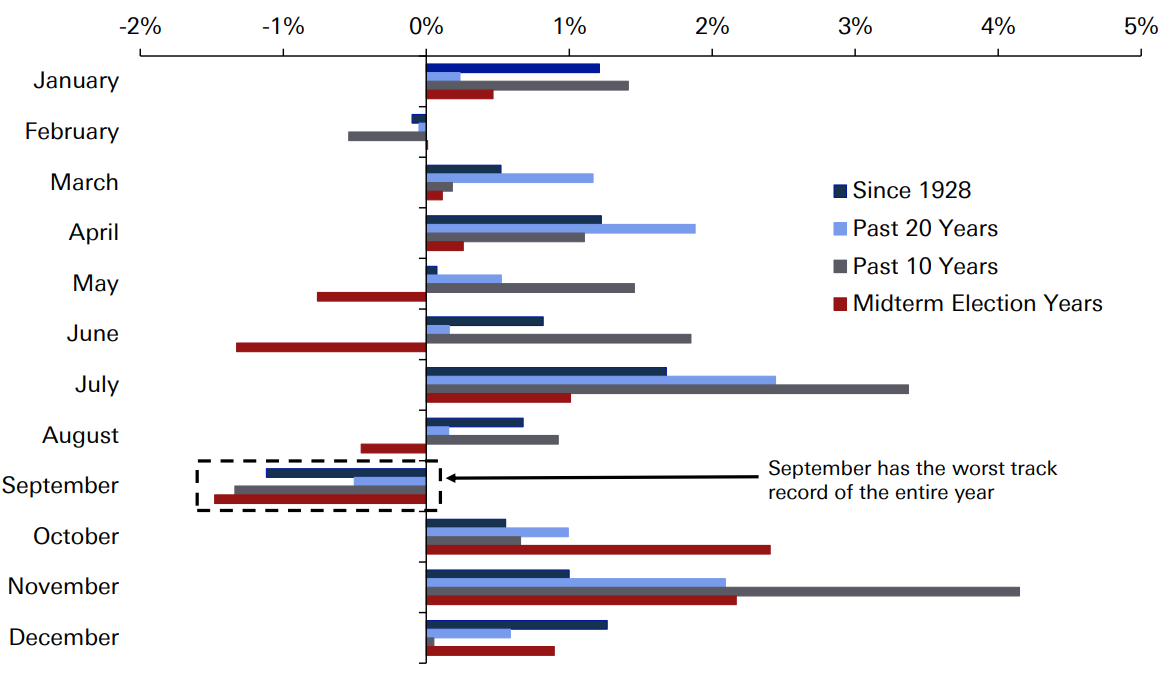
The potential for a significant shift in the political landscape of the United States has unsettled markets. The S&P 500 has largely drifted sideways since early August, while the tech-focused Nasdaq index has struggled to make any headway since early May. The run into midterm elections on 3 November has also coincided with a period when markets have historically suffered from lower returns during September.
Silver linings
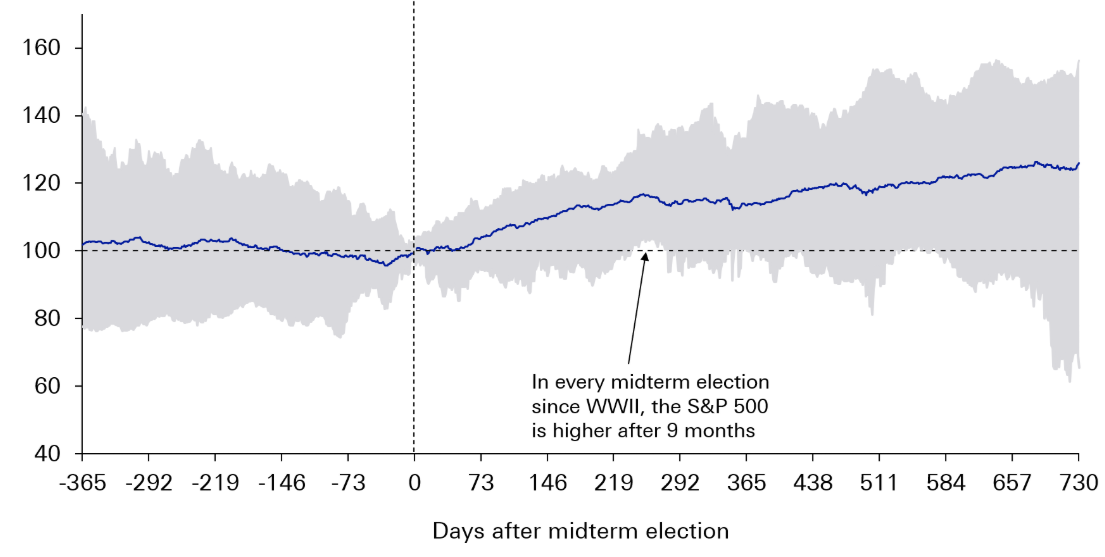
The good news is that research shows that once the election uncertainty clears, markets have historically wasted no time getting back on the front foot. This year looks like no exception, with Jim Reid, global head of macro strategy at Deutsche Bank, adding that it’s possible marketa are “already feeling the gravitational pull of the midterms”.
Average S&P 500 performance after midterm elections since the Second World War (with range)
Source: Bloomberg Finance LP, Deutsche Bank. Past performance is not a guide to future performance.
The historic performance of markets is even more encouraging when you begin to look at the last few months of the year. Once again, looking back at 100 years of stock market performance, we find that October, November and December have provided decent returns. While we would never make an investment decision based on a previous year’s performance, it can put recent market weakness into perspective, rather than as a portent of doom or any sign of things to come.
S&P 500 monthly performance (1928-2025). Seasonals consistently matter
Source: Bloomberg Finance LP, Deutsche Bank. Past performance is not a guide to future performance.
Divided politics are no problem for returns
If the Republicans were to lose control of both the House and the Senate in the coming elections, it wouldn’t necessarily be bad news for stock markets. In fact, there is strong historical precedent for stock markets continuing just fine.
One of the golden eras for the US stock market was the 12 years from 1981 to 1993 when the S&P 500 more than quadrupled in value. The Ronald Reagan years from 1981 to 1989 were divided, with a Republican president and Democrats in control of the House of Representatives. During the administration of George Bush senior from 1989 to 1993, again it was a Republican president and Democratic Congress.
The American political system is designed to function extremely effectively with differences of opinion. James Madison, the father of the US Constitution, built the structure of the presidency as the executive to run the country but with the checks and balances of a House of Representatives and a Senate.
In the midterms, all 435 members of the lower House of Representatives are up for election and are currently split 214 Democrat and 219 Republican, with one independent and one vacancy. While a third, or 35, of the 100 total seats in the upper house of the Senate are up for grabs and are split 45 Democrat, 53 Republican and two Independent. While current polling is pointing towards the Democrats taking the House, it is much harder to call the result in the Senate.
Executive orders
One of the main factors regardless of the result of the midterms is that President Trump will still be in charge, and that points towards a bumpy ride for the next two years. Trump has expanded the thinking of the unitary executive theory, namely that the president has the authority to do as he pleases, to new levels.
Foreign economic policy has been shaken up through tariffs, and international relations have been unsettled by supporting wars in the Middle East. Analysts from JP Morgan think this will continue after the midterms, believing “the trajectory of policy volatility is likely to be the status quo”.
In terms of the backdrop for the US economy, much of the main factors look set to continue as well. Elevated inflation and higher oil prices are putting pressure on consumers and businesses, although this is being offset by a key piece of Trump legislation, The Big Beautiful Bill, which will deliver an estimated $3.8 trillion (£2.8 trillion) in tax cuts to US business during the coming decade. Against those two competing factors, it’s easy to see how the stock market will continue to do what it does best and grind higher.
What do the midterms hold for AI investment?
One area that has come into focus has been the rapid growth of investment by AI hyperscalers (large cloud service providers like Amazon Web Services (AWS), Microsoft Azure and Google Cloud) and how this could be impacted by a change in the US political system. While both the Democratic and Republican parties are broadly supportive of the US becoming a world leader in AI technology, the pace of getting there could be different.
- Polar Capital Technology: the AI stocks I’m excited about in cognitive era
- Anthropic IPO: what UK investors need to know
- Sign up to our free newsletter for investment ideas, latest news and award-winning analysis
The problem has been the massive growth of data-centre construction needed to power the AI hyperscalers. This has placed a strain on local power and water networks. If the Republicans hold on to both the House and the Senate, it seems likely the pace of construction would not slow. Whereas Democratic candidates looking to win local elections have been campaigning on greater control over data construction and more legislation to safeguard the nascent AI technology. For a sector where valuations have already been pushed to extremes, a slowdown in growth rates could be a headwind for further gains.
Potential impacts for healthcare and consumer staples
One feature of Trump’s Big Beautiful Bill was to greatly reduce government spending on healthcare and support for households. If the Republicans retain control, it looks like reduced government spending would be a drag on these sectors.
However, if the Democrats control Congress, they could use their voting power to delay and slow spending cuts. This in turn could see healthcare and consumer staple names recover in the US into the year-end.
Macro will remain in the driving seat
While the midterm elections will provide a fascinating piece of political theatre, the far more important issue for investors will be to keep an eye on macro forces driving the markets. Policymakers are under serious pressure to keep a cap on inflation with interest rates already rising in the US. The direction of inflation and central bank rates has resulted in wild swings in the gold price and other commodities.
- Earnings beats fail to fire up S&P 500 index
- Stockwatch: the share poised to benefit from a new political alliance
The markets ignored soaring borrowing costs on government bonds for most of the summer, but have suddenly woken up to the fact that there may be a limit on fiscal expansion. The funding of vast investment into building data centres has also begun to stress the credit ratings of some of the companies involved.
The movement lower in technology names last week could just have been a pause for breath. But if it was the start of something more serious, you can expect the trends that emerged to continue in the coming months. Namely investors turning to the safety of fixed income like US treasuries and UK gilts that both rallied. Also, the FTSE 100 has a strong showing in dividend-paying defensive names that attract investors during a downturn, such as tobacco, defence, consumer staples, and infrastructure groups.
The key feature of the midterms seems to be that, as an investor, making any decisions based on the outcome looks like folly. Far better to keep a balanced portfolio, which should mean you still benefit from markets recovering into the end of the year.
John Ficenec is a freelance contributor and not a direct employee of interactive investor.
These articles are provided for information purposes only. Occasionally, an opinion about whether to buy or sell a specific investment may be provided by third parties. The content is not intended to be a personal recommendation to buy or sell any financial instrument or product, or to adopt any investment strategy as it is not provided based on an assessment of your investing knowledge and experience, your financial situation or your investment objectives. The value of your investments, and the income derived from them, may go down as well as up. You may not get back all the money that you invest. The investments referred to in this article may not be suitable for all investors, and if in doubt, an investor should seek advice from a qualified investment adviser.
Full performance can be found on the company or index summary page on the interactive investor website. Simply click on the company's or index name highlighted in the article.