What bond managers are watching this Budget
A Morningstar analyst asks four bond fund managers how they are positioned ahead of the Autumn Budget against a backdrop of rising yields.
27th October 2026 11:38
by Morningstar from ii contributor
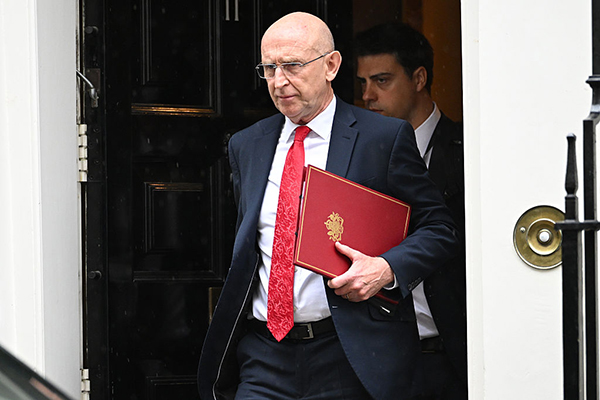
Chancellor John Healey after a weekly government Cabinet meeting at Downing Street. Photo: Leon Neal/Getty Images.
Ahead of the Autumn Budget, the UK economy is facing a number of headwinds.
Gross domestic product (GDP) growth has been resilient despite uncertainty over global growth, conflict in the Middle East and the energy price crisis, but it remains below long-term trends.
- Invest with ii: SIPP Account | Stocks & Shares ISA | See all Investment Accounts
High borrowing costs, fiscal concerns, renewed inflationary pressures from rising energy prices and weakness in the labour market are creating a challenging backdrop for the UK government.
Rising government bond yields
Like other major economies, the UK is facing growing pressure from increasing borrowing costs, which have reached multi-year highs in recent months.
The 30-year gilt yield recently reached its highest level since 1998, while the 10-year gilt yield hit its highest level since 2008.
A number of factors have contributed to the recent spike in government bond yields.
High government spending intended to stimulate growth flooded the market with government bonds, lowering prices and pushing up yields.
Investors are also demanding higher returns from long-dated bonds due to economic uncertainty, while central banks are expected to hike interest rates in reaction to renewed inflationary pressures from higher energy prices linked to tensions in the Middle East.
The Federal Reserve and European Central Bank (ECB) have already started, and the Bank of England is expected to follow.
Another important factor behind the spike in bond yields has been the significant debt issuance from technology hyper-scalers to finance the construction of data centres. They have issued over $200 billion (£150 billion) in corporate debt so far this year.
This massive supply of high-quality investment-grade corporate bonds is competing with government bonds for investors’ capital, contributing to the upward move in yields.
The key question for investors is what measures will be announced at the Autumn Budget and how gilt yields will react.
What could be announced in the Budget?
Chancellor John Healey will deliver his first Budget tomorrow (28 October), having promised “fiscal discipline” at the Labour Party Conference last month.
The government faces the challenge of supporting households and increasing defence spending while following its self-imposed fiscal rules: debt as a proportion of GDP must fall by 2029-30, and day-to-day government spending must be “in balance,” so it is not continually borrowing to pay for everyday operations.
Based on the government’s manifesto, the three main types of taxes – income tax, VAT and National Insurance – will not be increased. Healey is expected to focus on wealth, property, or sector-specific taxes to raise government revenue. Several measures have already been confirmed by the government or will be detailed further on Budget day.
Changes to the state pension triple lock from April 2030 onwards will aim to fund a National Care Service.
Instead of rising by the highest of wage growth, inflation, or 2.5%, the state pension will rise in line with the highest of 2.5% or inflation, while details on a mechanism to link it to earnings growth over time are still to be announced.
- Three state pension announcements to expect at the Budget
- Find out the latest UK Budget news here
- Autumn Budget preview and triple lock change explained
Support for first-time buyers and tax cuts on electricity bills, alongside a reduction in business rates for eligible pubs, social clubs, and live music venues, are some of the support measures that already have been announced.
A number of additional measures are anticipated or rumoured.
These include an increase in capital gains tax, either through a higher rate or changes to exemptions; a mansion tax, potentially by lowering the property value threshold for “High Value Council Tax Surcharge” from £2 million to £1.5 million; sector taxes on banks, gambling, or oil companies; and changes to the inheritance tax regime.
Additional cost-of-living support may also be announced, including a cut to tax on domestic gas bills and an extension of the freeze on fuel duty.
How bond fund managers are positioned ahead of the Budget
The fixed-income managers we interviewed widely expect that the Budget will not result in any material market volatility, with measures aligned to maintaining fiscal discipline.
The government faces fiscal constraints, and the recent rise in yields has limited the space for fiscal expansion.
Still, the Budget could create significant market volatility in case it includes any measures – such as excessive welfare spending and higher borrowing – that jeopardise fiscal discipline and unsettle gilt markets.
Most fixed-income managers do not hold significant overweight or underweight allocations in the UK.
Managers generally prefer gilt exposure in the intermediate part of the yield curve, which they believe offers attractive risk-adjusted yields.
Corporate bond allocations are focused on financials and non-cyclical sectors with predictable cash flows.
BlueBay Global Investment Grade Corporate Bond Fund
The BlueBay Global Investment Grade Corporate Bond Fund (People Pillar* rating: High/Process Pillar** rating: High)follows a wait-and-see approach to the Budget
The fund currently has no exposure to the UK, compared with around 5% within the fund’s benchmark.
If the team sees fiscal slippage and no plan for growth, it will look to be short UK rates, focusing that position further out on the curve because this would signal a fiscal issue rather than a short-term rates issue.
Conversely, if the government delivers a credible message, it may switch any long-rates positioning into the UK, as considerable scepticism is already priced into the UK gilt market.
Jupiter Strategic Bond Fund
Jupiter Strategic Bond I Acc (B4T6SD5) (People Pillar rating: High/Process Pillar Rating: Above Average) would be very surprised to see substantial fiscal loosening in the Budget.
The fund has an overall duration of around 5.9 years, including 1.8 years of exposure to the UK yield curve, concentrated mainly in the five- and 10-year maturities.
Its current UK corporate bond exposure (21%) is defensive with a focus on short duration, non-cyclical sectors, and senior secured exposures.
If the Budget delivers material and unexpected fiscal loosening, they could consider reducing their rates exposure.
They have already trimmed the UK contribution to portfolio duration this year because of higher volatility in UK rates.
Royal London UK Government Bond Fund
The Royal London UK Government Bond M Acc (B881TW5) fund (People Pillar rating: Above Average/Process Pillar rating: Above Average)does not expect the chancellor to announce significant new spending commitments or major policy initiatives that would materially alter the fiscal outlook, which should result in a relatively benign outcome for the gilt market.
The fund is running a long-duration strategy focused on five- to seven-year gilts, reflecting the market’s pricing for base rates over the medium term relative to their own expectations, and is also overweight longer-maturity government bonds because of the attractive yield level and expectations of reduced issuance.
Allianz Gilt Yield Fund
The Allianz Gilt Yield I Inc (3138339)(People Pillar rating: Average/Process Pillar rating: Average)is modestly long UK duration through both gilts and interest rate swaps as part of relative value expressions versus the US, Germany and Sweden.
The team believes that gilt valuations are being supported by the Bank of England’s quantitative tightening envelope, after the Bank surprised investors by scrapping outright sales of ultra-long gilts.
It also expects a cautious Budget, with the chancellor seeking to shore up fiscal credibility rather than making any fresh flagship policy announcements.
For investors, active fixed-income managers able to adjust exposures and manage risk dynamically may add value in an environment shaped by geopolitical tensions and changing inflation, monetary policy, and economic growth outlook.
*The Morningstar People Pillar evaluates the talent, tenure, and overall quality of a fund’s portfolio managers and analytical team. Please see the Morningstar website for more information.
**Process Pillar is one of the three core pillars in the Morningstar Medalist Rating framework used to evaluate funds. Please see the Morningstar website for more information.
Evangelia Gkeka is principal, manager research at Morningstar.
These articles are provided for information purposes only. Occasionally, an opinion about whether to buy or sell a specific investment may be provided by third parties. The content is not intended to be a personal recommendation to buy or sell any financial instrument or product, or to adopt any investment strategy as it is not provided based on an assessment of your investing knowledge and experience, your financial situation or your investment objectives. The value of your investments, and the income derived from them, may go down as well as up. You may not get back all the money that you invest. The investments referred to in this article may not be suitable for all investors, and if in doubt, an investor should seek advice from a qualified investment adviser.
Full performance can be found on the company or index summary page on the interactive investor website. Simply click on the company's or index name highlighted in the article.