Three state pension announcements to expect at the Budget
Next year’s state pension rise, a promise to protect some pensioners from tax, and more detail about the new triple lock should all feature in John Healey’s first red book.
22nd October 2026 13:26
by Craig Rickman from interactive investor
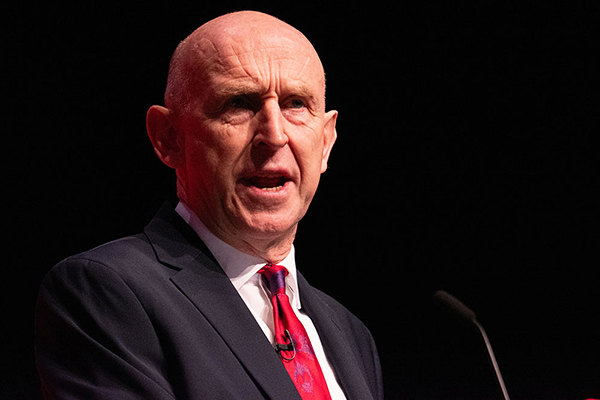
Chancellor John Healey pictured at the recent Labour Party Conference in Liverpool. Photo: Gary Roberts/SOPA Images/LightRocket via Getty Images.
At the risk of famous last words, this year’s Autumn Budget could be a quiet affair for investors.
This wouldn’t be a bad outcome by any stretch. Wealth tax hikes and seismic rule changes to pensions and individual savings accounts (ISA) dominated the first two fiscal events of this parliament, prompting many individuals and families to revisit their financial plans. A period of respite and consistency is sorely needed.
Speculation has been tamer this time around, and some of the dominant tax rumours – notably rises to capital gains tax (CGT) – have reportedly been shut out.
- Invest with ii: SIPP Account | Stocks & Shares ISA | See all Investment Accounts
History suggests we should steel ourselves for a “rabbit out the hat” moment. Although, as others have argued, perhaps the best surprise John Healey could deliver is to leave taxes alone.
Tax reforms aren’t the only thing to watch out for on Wednesday 28 October. We can also expect some key developments regarding the state pension. The Burnham administration has been busy in this area since assuming power, announcing an adjustment to the triple lock mechanism from 2030 onwards to help fund the government’s social care plans.
Further detail about how this might work isn’t the only state pension item on the agenda. There’s still the matter of next year’s increase to rubber stamp, as well as a promise to protect some low-income pensioners from a looming tax bill, with the full state pension set to hurtle past the personal allowance.
Let’s examine in more detail these three announcements.
1) 3.9% increase to be confirmed from April 2027
We learned yesterday that September inflation came in at 3.5%, accelerating from 3.2% the month before. Aside from proving a blow to households as goods and services are becoming more expensive, the data was also relevant for next year’s state pension increase.
Under the current triple lock mechanism, the state pension uprates annually by the highest of inflation, wage growth or 2.5%.
The earnings figure is measured in the three months to July and has already been confirmed at 3.9%, so we were just awaiting the inflation data - the 12-month consumer prices index (CPI) figure to September - to know which of the trio will drive April 2027’s increase.
With inflation lagging wage growth, notably for the fourth year in a row, the full new state pension will rise £489 to 13,036 a year, while the full basic state pension will increase £375 to £9,990, annually.
This will prove a welcome boost to retirees, especially those who rely heavily on the state pension to make ends meet in later life. interactive investor’s latest Great British Retirement Survey found it’s the main source of income for almost half (48%) of pensioners.
- When will you get your state pension?
- How much do you need to secure a comfortable retirement?
- Find out the latest UK Budget news here
Inflation is expected to remain above the Bank of England’s 2% target for some time, with the International Monetary Fund (IMF) forecasting 3.3% in 2026 and 2.8% in 2027, heaping further pressure on household finances. An inflation-beating increase to the state pension will ease at least some of the strain.
Given the government’s recently announced shake-up to the triple lock, further honouring its manifesto commitment to retain the policy for the rest of this parliament, rubber stamping these increases on Wednesday is a formality.
But we should note that the triple lock doesn’t apply to all parts of the state pension. The extra income of any deferred amount in payment, uprates in line with the CPI only, which as mentioned above, was 3.5%.
2) Solving the personal allowance dilemma
At last year’s Autumn Budget, then-chancellor Rachel Reeves announced that anyone whose sole income is from the state pension won’t face a tax bill, with the full amount set to exceed the £12,570 personal allowance.
The personal allowance is the amount of income you can receive every year before paying tax and has been frozen since 2021-22. With the full state pension set to rise to above £13,000 from April 2027, pensioners who receive the maximum sum can expect to pay around £93 in tax.
But the government has pledged to step in, stating: “Pensioners whose only income is the full new or basic state pension without any increments will not pay income tax and we are committed to that over this parliament.”
We have a new chancellor since that commitment was made, yet both Andy Burnham and John Healey have promised to honour it. Exactly how this system will work throughout the remainder of this parliament is unclear. Presumably we’ll learn more at the Budget with the new tax year less than six months away. People in receipt of the state pension need to know whether they’ll pay tax on it to plan their finances accordingly.
- Why the state pension increase may carry a new tax sting
- Sign up to our free newsletter for investment ideas, latest news and award-winning analysis
A key aspect to watch out for is this definition of “without any increments”. Reading between the lines, if you have any additional state pension, or you deferred claiming the state pension for one or more years, you won’t qualify under the government’s definition. This risks potential unfairness, as it could create a scenario where two retirees receive the same level of state pension income, yet one pays tax while the other doesn’t.
We also need clarity on whether only taxed income applies or if tax-free sources, like from ISAs, will feature in the assessment, too.
3) Further information on the ‘adjusted triple lock’
Unquestionably the headline announcement of Burnham’s premiership to date is the shake-up to the triple lock.
In what many considered a no-go area given its political sensitivity, the prime minister announced at the Labour Party Conference in late September that the state pension’s annual uprating system will change from the new parliament; a move the government believes can help fund a new National Care Service.
So, what’s due to change? From April 2030, the calculations for inflation and 2.5% will remain the same, but the earnings element will be measured over time instead of being assessed every year. This means there will still be three parts to the uprating mechanism but it should remove the ratcheting effect where an inflation spike is followed by a period of wages playing catch up.
- Autumn Budget preview and triple lock change explained
- Burnham’s triple lock shake-up and what it could mean for pensioners
We’re still not crystal clear on exactly how the new triple lock will function, and the uncertainty about future inflation and wage rises has sparked debate about whether the tweak will free up sufficient savings to realistically support Burnham’s social care plans. According to the government’s own forecasts, the adjusted triple lock could save £15 billion by 2030 and £50 billion by 2030. But as some think tanks such as the Institute for Fiscal Studies (IFS) have warned the actual savings could be much lower.
While this change is still a few years away - and may not see the light of day with rival parties pledging commitment to the existing system - current and future retirees will want more clarity about how it could affect their later-life income. The adjustment will mean the state pension doesn’t increase at the same pace as it would under the current triple lock.
The Autumn Budget 2026 is an obvious forum for Healey to share more about how the proposed system will work, both in terms of the impact on pensioners and its link to social care.
These articles are provided for information purposes only. Occasionally, an opinion about whether to buy or sell a specific investment may be provided by third parties. The content is not intended to be a personal recommendation to buy or sell any financial instrument or product, or to adopt any investment strategy as it is not provided based on an assessment of your investing knowledge and experience, your financial situation or your investment objectives. The value of your investments, and the income derived from them, may go down as well as up. You may not get back all the money that you invest. The investments referred to in this article may not be suitable for all investors, and if in doubt, an investor should seek advice from a qualified investment adviser.
Full performance can be found on the company or index summary page on the interactive investor website. Simply click on the company's or index name highlighted in the article.