The Analyst: how to enhance your Vanguard LifeStrategy exposure
Stock market performance so far in 2026 has many investors asking how to complement their Vanguard LifeStrategy holdings. Analyst Dzmitry Lipski has the answers.
9th July 2026 14:07
by Dzmitry Lipski from interactive investor
Photo: Budrul Chukrut/SOPA Images/LightRocket via Getty Images.
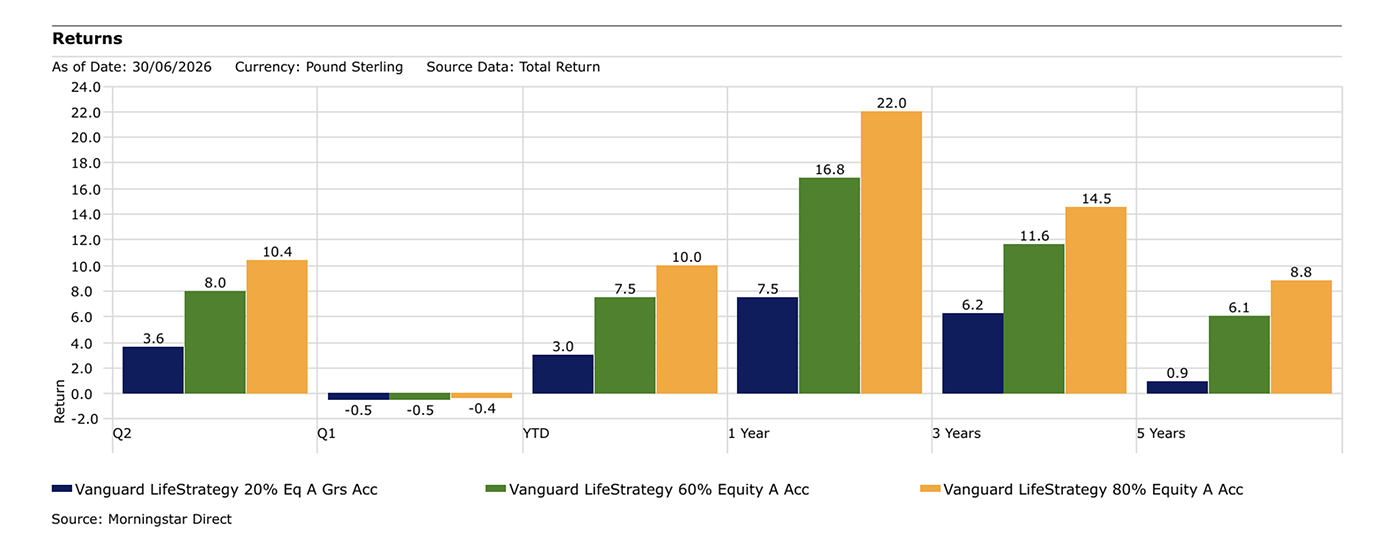
The outbreak of war in the Middle East created a broad macroeconomic shock, most visibly through higher energy prices, renewed inflation concerns, and a repricing of interest rate expectations. This put pressure on both parts of a traditional equity-bond portfolio, such as the Vanguard LifeStrategy range. Equities weakened as investor risk appetite declined, while conventional bonds came under pressure as rising bond yields reduced their value.
As a result, the first quarter of 2026 proved challenging for portfolios invested primarily in traditional asset classes. By contrast, investors with broader diversification across asset classes were generally better positioned to navigate the volatile environment. Performance improved during the second quarter as markets stabilised and the Vanguard LifeStrategy funds recovered.
- Invest with ii: SIPP Account | Stocks & Shares ISA | See all Investment Accounts
Past performance is not a guide to future performance.
The experience also highlights why many investors ask whether Vanguard LifeStrategy should be complemented with additional investments.
While the funds already provide broad exposure to global equities and bonds, carefully selected satellite holdings can broaden the portfolio’s sources of return and potentially improve long-term outcomes. This reinforces the value of diversification not only across regions, but also across investment styles and asset classes.
Global Equity Income
A global equity income strategy adds a more defensive equity layer, focusing on companies with resilient business models, strong cash flows and sustainable dividends.
While Vanguard LifeStrategy already invests in global equities, it follows a market-cap-weighted approach rather than an income-focused one.
Income strategies typically have a greater exposure to value and quality companies and lower-volatility sectors. As a result, they may help provide a steadier income stream and greater resilience during periods of market weakness.
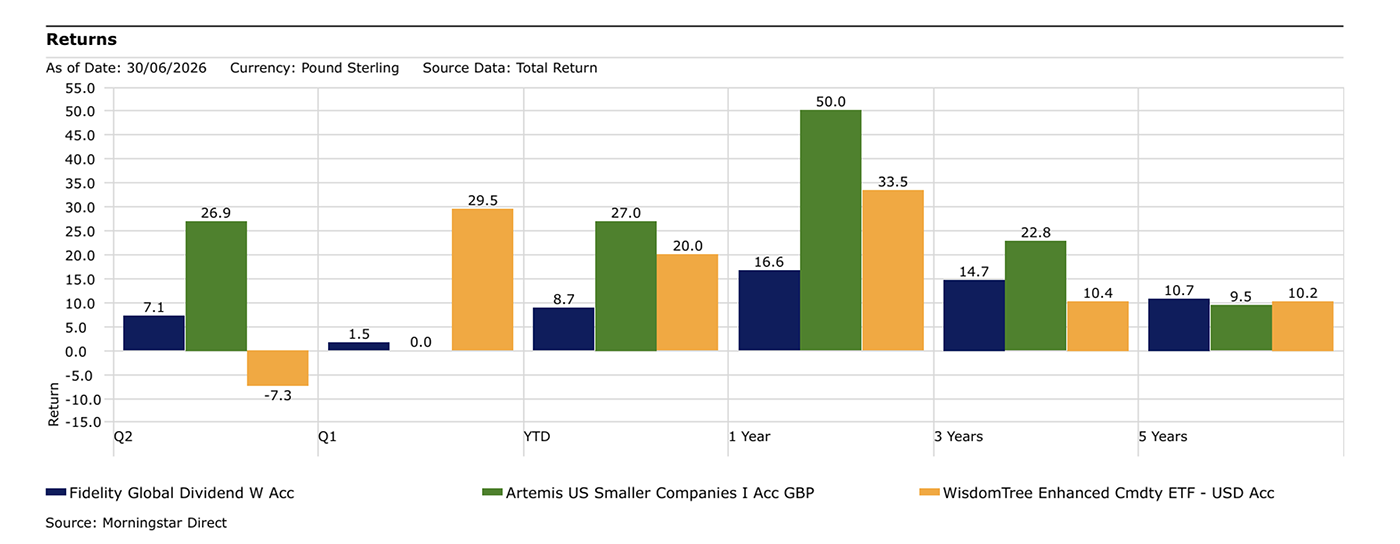
Fund ideas: Fidelity Global Dividend W Acc (B7GJPN7) or UK-oriented Artemis Income I Acc (B2PLJH1).
Smaller Companies
Smaller companies are relatively underrepresented within Vanguard LifeStrategy, which is primarily invested in large-cap global indices.
Adding exposure to smaller companies introduces different return drivers and offers the potential for higher long-term growth, while also broadening diversification across the market-cap spectrum. Investors should recognise, however, that this comes with higher volatility and greater investment risk.
Fund ideas: Artemis US Smaller Companies I Acc GBP (BMMV576) or WS Gresham House UK Smaller Coms C Acc (BH416G5).
Real Assets
Real assets can provide exposure to investments that behave differently from traditional equities and bonds.
Periods of persistent inflation like in 2022 have shown that conventional bond allocations can struggle when interest rates rise.
Assets such as commodities, infrastructure and gold have historically exhibited lower correlations with traditional asset classes and may help protect purchasing power during inflationary periods.
Fund idea: WisdomTree Enhanced Cmdty ETF - USD Acc GBP (LSE:WCOB).
Past performance is not a guide to future performance.
Which strategies may suit each Vanguard LifeStrategy fund?
Vanguard LifeStrategy 20% Eq A Grs Acc (B4NXY34)- this is the most defensive portfolio in the range, with a high allocation to bonds. Complementary strategies are therefore typically focused on enhancing long-term growth. Global Equity Income or Smaller Companies may improve return potential without materially changing the portfolio’s cautious profile.
Vanguard LifeStrategy 40% Equity A Acc (B3ZHN96) - a more balanced but still cautious portfolio where Global Equity Income could work well, adding quality and income characteristics. Real Assets can also help diversify the bond exposure and provide inflation resilience.
Vanguard LifeStrategy 60% Equity A Acc (B3TYHH9)- the “classic balanced 60/40” option, making it a strong core holding for satellite strategies. Smaller Companies can enhance growth potential, while Real Assets or Equity Income can improve diversification and portfolio resilience.
Vanguard LifeStrategy 80% Equity A Acc (B4PQW15) - with a high equity allocation, this portfolio is already growth-oriented and more volatile. Complementary strategies are often more defensive, such as Global Equity Income or Real Assets, to help reduce concentration risk and smooth returns during weaker equity markets.
- Time to upgrade to Vanguard LifeStrategy 2.0?
- Sign up to our free newsletter for investment ideas, latest news and award-winning analysis
Vanguard LifeStrategy funds are designed to serve as a core holding, providing diversified exposure to global equity and bond markets. The role of additional investments is not to duplicate that exposure, but to enhance the portfolio by adding different return drivers or improving resilience in a range of market environments.
It is worth noting that satellite holdings should generally remain modest (for example, 10% to 20% of the portfolio) so that the core Vanguard LifeStrategy fund can continue to deliver its intended asset allocation.
These articles are provided for information purposes only. Occasionally, an opinion about whether to buy or sell a specific investment may be provided by third parties. The content is not intended to be a personal recommendation to buy or sell any financial instrument or product, or to adopt any investment strategy as it is not provided based on an assessment of your investing knowledge and experience, your financial situation or your investment objectives. The value of your investments, and the income derived from them, may go down as well as up. You may not get back all the money that you invest. The investments referred to in this article may not be suitable for all investors, and if in doubt, an investor should seek advice from a qualified investment adviser.
Full performance can be found on the company or index summary page on the interactive investor website. Simply click on the company's or index name highlighted in the article.