Pensions and inheritance tax: what new rules really mean for your estate
The percentage of deaths triggering death duties is expected to double over the next five years, and ending the exemption on leftover pension funds is a dominant factor.
12th November 2026 15:25
by Craig Rickman from interactive investor

In every financial year between 2007/08 and 2023/24, the proportion of UK deaths that triggered an inheritance tax (IHT) bill has been fewer than one in 20. It’s a statistic that’s frequently trotted out in the media, often to reassure people that, while they might worry about a looming IHT bill, it’s not a problem everyone faces.
- Our Services: SIPP Account | Stocks & Shares ISA | See all Investment Accounts
But as the Office for Budget Responsibility’s (OBR) latest forecasts show, the net will soon widen. In its Economic and Fiscal Outlook – October 2026, published alongside the latest budget, the Treasury body predicts that by 2031/32 almost one in nine deaths will result in IHT; double the amount that pay the tax today.
There are two main policy drivers here. First, the decision to freeze the IHT tax-free thresholds is bringing more estates into the fold as assets like investment portfolios and properties naturally rise in value over time and enjoy no protection from inflation. Second, the Autumn Budget 2024 unveiled sweeping reforms to businesses, farms, and pensions, which will broaden the assets that fall into estate calculations.
The projected impact of pensions is notably striking. In the current tax year, the OBR predicts 5.91% of deaths will result in death duties, but this will jump sharply to 8.3% in 2027/28 when the pension rule change kicks in. According to the OBR, the changes to pensions, agriculture and business will “account for around one-sixth of total revenue by the end of the forecast.”
Proportion of estates expected to be subject to inheritance by financial year
| 2024-25 | 2025-26 | 2026-27 | 2027-28 | 2028-29 | 2029-30 | 2030-31 | 2031-32 | |
| Proportion of deaths subject to inheritance tax (per cent) | 4.87 | 5.35 | 5.91 | 8.30 | 8.87 | 9.47 | 9.96 | 10.48 |
Source: Office for Budget Responsibility
There is also a frequently overlooked factor when assessing the proportion of estates liable for IHT: wealth often moves sideways on death where a surviving spouse or civil partner is involved, where no IHT is payable regardless of the estate’s size. Any unused tax-free allowances, known as nil rate bands, can be transferred, too.
- Is inheritance tax planning now a midlife pursuit?
- Can you gift property or other assets to reduce IHT?
This helps explain the recent uptick in marriages, including ‘deathbed marriages’. Tying the knot not only relieves your better half of IHT but can also reduce the potential burden on younger generations.
Giving with one hand, taking with the other
Over the past two-and-half decades not all reforms to the IHT landscape have been punitive. The facility to transfer any unused nil rate band (NRB), introduced on 9 October 2007, gave married couples extra breathing space from death duties.
The graphic below shows, between 2006/07 and 2008/09, the number and proportion of estates that triggered IHT halved.
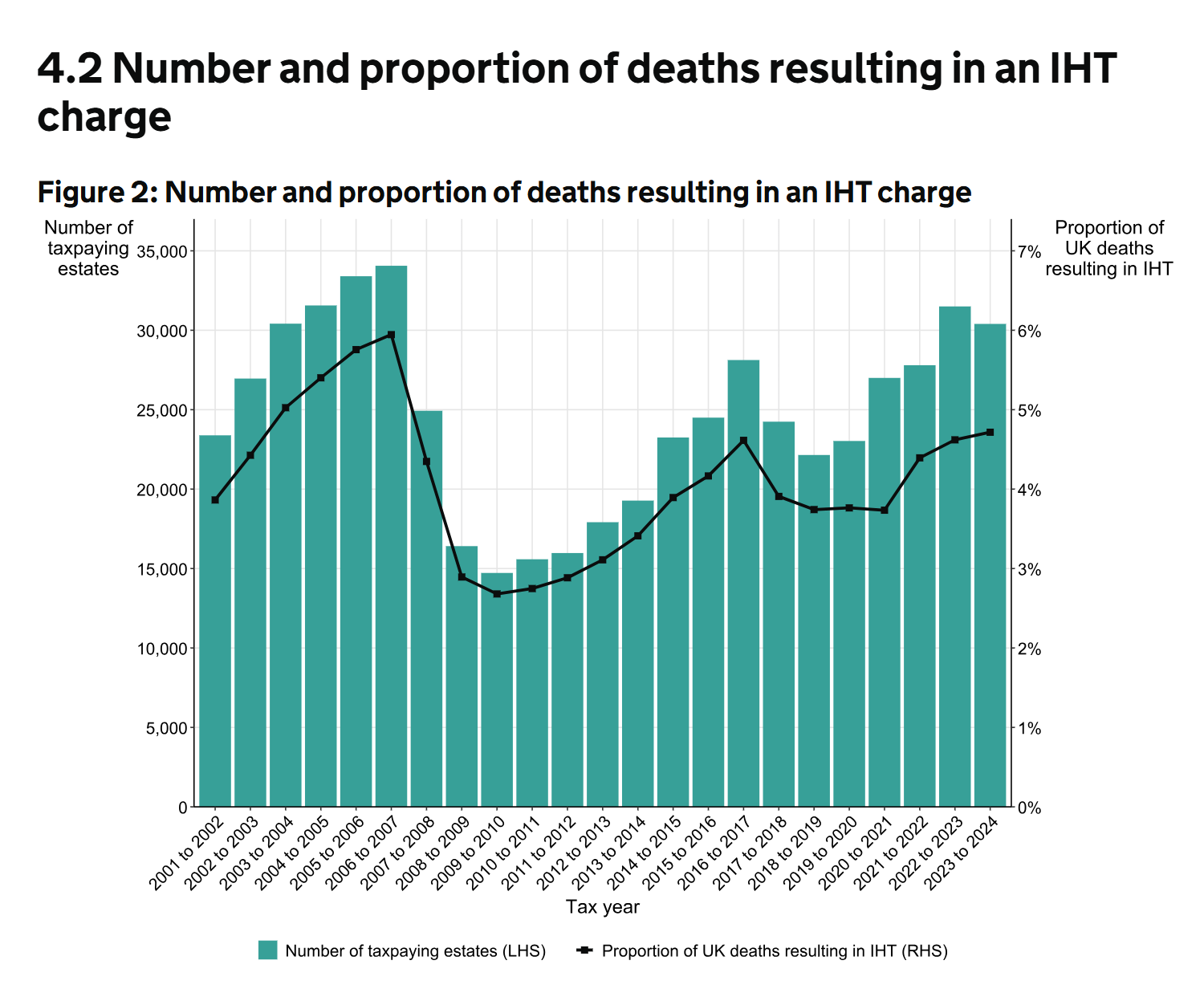
The birth of the residence nil rate band (RNRB) in 2017 - which affords an extra allowance to people who own a home and leave it to direct descendants - also had an impact, causing number of estates and proportion of deaths paying IHT to fall. The RNRB started at a £100,000 and increased by £25,000 increment every year until landing at £175,000 in April 2020, giving married couples an extra £350,000 to pass on tax free.
Other treatment of the NRB and RNRB has been less favourable. Namely, they’ve been frozen. The NRB hasn’t budged from its £325,000 level since 2009, and the RNRB has remained at £175,000 for six years.
Both are scheduled to stay as they are until April 2031, which in combination with the policy reforms, will continue to pull more estates into IHT, and not just the wealthiest ones. That assertion is supported by OBR data that indicates the average IHT bill will fall by more than 20% between now and 2031-32, presumably because smaller estates will drag the figure down. Arguments that IHT is a levy reserved for the rich have become increasingly tenuous.
| 2024-25 | 2025-26 | 2026-27 | 2027-28 | 2028-29 | 2029-30 | 2030-31 | 2031-32 | |
| Average tax bill for taxpaying estates (£ '000s) | 242.57 | 241.69 | 246.63 | 204.61 | 201.73 | 198.83 | 199.32 | 196.57 |
Assessing the impact from April 2027
The date for pensions becoming liable for IHT is just a handful of months away and the policy’s introduction is stark. If you pass away before 6 April, unused pensions avoid the tax. But die on or after the start of the new tax year, and they’re hauled into the estate calculation and HMRC will take 40% on anything that exceeds your NRB and RNRB (if available). Given that if death occurs after age 75, beneficiaries pay income tax on withdrawals at their marginal rate, it creates the possibility of two tax hits on one pot.
With the clock ticking down to 6 April 2027, it’s important to find out where you stand. Let’s answer some of the key questions you might have.
Which types of pensions are affected?
While most pensions will be impacted by this rule change, some are exempt.
The main ones included are any unspent or unused funds within defined contribution (DC) pensions, such as personal plans like self-invested personal pensions (SIPP). Any lump sum benefits from defined benefit (DB) schemes will also form part of your estate.
In terms of excluded pensions, death-in-service benefits from employment, joint-life annuities, dependants’ pensions from a DB scheme won’t count towards your estate.
How much can I pass on tax free on death?
Importantly, the spousal and civil partner exemption will remain. In this example, it’s on the second death where IHT can apply.
But even then, you can still use your lifetime tax-free allowances to mitigate a tax bill.
Everyone gets the £325,000 NRB, while the £175,000 RNRB is available to most who pass their family home to direct descendants like children and grandchildren. I say most because the RNRB reduces by £1 for everyone £2 your estate exceeds £2 million, meaning its lost once your estate is worth £2.35 million for single people or £2.7 million for married couples and civil partnerships.
So, you could pass on as much £1 million (if you inherited a spouse or civil partner’s NRB and RNRB) or as little as £325,000, tax free. If you own a farm or business, it could be even higher. And only the pension value, when added to other assets, that exceeds this figure suffers IHT.
Finding out where you stand is an important first port of call, especially if you’re eyeing up ways to reduce IHT.
Why might I need to watch out for the taper at £2 million?
Pension assets pushing your estate above £2 million could have particularly punishing consequences. That’s because your heirs could face a triple whammy of lost RNRB, 40% IHT, and income tax on withdrawals, creating a potential effective rate which could reach 80%.
Should I draw from my pension or ISA first in retirement?
Until the pension change was announced in October 2024, many investors chose to draw from individual savings accounts (ISA) before pensions to harness the latter’s IHT exemption.
- Older generations accelerate financial gifts as IHT changes bite
- The conversations that could slash your inheritance tax bill
- The Great British Retirement Survey: key findings and retirement insights
But the prospect of heirs paying both IHT and income tax on inherited pensions means many have already switched the order.
Presuming you die after age 75 and the full pot is subject to IHT, the combined rate could be 52% if the beneficiary pays basic-rate tax on withdrawals, jumping to 64% and 67% at the higher and additional rates, respectively.
Choosing to draw ISA or pension first isn’t necessarily a straightforward decision, and the best course of ultimately hinges on the tax rates you and your heirs pay on withdrawals. If you plan to spend down your pension, or gift any surplus pension funds to younger generations, the tax-free lump sum may be an obvious place to start, and beyond that making sure you keep within the 20% tax band.
One thing to consider, is that recipient of an inherited pension doesn’t have to draw money out straightaway. If it’s passed to a beneficiary drawdown account, they could use the pot to retire early, with withdrawals potentially tax free if they pack up work before state pension age and have a full personal allowance (currently £12,570) to harness.
On the flip side, leaving ISA funds instead of pensions to your children offers more certainty. While the money must leave the ISA wrapper (unless left to a spouse), you know that whatever their situation at the time, they can spend it down without worrying about an income tax bill.
A way to mitigate any tax you pay on SIPP withdrawals is to direct the money into an adult child’s pension, provided they’re happy for the money to be tied up. Basic-rate relief is applied immediately, and the beneficiary can claim extra tax back if they’re in a higher bracket.
In summary, the complexity and personalised nature of this decision means it can be wise to get regulated financial advice.
What are the key tax considerations if I want to gift money?
With IHT becoming a bigger problem, making gifts to younger generations is racing up the pecking order.
It’s therefore helpful to learn whether gifts are classed as immediately exempt, potentially exempt or chargeable.
The gifts out of normal expenditure rule allows you to pass on as much of your income as you like, provided the money comes from income rather than capital, the gifts are regular in nature, and don’t affect your standard of living. As far as we understand, SIPP withdrawals qualify under the definition.
There are some other tax-free exemptions at your disposal. You can give away £3,000 a year (you can bring forward last year’s £3,000 if unused meaning a couple could pass on £12,000 and get instant relief), and parents and grandparents can each gift up £5,000 or £2,500, respectively, for weddings.
Most other gifts are classed as ‘potentially exempt’ meaning you must survive seven years from the date it was made. You should note that gifts into certain trusts that exceed your £325,000 NRB are classed as ‘chargeable lifetime transfers’ and face immediate IHT at 20%.
A final note is to wary of other taxes that can be incurred in the gifting process, such as transferring or selling a second home or share portfolio which could trigger capital gains tax (CGT).
These articles are provided for information purposes only. Occasionally, an opinion about whether to buy or sell a specific investment may be provided by third parties. The content is not intended to be a personal recommendation to buy or sell any financial instrument or product, or to adopt any investment strategy as it is not provided based on an assessment of your investing knowledge and experience, your financial situation or your investment objectives. The value of your investments, and the income derived from them, may go down as well as up. You may not get back all the money that you invest. The investments referred to in this article may not be suitable for all investors, and if in doubt, an investor should seek advice from a qualified investment adviser.
Full performance can be found on the company or index summary page on the interactive investor website. Simply click on the company's or index name highlighted in the article.