SpaceX: what Wall Street thinks the shares are really worth
It’s very clear that opinion on Elon Musk’s company is divided now that restrictions on analyst coverage has been lifted. Graeme Evans explains this and the ‘multiple drivers of upside’.
8th July 2026 14:05
by Graeme Evans from interactive investor
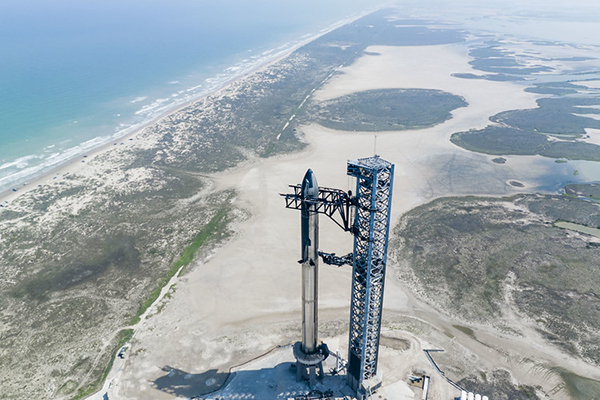
Starship Test Flight Mission. Credit: SpaceX via Flickr.
Wall Street’s initial view on the value of Space Exploration Technologies Corp Class A (NASDAQ:SPCX) points to a $1 trillion-plus difference of opinion after one leading bank began its coverage with a share price target of $300.
Morgan Stanley’s Overweight stance backs Elon Musk’s rocket launch, Starlink broadband and social media and AI compute company to double last night’s $2 trillion (£1.5 trillion) market capitalisation.
- Invest with ii: Buy US Stocks from UK | Most-traded US Stocks | Cashback Offers
Citi, Goldman Sachs and UBS see upside to between $200 and $210, while the base case for RBC Capital and JP Morgan values the shares at $225 and Deutsche Bank at $255.
SpaceX last night closed below $150 for the first time since the day of its initial public offering (IPO) on 12 June, when 640 million shares were priced at $135 in order to raise a record $86 billion at a $1.8 trillion valuation.
The shares touched $225 the following week but profit takers and other sellers have since moved in. Among ii customers, SpaceX has been the most traded on our platform over the past month but with about 40% of these dealings being to sell the stock.
Those who have stayed on board or added shares since the IPO have been boosted by the initial stance of several Wall Street banks after restrictions on their coverage ended this week.
Morgan Stanley’s $300 price target is accompanied by an “intentionally wide” $75 bear case and $600 bull case, which it said balanced SpaceX’s unique ability to capture the expanding space and AI opportunity against material execution, funding and technology risk.
- Fund Focus: beyond Space X - the next frontier of space stocks
- Top stocks to insulate your portfolio from AI volatility
- The AIM companies involved in new space race
It highlights SpaceX’s combined near-monopoly launch economics, the world’s largest LEO (Low Earth Orbit) satellite network through Starlink and a fast-scaling AI infrastructure business.
The bank’s base case sees revenue rising from $45 billion in 2026 to $319 billion in 2030 and $3.3 trillion in 2040.
Morgan Stanley added: “We see the company as one of the few platforms that can link real estate in orbit, global connectivity, and compute capacity into one infrastructure stack.”
It regards the fully reusable transportation system Starship as the main unlock for SpaceX’s long-term economics across space, connectivity and AI.
The cost of sending one kilogram of payload into space is more than $1,000 but Morgan Stanley sees this falling to $500 by 2030 and to SpaceX’s long-term target of $200 by 2035.
It added: “Falling cost per kg expands the feasible market for larger Starlink satellites, Mobile Gen 2 satellites, orbital compute, lunar logistics, and future in-space infrastructure.”
The bank estimates that the number of Starship launches will increase from 46 in 2027 to 375 in 2030 and 6,019 by 2040. In its base case, this supports 88,000 tons to orbit in 2040 and 113,000 under its bull case scenario.
- Ian Cowie: how I’m investing in space
- Investing in space: funds, trusts, and ETFs offering a route in
- Have delayed mega-IPOs intensified pressure on AI funding?
It also backs Starlink to achieve broad total addressable market adoption as Starship, V3 broadband satellites and Mobile Gen 2 satellites multiply available capacity.
This should allow for materially improved speeds, latency and lower effective pricing across consumer, enterprise, government and mobile markets. The bank models Connectivity revenue rising from $11.4 billion in 2025 to $120.6 billion in 2030 and $687.7 billion in 2040.
It highlights enterprise AI as the largest opportunity in its modelling, with SpaceX able to monetise across the three layers of neocloud compute rental, managed AI infrastructure and full enterprise applications.
At Morgan Stanley’s $300 a share estimate, SpaceX trades at approximately 25 times forecast 2028 sales and 36 times underlying earnings.
The bank added: “Our $300 base case gives SpaceX credit for a steep but risk-adjusted path to scale, with roughly half of valuation from Space and Connectivity and roughly half from AI.”
Deutsche Bank highlighted comparisons with Tesla Inc (NASDAQ:TSLA) as it sees SpaceX as a unique company with no single peer set and warranting a unique valuation framework.
It said: “Beyond having multiple industry-leading businesses, the capabilities of its segments are interconnected, acting as a reinforcing system where bigger/cheaper rockets lead to greater/cheaper network capacity and compute, which in turn drives higher growth/profitability.
Deutsche Bank said SpaceX has accomplished what governments have struggled to do for decades by making large rockets reliable, reusable and increasingly affordable.
In satellites, it said Starlink has become an agile and resilient connectivity network for consumers, enterprises, and governments. And while competition will be fierce, it believes SpaceX has a clear advantage in deploying AI infrastructure on the ground and eventually in orbit.
“In short, across nearly every category, we struggle to find competitors that can challenge SpaceX’s moat and therefore initiate coverage with a Buy rating and $255 price target.”
- Why IAG shares ‘still look cheap’
- Sign up to our free newsletter for investment ideas, latest news and award-winning analysis
- The conversations that could slash your inheritance tax bill
UBS values the Space operations at 24 times 2028 revenues, with Connectivity at 30 times earnings and AI at 28 times earnings. On a blended basis, this implies 18 times 2028 revenues and 30 times earnings.
The multiples sit above or towards the higher-end of comparatives but the bank believes this is justified given the growth outlook and potential upside from other opportunities not contemplated in its base case.
UBS added: “We view SpaceX as an unparalleled set of assets with multiple drivers of upside for risk-tolerant, long-term investors.
“We believe scaling the rapidly reusable Starship launch vehicle will effectively give SpaceX commercial control of access to space for a decade with the ability to exploit new businesses as they emerge.”
These articles are provided for information purposes only. Occasionally, an opinion about whether to buy or sell a specific investment may be provided by third parties. The content is not intended to be a personal recommendation to buy or sell any financial instrument or product, or to adopt any investment strategy as it is not provided based on an assessment of your investing knowledge and experience, your financial situation or your investment objectives. The value of your investments, and the income derived from them, may go down as well as up. You may not get back all the money that you invest. The investments referred to in this article may not be suitable for all investors, and if in doubt, an investor should seek advice from a qualified investment adviser.
Full performance can be found on the company or index summary page on the interactive investor website. Simply click on the company's or index name highlighted in the article.