Why IAG shares ‘still look cheap’
Despite a strong recovery from the March low, some in the City remain optimistic about the airline’s share price, citing a number of potentially positive catalysts.
7th July 2026 15:32
by Graeme Evans from interactive investor
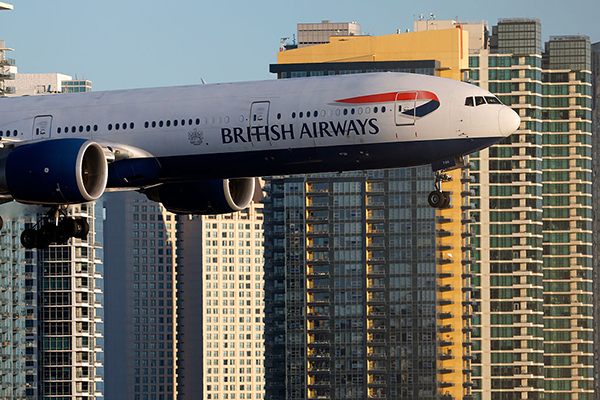
A British Airways plane approaching San Diego International Airport last month. Photo: Kevin Carter/Getty Images.
The resurgent shares of British Airways owner International Consolidated Airlines Group SA (LSE:IAG) have been backed to climb by another 19% after a City firm revised its estimates to reflect lower fuel costs.
Bank of America upped its price target by 70p to 570p, which compares with today’s 482p following a recovery from the 342p seen in the first fortnight of the US-Iran war.
The bank’s upgrade is driven by a 5% uplift to its earnings estimate for 2026 to 4.6 billion euros (£3.9 billion), having seen IAG report a record 5 billion euros in 2025’s annual results.
- Invest with ii: Share Dealing with ii | Open a Stocks & Shares ISA | Our Investment Accounts
On a valuation multiple of eight times forecast earnings, BofA said the shares “still look cheap”.
It highlighted IAG’s return on invested capital of more than 15%, as well as strong balance sheet and scope for 9% annual shareholder returns.
Friday’s new targets follow a strong recovery for shares across the European airline sector over the past 30 days, boosted by a falling fuel price and more upbeat view on demand since the recent reopening of the Strait of Hormuz.
UBS noted this week that data for the third quarter showed long-haul capacity growth of 3%, whereas the second quarter saw a 2% fall.
Year-to-date jet kerosene prices are still up more than 40% but have moderated compared to a peak increase of over 160%.
- eyeQ: an intriguing situation at easyJet
- Top stocks to insulate your portfolio from AI volatility
- Stockwatch: another oversold share due a recovery?
The next catalyst for the sector is the release of second-quarter results, starting with Ryanair on 20 July before IAG presents its figures on 31 July.
The BA and Iberia owner said in May’s first-quarter results that its hedging strategy had protected the business from the shorter-term impact of major increases in jet fuel prices.
Revenue in the first three months of the year increased by 1.9% to 7.2 billion euros and operating profit by 77.3% amid limited impact on cost from the Middle East conflict.
Around 3% of capacity was exposed to the Gulf region prior to the start of the conflict, which was operated mostly by British Airways. A large part of this network has been redeployed, including on routes to Bangkok, Singapore and Male.
IAG said that it was 70% hedged for the remainder of the year, adding that it expects to recover around 60% of the higher fuel cost during this year via revenue and cost management actions.
BofA regards this guidance as conservative when compared with US and European peers, with its own forecasts implying a 50% fuel recapture in the second quarter and an improvement to 75% across 2026.
- ii view: Shell predicts Q2 boom in trading profit
- Sign up to our free newsletter for investment ideas, latest news and award-winning analysis
It is also optimistic about the outlook for summer fares as US demand remains robust.
The bank added: “The US-Iran deal talks and falling fuel prices have improved the second-half earnings outlook, and we think IAG could raise its guidance with half-year results.”
IAG’s shares were 457.3p on the eve of annual results on 27 February, when IAG posted an operating margin at the top end of 12-15% medium-term guidance. This compared with about 5% at Deutsche Lufthansa AG (XETRA:LHA) and 6.5% at Air France-KLM (EURONEXT:AF).
The results reflected a helpful post-Covid backdrop for all EU airlines as they benefited from declining unit fuel costs as well as strong growth in demand and capacity constraints.
These articles are provided for information purposes only. Occasionally, an opinion about whether to buy or sell a specific investment may be provided by third parties. The content is not intended to be a personal recommendation to buy or sell any financial instrument or product, or to adopt any investment strategy as it is not provided based on an assessment of your investing knowledge and experience, your financial situation or your investment objectives. The value of your investments, and the income derived from them, may go down as well as up. You may not get back all the money that you invest. The investments referred to in this article may not be suitable for all investors, and if in doubt, an investor should seek advice from a qualified investment adviser.
Full performance can be found on the company or index summary page on the interactive investor website. Simply click on the company's or index name highlighted in the article.